Tyrer Ashley, Gilbert Jessica R, Adams Sarah, Stiles Alexandra B, Bankole Azziza O, Gilchrist Iain D, Moran Rosalyn J
Department of Engineering Mathematics, University of Bristol, Bristol BS8 1UB, UK.
National Institute for Mental Health, Bethesda, MD 20892, USA.
Brain Commun. 2020 Dec 10;2(2):fcaa212. doi: 10.1093/braincomms/fcaa212. eCollection 2020.
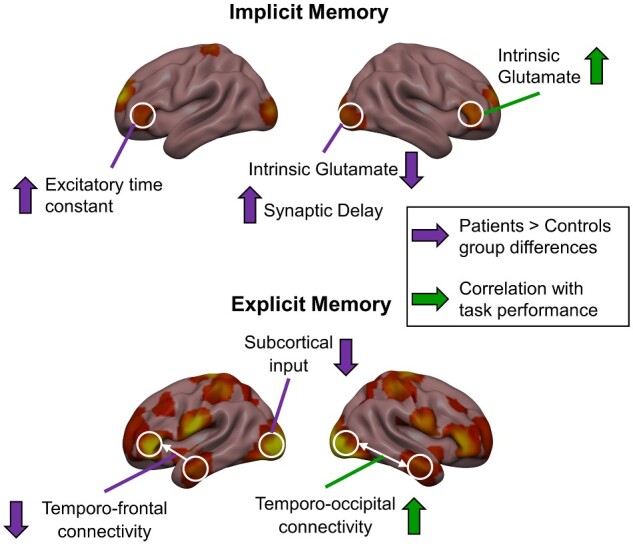
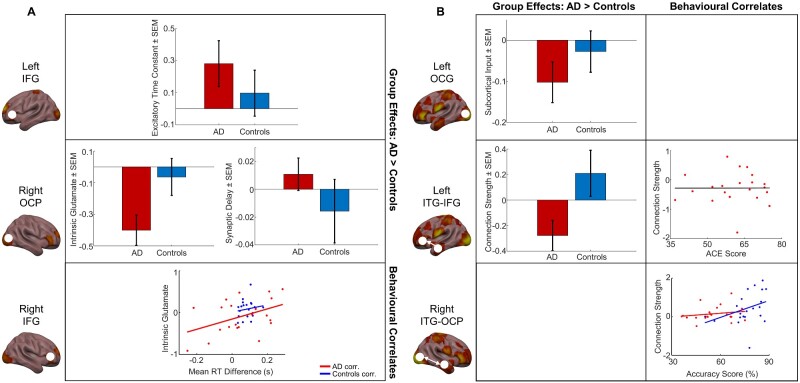
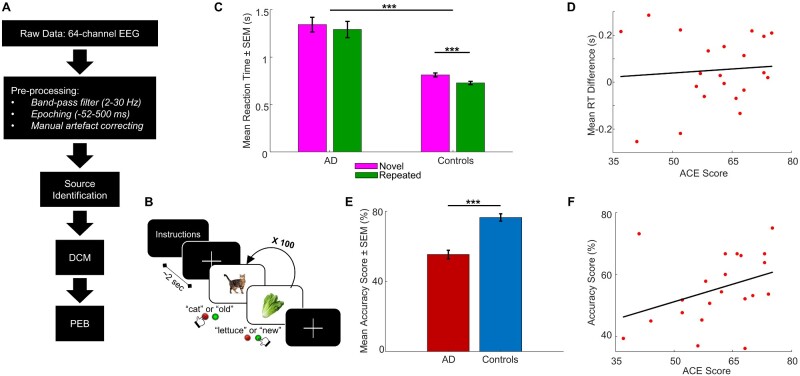
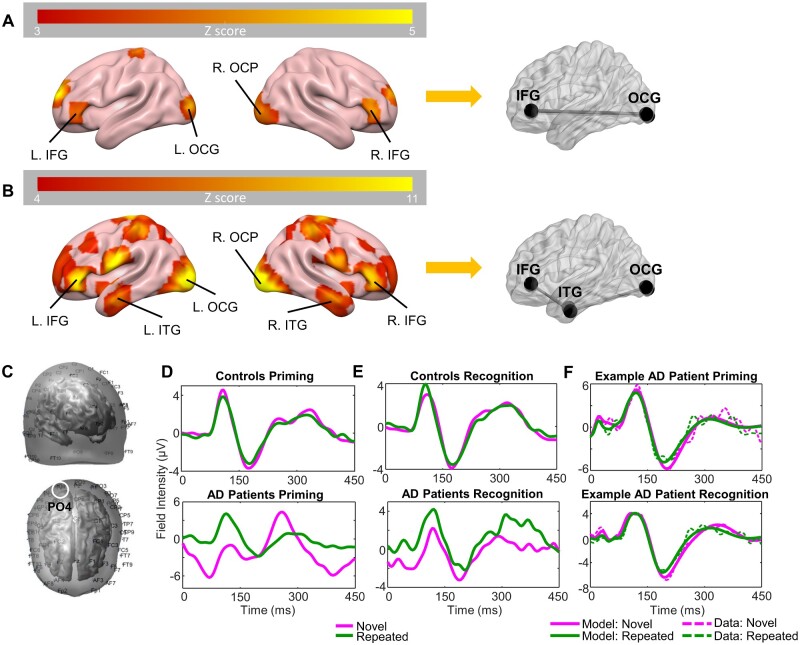
Altered connectivity within neuronal networks is often observed in Alzheimer's disease. However, delineating pro-cognitive compensatory changes from pathological network decline relies on characterizing network and task effects together. In this study, we interrogated the dynamics of occipito-temporo-frontal brain networks responsible for implicit and explicit memory processes using high-density EEG and dynamic causal modelling. We examined source-localized network activity from patients with Alzheimer's disease ( = 21) and healthy controls ( = 21), while they performed both visual recognition (explicit memory) and implicit priming tasks. Parametric empirical Bayes analyses identified significant reductions in temporo-frontal connectivity and in subcortical visual input in patients, specifically in the left hemisphere during the recognition task. There was also slowing in frontal left hemisphere signal transmission during the implicit priming task, with significantly more distinct dropout in connectivity during the recognition task, suggesting that these network drop-out effects are affected by task difficulty. Furthermore, during the implicit memory task, increased right frontal activity was correlated with improved task performance in patients only, suggesting that right-hemisphere compensatory mechanisms may be employed to mitigate left-lateralized network dropout in Alzheimer's disease. Taken together, these findings suggest that Alzheimer's disease is associated with lateralized memory circuit dropout and potential compensation from the right hemisphere, at least for simpler memory tasks.
在阿尔茨海默病中,经常观察到神经网络内的连接性改变。然而,区分认知促进性代偿变化与病理性网络衰退,需要同时对网络和任务效应进行特征描述。在本研究中,我们使用高密度脑电图和动态因果模型,探究了负责内隐和外显记忆过程的枕颞额叶脑网络的动力学。我们检查了阿尔茨海默病患者(n = 21)和健康对照者(n = 21)在进行视觉识别(外显记忆)和内隐启动任务时的源定位网络活动。参数经验贝叶斯分析发现,患者的颞额叶连接性和皮层下视觉输入显著降低,特别是在识别任务期间左半球。在内隐启动任务期间,左额叶半球信号传输也减慢,在识别任务期间连接性的明显中断显著增多,这表明这些网络中断效应受任务难度影响。此外,仅在患者的内隐记忆任务期间,右额叶活动增加与任务表现改善相关,这表明右半球代偿机制可能被用于减轻阿尔茨海默病中左侧化网络中断。综上所述,这些发现表明,阿尔茨海默病与记忆回路的侧化中断以及右半球的潜在代偿有关,至少对于较简单的记忆任务是如此。