Headache and Orofacial Pain Effort (H.O.P.E.), Department of Biologic and Materials Sciences & Prosthodontics, University of Michigan School of Dentistry, 1011 N. University Ave, Room 1014A, Ann Arbor, MI, 48109-1078, USA.
Michigan Neuroscience Institute, University of Michigan, Ann Arbor, MI, 48109, USA.
J Headache Pain. 2021 Jan 7;22(1):4. doi: 10.1186/s10194-020-01210-6.
The moment-to-moment variability of resting-state brain activity has been suggested to play an active role in chronic pain. Here, we investigated the regional blood-oxygen-level-dependent signal variability (BOLD) and inter-regional dynamic functional connectivity (dFC) in the interictal phase of migraine and its relationship with the attack severity.
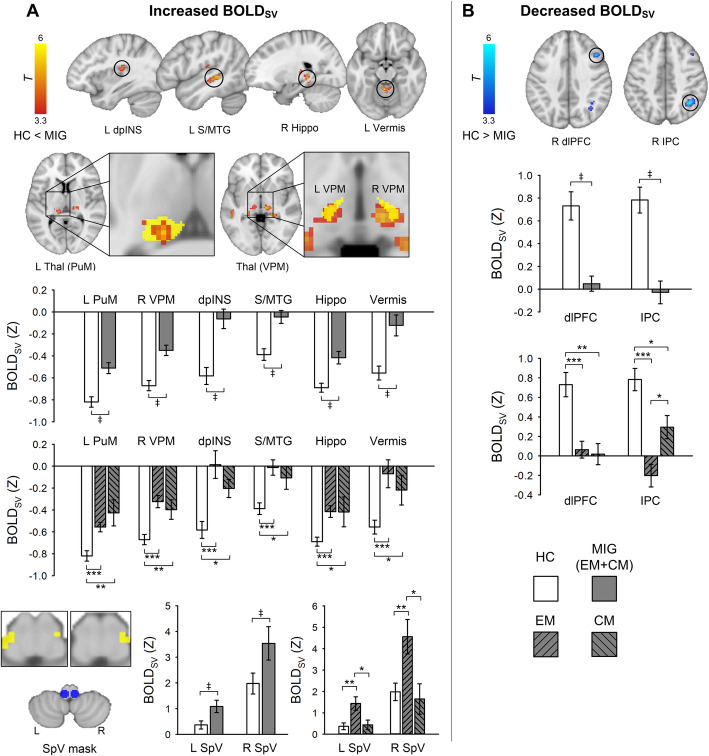
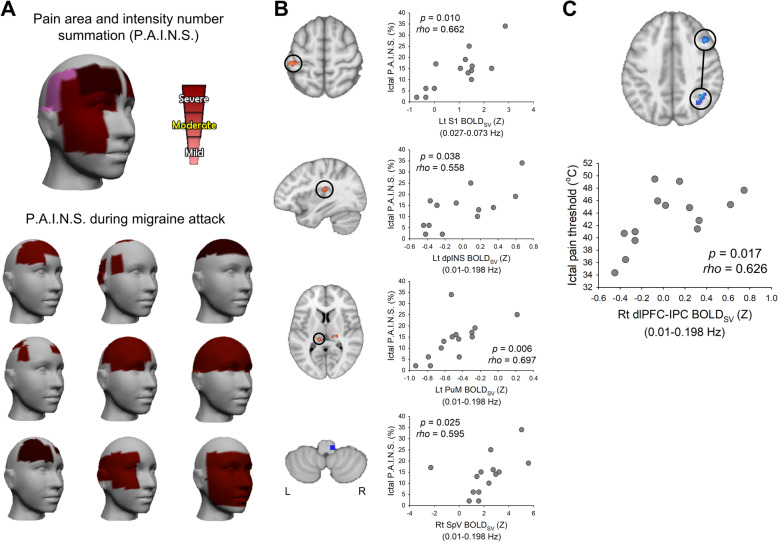
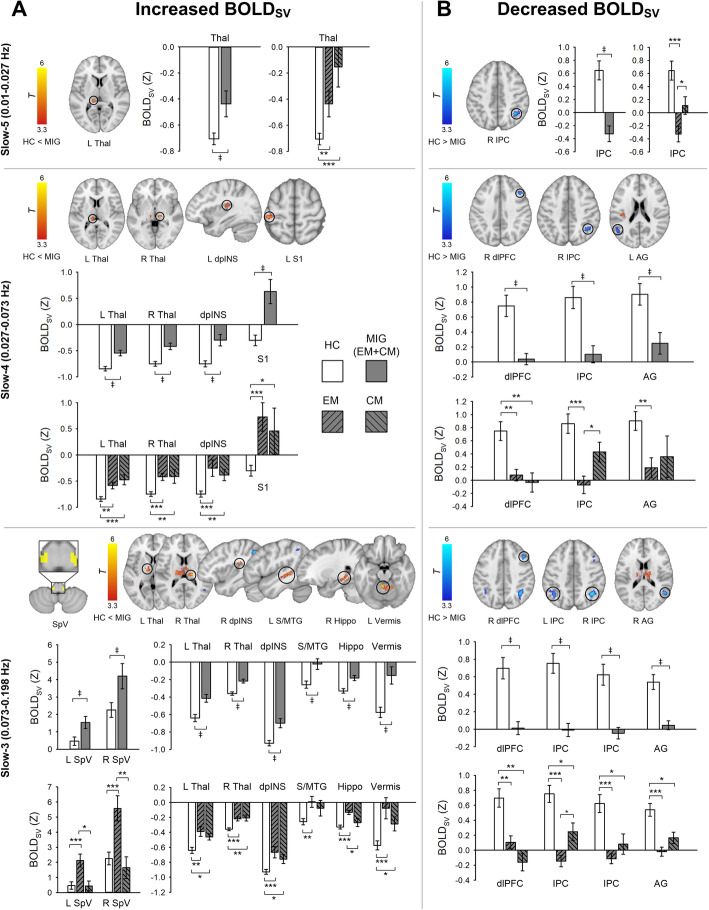
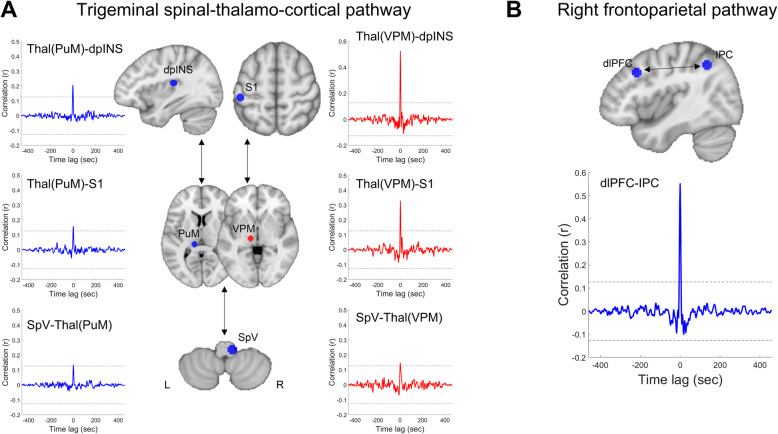
We acquired resting-state functional magnetic resonance imaging from 20 migraine patients and 26 healthy controls (HC). We calculated the standard deviation (SD) of the BOLD time-series at each voxel as a measure of the BOLD signal variability (BOLD) and performed a whole-brain voxel-wise group comparison. The brain regions showing significant group differences in BOLD were used to define the regions of interest (ROIs). The SD and mean of the dynamic conditional correlation between those ROIs were calculated to measure the variability and strength of the dFC. Furthermore, patients' experimental pain thresholds and headache pain area/intensity levels during the migraine ictal-phase were assessed for clinical correlations.
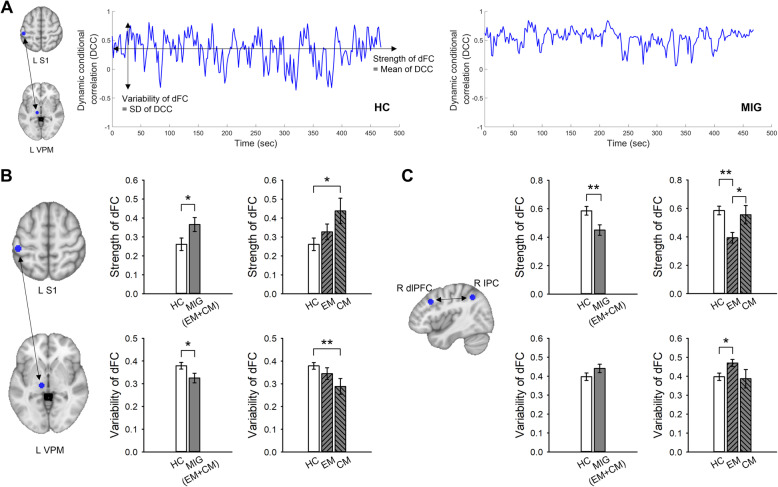
We found that migraineurs, compared to HCs, displayed greater BOLD in the ascending trigeminal spinal-thalamo-cortical pathways, including the spinal trigeminal nucleus, pulvinar/ventral posteromedial (VPM) nuclei of the thalamus, primary somatosensory cortex (S1), and posterior insula. Conversely, migraine patients exhibited lower BOLD in the top-down modulatory pathways, including the dorsolateral prefrontal (dlPFC) and inferior parietal (IPC) cortices compared to HCs. Importantly, abnormal interictal BOLD in the ascending trigeminal spinal-thalamo-cortical and frontoparietal pathways were associated with the patient's headache severity and thermal pain sensitivity during the migraine attack. Migraineurs also had significantly lower variability and greater strength of dFC within the thalamo-cortical pathway (VPM-S1) than HCs. In contrast, migraine patients showed greater variability and lower strength of dFC within the frontoparietal pathway (dlPFC-IPC).
Migraine is associated with alterations in temporal signal variability in the ascending trigeminal somatosensory and top-down modulatory pathways, which may explain migraine-related pain and allodynia. Contrasting patterns of time-varying connectivity within the thalamo-cortical and frontoparietal pathways could be linked to abnormal network integrity and instability for pain transmission and modulation.
静息态脑活动的瞬间变异性被认为在慢性疼痛中起积极作用。在这里,我们研究了偏头痛间歇期的区域血氧水平依赖信号变异性(BOLD)和区域间动态功能连接(dFC)及其与发作严重程度的关系。
我们从 20 名偏头痛患者和 26 名健康对照者(HC)中采集静息态功能磁共振成像。我们计算了每个体素的 BOLD 时间序列的标准差(SD)作为 BOLD 信号变异性(BOLD)的测量值,并进行了全脑体素水平的组间比较。在 BOLD 显示出显著组间差异的脑区中定义感兴趣区(ROI)。计算这些 ROI 之间的动态条件相关的 SD 和平均值,以测量 dFC 的变异性和强度。此外,还评估了患者在偏头痛发作期的实验性疼痛阈值和头痛疼痛区域/强度水平,以进行临床相关性分析。
与 HC 相比,我们发现偏头痛患者在上升三叉神经脊髓-丘脑-皮质通路中显示出更大的 BOLD,包括三叉神经脊束核、丘脑腹后内侧核(VPM)、初级体感皮层(S1)和后岛叶。相反,与 HC 相比,偏头痛患者在自上而下的调节通路中显示出更低的 BOLD,包括背外侧前额叶(dlPFC)和下顶叶(IPC)皮质。重要的是,上升三叉神经脊髓-丘脑-皮质通路和额顶叶通路的异常静息态 BOLD 与患者头痛发作期间的头痛严重程度和热痛敏感性有关。偏头痛患者在丘脑-皮质通路(VPM-S1)内的 dFC 也表现出明显更低的变异性和更高的强度。相比之下,偏头痛患者在额顶叶通路(dlPFC-IPC)内表现出更大的变异性和更低的 dFC 强度。
偏头痛与上升三叉感觉和自上而下调节通路中时间信号变异性的改变有关,这可能解释了偏头痛相关的疼痛和痛觉过敏。丘脑-皮质和额顶叶通路内时变连接的对比模式可能与异常的网络完整性和不稳定性有关,这些异常与疼痛传递和调制有关。