Lehrstuhl für Tierzucht, Technische Universität München, Freising, Germany.
Animal Genomics, ETH Zürich, Zürich, Switzerland.
BMC Genomics. 2021 Jan 7;22(1):38. doi: 10.1186/s12864-020-07343-x.
Atypical external genitalia are often a sign of reproductive organ pathologies and infertility with both environmental or genetic causes, including karyotypic abnormalities. Genome-wide association studies (GWAS) provide a means for identifying chromosomal regions harboring deleterious DNA-variants causing such phenotypes. We performed a GWAS to unravel the causes of incidental cases of atypically small vulvae in German Landrace gilts.
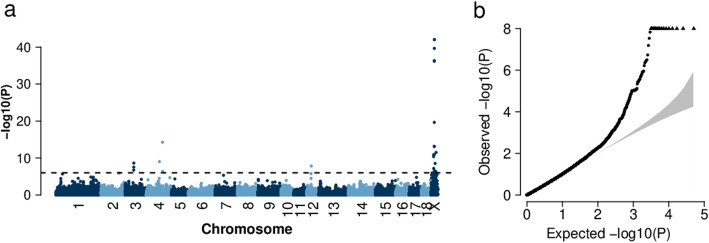
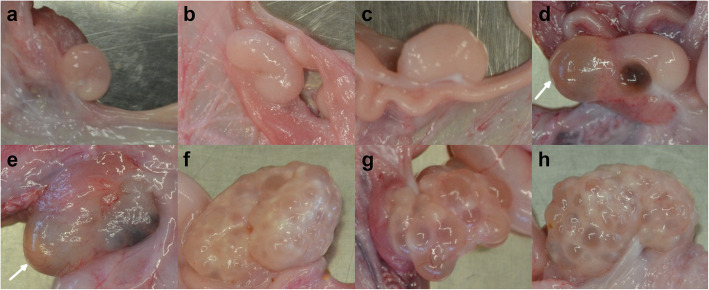
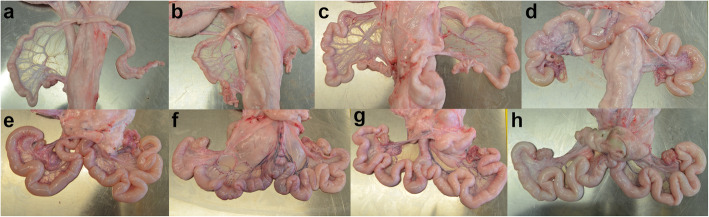
A case-control GWAS involving Illumina porcine SNP60 BeadChip-called genotypes of 17 gilts with atypically small vulvae and 1818 control animals (fertile German Landrace sows) identified a significantly associated region on the X-chromosome (P = 8.81 × 10). Inspection of whole-genome sequencing data in the critical area allowed us to pinpoint a likely causal variant in the form of a nonsense mutation of bone morphogenetic protein-15 (BMP15; Sscrofa11.1_X:g.44618787C>T, BMP15:p.R212X). The mutant allele occurs at a frequency of 6.2% in the German Landrace breeding population. Homozygous gilts exhibit underdeveloped, most likely not functional ovaries and are not fertile. Male carriers do not seem to manifest defects. Heterozygous sows produce 0.41±0.02 (P=4.5 × 10) piglets more than wildtype animals. However, the mutant allele's positive effect on litter size accompanies a negative impact on lean meat growth.
Our results provide an example for the power of GWAS in identifying the genetic causes of a fuzzy phenotype and add to the list of natural deleterious BMP15 mutations that affect fertility in a dosage-dependent manner, the first time in a poly-ovulatory species. We advise eradicating the mutant allele from the German Landrace breeding population since the adverse effects on the lean meat growth outweigh the larger litter size in heterozygous sows.
非典型外生殖器通常是生殖器官疾病和不育的标志,其病因既有环境因素,也有遗传因素,包括染色体异常。全基因组关联研究(GWAS)为识别导致这种表型的有害 DNA 变异的染色体区域提供了一种手段。我们进行了 GWAS,以揭示德国长白母猪中偶然出现的小阴唇畸形的原因。
一项涉及 Illumina 猪 SNP60 BeadChip 的病例对照 GWAS,对 17 头小阴唇畸形的母猪和 1818 头对照动物(可育的德国长白母猪)进行了基因分型,在 X 染色体上发现了一个与疾病显著相关的区域(P=8.81×10)。在关键区域检查全基因组测序数据,使我们能够确定一种可能的致病变异,即骨形态发生蛋白 15(BMP15;Sscrofa11.1_X:g.44618787C>T,BMP15:p.R212X)的无义突变。在德国长白猪的繁殖群体中,突变等位基因的频率为 6.2%。纯合子小母猪表现出发育不良的、极有可能没有功能的卵巢,且不育。雄性携带者似乎没有表现出缺陷。杂合子母猪比野生型动物多产 0.41±0.02(P=4.5×10)头仔猪。然而,突变等位基因对产仔数的积极影响伴随着对瘦肉生长的负面影响。
我们的研究结果为 GWAS 识别模糊表型的遗传原因提供了一个范例,并增加了以剂量依赖方式影响繁殖力的天然有害 BMP15 突变的列表,这是在多排卵物种中首次发现。由于瘦肉生长的负面影响大于杂合子母猪更大的产仔数,我们建议从德国长白猪的繁殖群体中消除突变等位基因。