Department of Clinical Veterinary Medicine, Swiss Institute of Equine Medicine (ISME), Vetsuisse Faculty, University of Bern, and Agroscope, Bern, Switzerland.
Institute of Virology and Immunology, University of Bern, Bern, Switzerland.
J Vet Intern Med. 2021 Jan;35(1):610-619. doi: 10.1111/jvim.16027. Epub 2021 Jan 7.
MicroRNAs (miRNAs) are potential biomarkers for equine sarcoids (ES).
To assess eca-miR-331, eca-miR-100, and eca-miR-1 as serum biomarkers for ES disease.
Sixty-eight ES cases (56 horses, 12 donkeys), 69 tumor-free controls (60 horses, 9 donkeys), and 20 horses with other skin tumors.
For this case-control study, expression of serum eca-miR-331, eca-miR-100, and eca-miR-1 in ES-affected equids was compared to tumor-free age-, sex-, and breed-matched control horses and donkeys with other skin tumors using reverse transcription quantitative PCR (polymerase chain reaction) for relative miRNA quantification. Biological, preanalytical, and clinical variable influences on miRNA expression were examined. Receiver operator characteristic (ROC) curve analyses were used to determine differences in miRNA expression between groups.
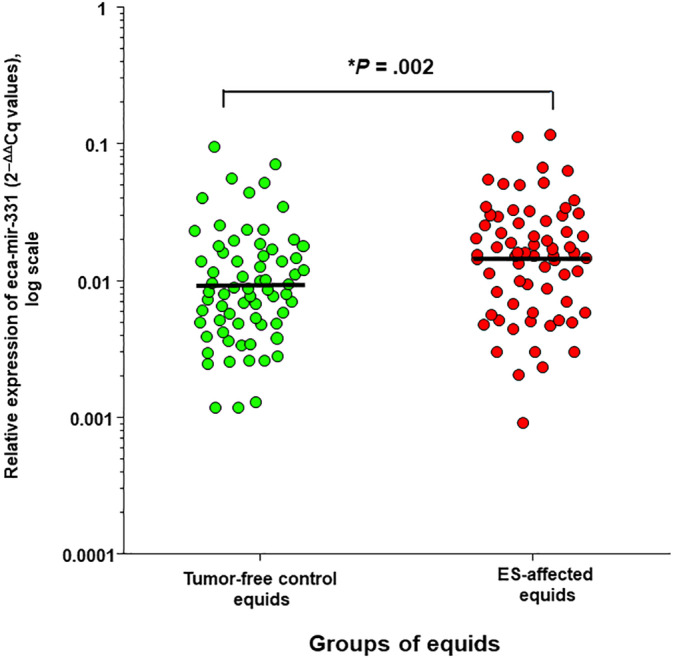
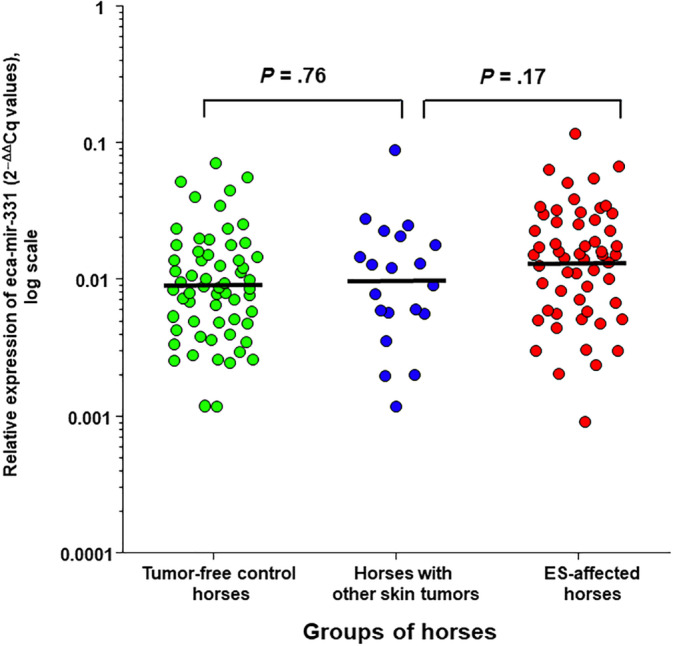
The expression of eca-miR-100 was affected by age (P = .003) and expression of eca-miR-100 and eca-miR-1 were affected by hemolysis (both P < .001). Eca-miR-331 was unaffected by biological variation, hemolysis, ES type, and disease severity. Eca-miR-331 concentrations were higher in ES-affected compared to tumor-free controls (P = .002). The ROC curve analysis indicated an area under the curve of 0.65 (P = .002) with a sensitivity of 60%, specificity of 71%, and positive and negative likelihood ratios of 2.1 and 0.56, respectively, to diagnose ES. Eca-miR-331 expression did not discriminate between horses with ES and other skin tumors. Expression of eca-miR-100 and eca-miR-1 was not different between groups.
Serum eca-miR-331 expression is neither sensitive nor specific enough as a single ES biomarker. If combined with other miRNAs, it may be helpful for ES diagnosis.
微小 RNA(miRNA)是马肉瘤(ES)的潜在生物标志物。
评估血清中 eca-miR-331、eca-miR-100 和 eca-miR-1 作为 ES 疾病的生物标志物。
68 例 ES 病例(56 匹马,12 头驴),69 例无肿瘤对照(60 匹马,9 头驴),20 例患有其他皮肤肿瘤的马。
在这项病例对照研究中,通过逆转录定量 PCR(聚合酶链反应)比较 ES 患病动物与年龄、性别和品种匹配的无肿瘤对照马和驴的血清 eca-miR-331、eca-miR-100 和 eca-miR-1 的表达,以进行相对 miRNA 定量。检查了生物、分析前和临床变量对 miRNA 表达的影响。使用接收者操作特征(ROC)曲线分析来确定组间 miRNA 表达的差异。
eca-miR-100 的表达受年龄影响(P=0.003),eca-miR-100 和 eca-miR-1 的表达受溶血影响(均 P<0.001)。Eca-miR-331 不受生物变异性、溶血、ES 类型和疾病严重程度的影响。与无肿瘤对照相比,ES 患病动物的 eca-miR-331 浓度更高(P=0.002)。ROC 曲线分析表明,曲线下面积为 0.65(P=0.002),灵敏度为 60%,特异性为 71%,阳性和阴性似然比分别为 2.1 和 0.56,用于诊断 ES。Eca-miR-331 的表达不能区分 ES 与其他皮肤肿瘤。eca-miR-100 和 eca-miR-1 的表达在各组之间无差异。
血清 eca-miR-331 的表达作为 ES 的单一生物标志物既不敏感也不特异。如果与其他 miRNA 结合使用,可能有助于 ES 的诊断。