Samanta Archana, Chen Hui, Samanta Pratick, Popov Sergei, Sychugov Ilya, Berglund Lars A
Department of Applied Physics, KTH Royal Institute of Technology, Stockholm 114 19, Sweden.
Department of Fibre and Polymer Technology, Wallenberg Wood Science Center, KTH Royal Institute of Technology, Stockholm 100 44, Sweden.
ACS Appl Mater Interfaces. 2021 Jan 20;13(2):3270-3277. doi: 10.1021/acsami.0c21369. Epub 2021 Jan 8.
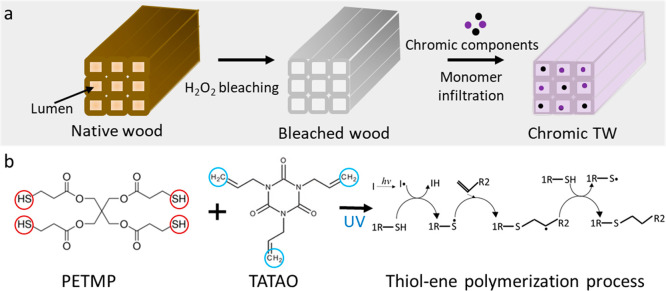
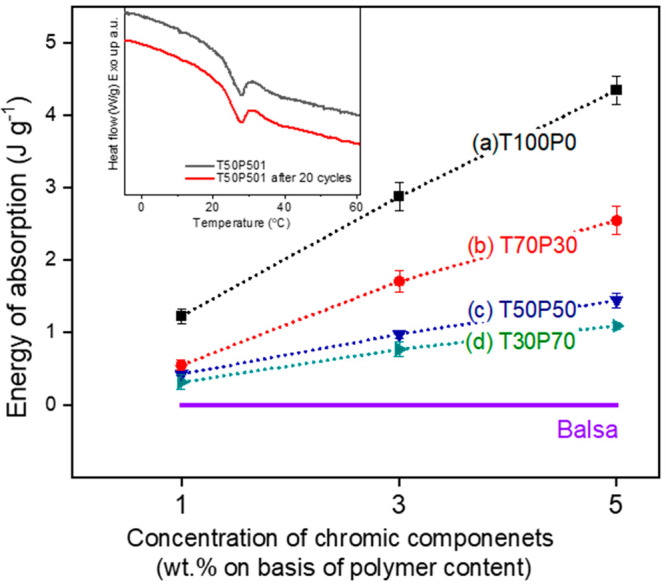
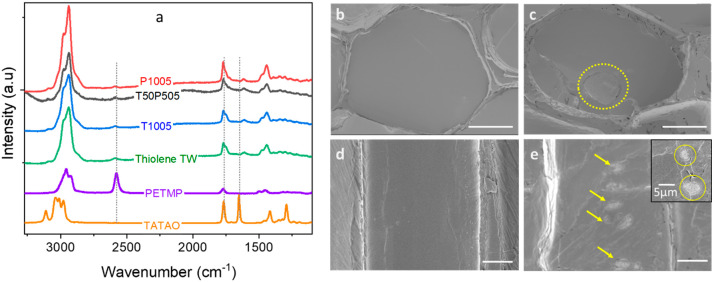
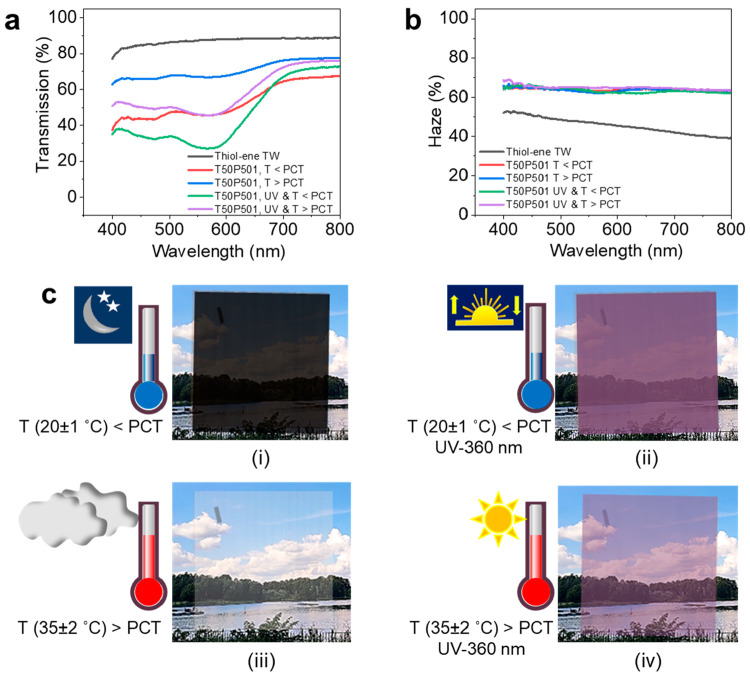
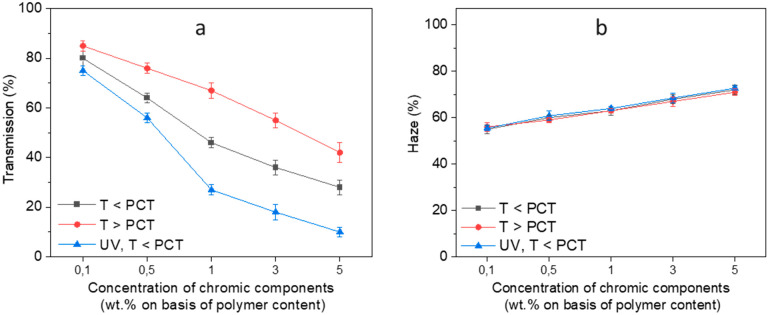
Transparent wood (TW)-based composites are of significant interest for smart window applications. In this research, we demonstrate a facile dual-stimuli-responsive chromic TW where optical properties are reversibly controlled in response to changes in temperature and UV-radiation. For this functionality, bleached wood was impregnated with solvent-free thiol and ene monomers containing chromic components, consisting of a mixture of thermo- and photoresponsive chromophores, and was then UV-polymerized. Independent optical properties of individual chromic components were retained in the compositional mixture. This allowed to enhance the absolute optical transmission to 4 times above the phase change temperature. At the same time, the transmission at 550 nm could be reduced 11-77%, on exposure to UV by changing the concentration of chromic components. Chromic components were localized inside the lumen of the wood structure, and durable reversible optical properties were demonstrated by multiple cycling testing. In addition, the chromic TW composites showed reversible energy absorption capabilities for heat storage applications and demonstrated an enhancement of 64% in the tensile modulus as compared to a native thiol-ene polymer. This study elucidates the polymerization process and effect of chromic components distribution and composition on the material's performance and perspectives toward the development of smart photoresponsive windows with energy storage capabilities.
基于透明木材(TW)的复合材料在智能窗户应用中具有重大意义。在本研究中,我们展示了一种简便的双刺激响应变色TW,其光学性能可根据温度和紫外线辐射的变化进行可逆控制。为实现此功能,将漂白木材用含有变色成分的无溶剂硫醇和烯单体浸渍,这些变色成分由热响应和光响应发色团的混合物组成,然后进行紫外线聚合。各变色成分的独立光学性能在组成混合物中得以保留。这使得绝对光学透过率在相变温度以上提高到4倍。同时,通过改变变色成分的浓度,在暴露于紫外线时,550nm处的透过率可降低11 - 77%。变色成分定位在木材结构的管腔内,通过多次循环测试证明了其持久的可逆光学性能。此外,变色TW复合材料在蓄热应用中表现出可逆的能量吸收能力,与天然硫醇 - 烯聚合物相比,拉伸模量提高了64%。本研究阐明了聚合过程以及变色成分分布和组成对材料性能的影响,以及具有储能能力的智能光响应窗户的发展前景。