Institute for Physiology and Pathophysiology, Johannes Kepler University Linz, Altenberger Strasse 69, Linz 4040, Austria.
DZHK (German Centre for Cardiovascular Research), Partner Site Berlin, Berlin 13347, Germany.
Clin Sci (Lond). 2021 Jan 15;135(1):201-227. doi: 10.1042/CS20190895.
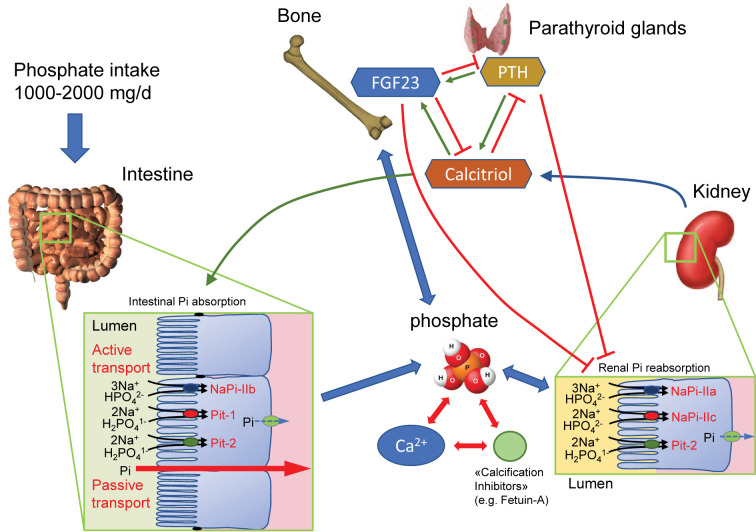
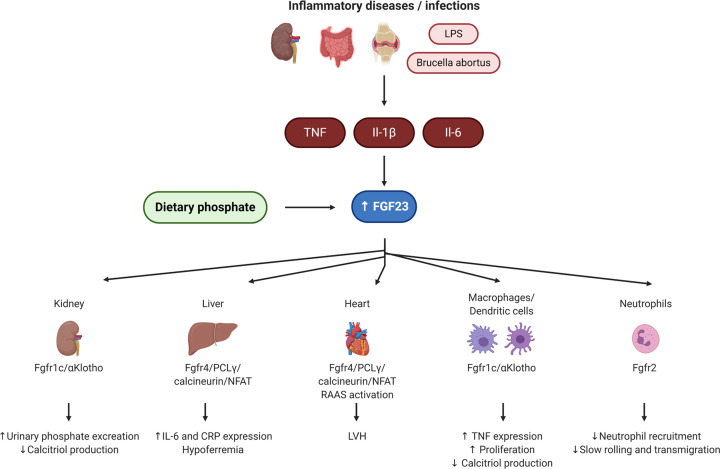
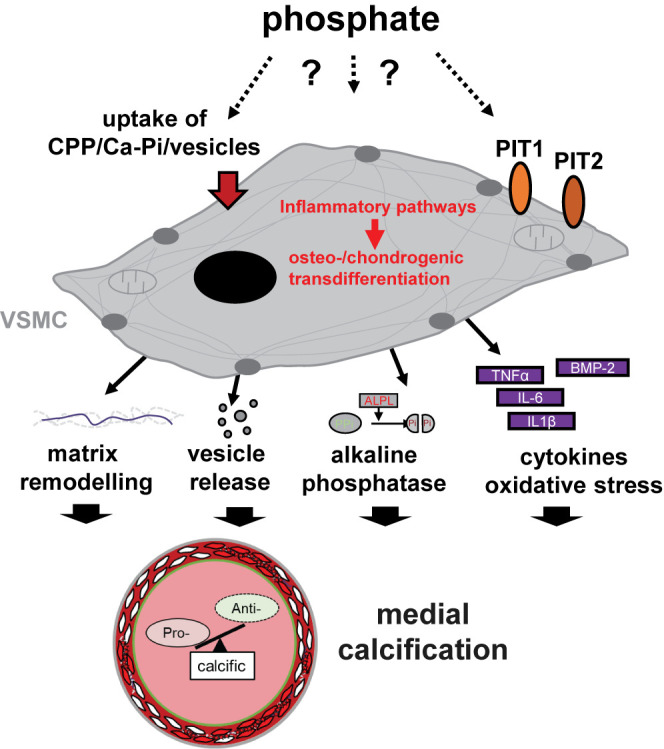
Dietary habits in the western world lead to increasing phosphate intake. Under physiological conditions, extraosseous precipitation of phosphate with calcium is prevented by a mineral buffering system composed of calcification inhibitors and tight control of serum phosphate levels. The coordinated hormonal regulation of serum phosphate involves fibroblast growth factor 23 (FGF23), αKlotho, parathyroid hormone (PTH) and calcitriol. A severe derangement of phosphate homeostasis is observed in patients with chronic kidney disease (CKD), a patient collective with extremely high risk of cardiovascular morbidity and mortality. Higher phosphate levels in serum have been associated with increased risk for cardiovascular disease (CVD) in CKD patients, but also in the general population. The causal connections between phosphate and CVD are currently incompletely understood. An assumed link between phosphate and cardiovascular risk is the development of medial vascular calcification, a process actively promoted and regulated by a complex mechanistic interplay involving activation of pro-inflammatory signalling. Emerging evidence indicates a link between disturbances in phosphate homeostasis and inflammation. The present review focuses on critical interactions of phosphate homeostasis, inflammation, vascular calcification and CVD. Especially, pro-inflammatory responses mediating hyperphosphatemia-related development of vascular calcification as well as FGF23 as a critical factor in the interplay between inflammation and cardiovascular alterations, beyond its phosphaturic effects, are addressed.
在西方世界,饮食习惯导致磷酸盐摄入量增加。在生理条件下,由钙化抑制剂和严格控制血清磷酸盐水平组成的矿物质缓冲系统可防止磷酸盐与钙在骨外沉淀。血清磷酸盐的协调激素调节涉及成纤维细胞生长因子 23(FGF23)、αKlotho、甲状旁腺激素(PTH)和 1,25-二羟维生素 D3(calcitriol)。在慢性肾脏病(CKD)患者中,观察到磷酸盐稳态严重失调,CKD 患者具有极高的心血管发病率和死亡率风险。血清中较高的磷酸盐水平与 CKD 患者以及普通人群中心血管疾病(CVD)风险增加相关。目前对磷酸盐与 CVD 之间的因果关系尚不完全清楚。假设磷酸盐与心血管风险之间存在联系,是由于血管钙化的发生,这是一个涉及复杂的机制相互作用的主动促进和调节的过程,包括促炎信号的激活。新出现的证据表明,磷酸盐稳态失调与炎症之间存在联系。本综述重点介绍了磷酸盐稳态、炎症、血管钙化和 CVD 之间的关键相互作用。特别是,炎症反应介导高磷酸盐血症相关的血管钙化的发展,以及 FGF23 作为炎症和心血管改变相互作用中的关键因素,超出其排磷酸盐作用。