Centre for Environmental Sciences, Hasselt University, Agoralaan Gebouw D, 3590 Diepenbeek, Belgium.
Department of Obstetrics and Gynaecology, Ghent University, 9000 Ghent, Belgium; Centre of Human Genetics, Leuven University, 3000 Leuven, Belgium.
EBioMedicine. 2021 Jan;63:103164. doi: 10.1016/j.ebiom.2020.103164. Epub 2021 Jan 7.
Telomere length (TL) is considered a biological marker of aging and may indicate age-related disease susceptibility. Adults and children show a fixed ranking and tracking of TL over time. However, the contribution of an individual's initial birth TL to their later life TL is unknown. We evaluated change and tracking of TL from birth to child- and adulthood.
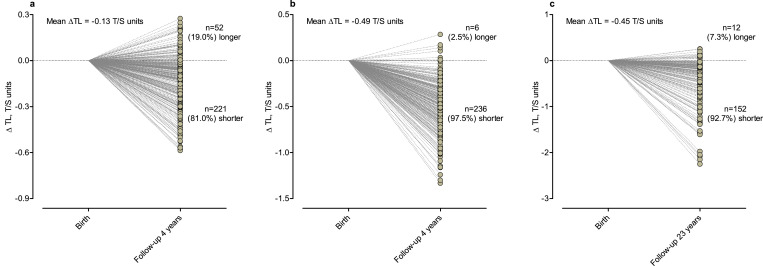
Telomere length at birth was measured using qPCR in two independent prospective birth cohorts. After a median follow-up period of 4 years in ENVIRONAGE (n = 273) we assessed leukocyte telomere length (LTL) and after 23 years in EFPTS (n = 164) buccal TL was assessed. Correlations and multivariable regression models were applied to study telomere tracking and determinants of TL change from birth onwards.
In children, LTL at the age of 4 correlates with TL at the start of life both in cord blood (r = 0.71, P < 0.0001;) and placenta (r = 0.60, P < 0.0001) and was -11.2% and -33.1% shorter, respectively. In adulthood, buccal TL at the age of 23 correlates with placental TL (r = 0.46, P < 0.0001) and was -35.9% shorter. TL attrition was higher in individuals with longer birth TL. However, based on TL ranking, individuals do not tend to change dramatically from TL rank after 4 or 23 years of follow-up. Finally, longer maternal TL associates with lower telomere attrition in the next generation.
The high prediction of newborn TL for later life TL, and stable TL ranking from birth onwards underscores the importance of understanding the initial setting of newborn TL and its significance for later life.
European Research Council (ERC-StG310898) and Flemish Scientific Fund (12X9620N).
端粒长度(TL)被认为是衰老的生物标志物,可能表明与年龄相关的疾病易感性。成年人和儿童随着时间的推移表现出 TL 的固定排序和跟踪。然而,个体出生时的初始 TL 对其以后的 TL 贡献尚不清楚。我们评估了从出生到儿童期和成年期 TL 的变化和跟踪。
使用 qPCR 在两个独立的前瞻性出生队列中测量出生时的端粒长度。在 ENVIRONAGE(n=273)中进行中位数为 4 年的中位随访后,我们评估了白细胞端粒长度(LTL),在 EFPTS(n=164)中进行中位数为 23 年的随访后,评估了口腔 TL。应用相关性和多变量回归模型研究 TL 从出生开始的跟踪和变化的决定因素。
在儿童中,4 岁时的 LTL 与生命开始时的 TL 相关,在脐带血(r=0.71,P<0.0001)和胎盘(r=0.60,P<0.0001)中均相关,分别短 11.2%和 33.1%。在成年期,23 岁时的口腔 TL 与胎盘 TL 相关(r=0.46,P<0.0001),短 35.9%。出生时 TL 较长的个体 TL 损耗较高。然而,基于 TL 排名,个体在 4 年或 23 年的随访后,TL 排名不会发生显著变化。最后,较长的母系 TL 与下一代的 TL 损耗较低相关。
新生儿 TL 对以后的 TL 具有很高的预测性,并且从出生开始 TL 排名稳定,这强调了理解新生儿 TL 的初始设定及其对以后生活的意义的重要性。
欧洲研究理事会(ERC-StG310898)和佛兰芒科学基金会(12X9620N)。