Chen Zhangting, Chen Xuemei, Wang Chaoying, Li Changxiao
Key Laboratory of Eco-Environments in the Three Gorges Reservoir Region (Ministry of Education), State Cultivation Base of Eco-agriculture for Southwest Mountainous Land, College of Life Sciences, Southwest University, Chongqing, China.
School of Tourism Management, Guilin Tourism University, Guilin, China.
Front Plant Sci. 2020 Dec 7;11:569871. doi: 10.3389/fpls.2020.569871. eCollection 2020.
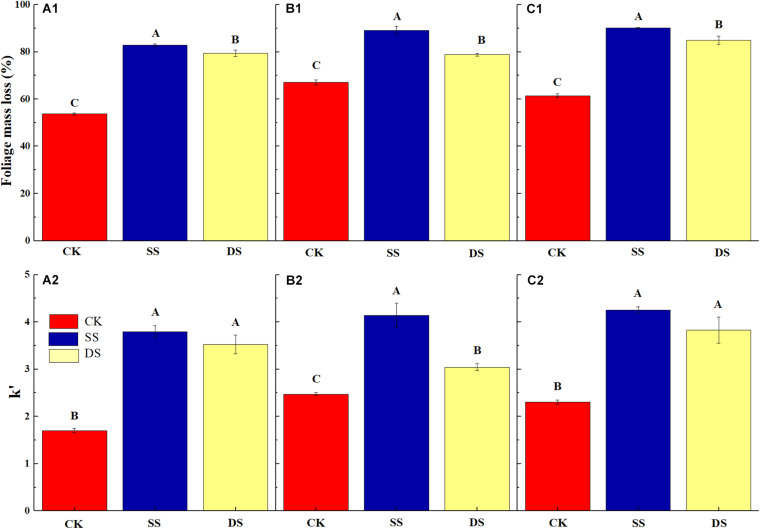
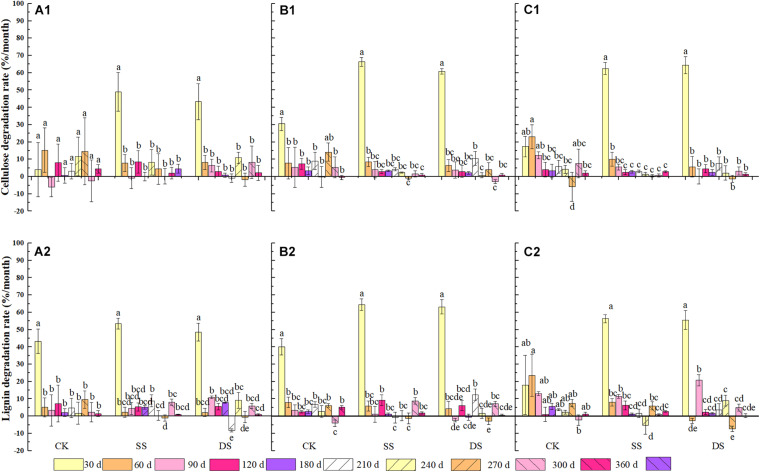
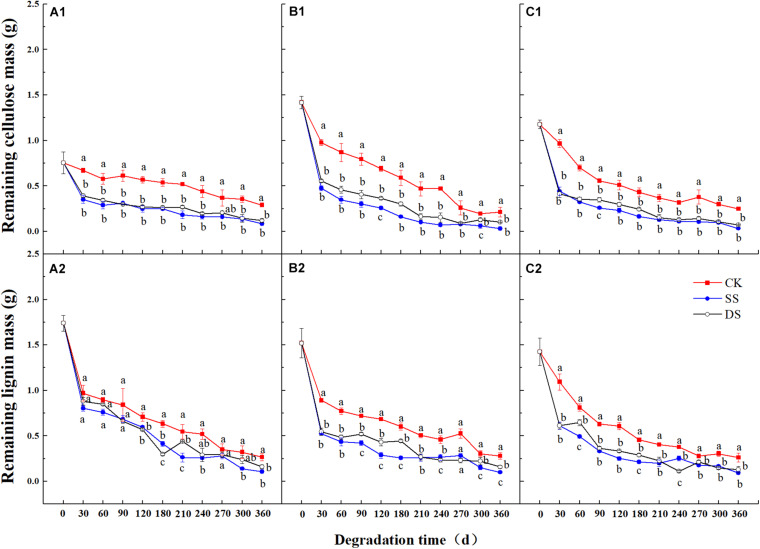
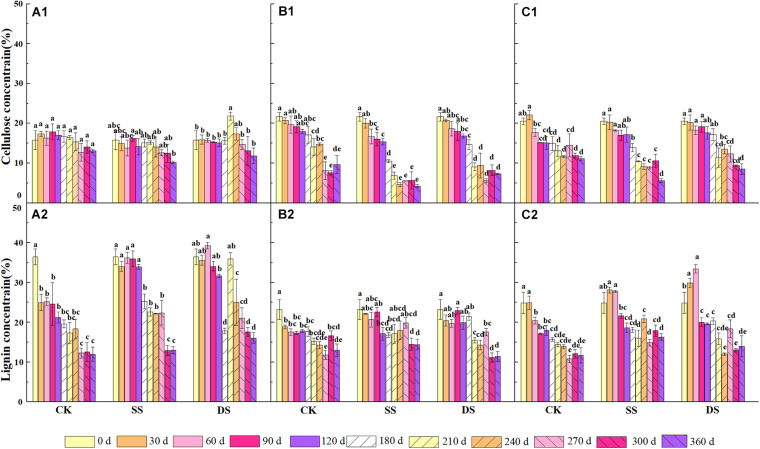
The riparian zone can affect the degradation of foliar cellulose and lignin by changing the hydrological gradient of the foliage decomposition environment. However, their degradation dynamics during the process of foliage decomposition remain unclear in mixed plantation forests in a riparian zone. Herein, we explored degradation of cellulose and lignin for two dominant riparian species, bald cypress [ (L.) Rich.] and Chinese willow ( Koidz.), and a combined treatment with equal proportions of foliar mass of these species, involving three water treatments [no submergence (CK), shallow submergence (SS), and deep submergence (DS)] in a riparian zone of the Three Gorges Dam Reservoir (TGDR), China. Throughout an entire year's incubation, the degradation of cellulose and lignin was 55.57-97.76% and 79.87-93.82%, respectively. In the early stage of decomposition (i.e., the first 30 days), cellulose and lignin were rapidly degraded, and the mass loss of cellulose and lignin in water environments (SS and DS) was greater than that in a non-flooded environment (CK) regardless of the foliage type. The degradation of cellulose and lignin was mainly related to the quality of the leaf litter (as indicated by the concentrations of cellulose and lignin, and the contents of C, N, and P), decomposition period, and local environmental factors (temperature, water gradients, and dissolved oxygen). Our results will provide a clear insight into the material cycling process in a riparian zone of the TGDR and similar ecosystems in other regions.
河岸带可通过改变树叶分解环境的水文梯度来影响叶纤维素和木质素的降解。然而,在河岸带混交人工林中,树叶分解过程中它们的降解动态仍不清楚。在此,我们探究了三峡大坝水库(TGDR)河岸带两种主要河岸树种落羽杉[(L.)Rich.]和垂柳(Koidz.)以及这些树种叶量等比例混合处理的纤维素和木质素降解情况,涉及三种水分处理[无淹没(CK)、浅淹(SS)和深淹(DS)]。在为期一整年的培养过程中,纤维素和木质素的降解率分别为55.57 - 97.76%和79.87 - 93.82%。在分解初期(即前30天),纤维素和木质素迅速降解,且无论树叶类型如何,水环境(SS和DS)中纤维素和木质素的质量损失均大于非淹水环境(CK)。纤维素和木质素的降解主要与凋落物质量(以纤维素和木质素浓度以及C、N和P含量表示)、分解时期和当地环境因素(温度、水梯度和溶解氧)有关。我们的结果将为TGDR河岸带及其他地区类似生态系统的物质循环过程提供清晰的见解。