Janusz Grzegorz, Pawlik Anna, Sulej Justyna, Swiderska-Burek Urszula, Jarosz-Wilkolazka Anna, Paszczynski Andrzej
Department of Biochemistry, Maria Curie-Sklodowska University, Akademicka 19 St., 20-033 Lublin, Poland.
Department of Botany and Mycology, Maria Curie-Sklodowska University, Akademicka 19 St., 20-033 Lublin, Poland.
FEMS Microbiol Rev. 2017 Nov 1;41(6):941-962. doi: 10.1093/femsre/fux049.
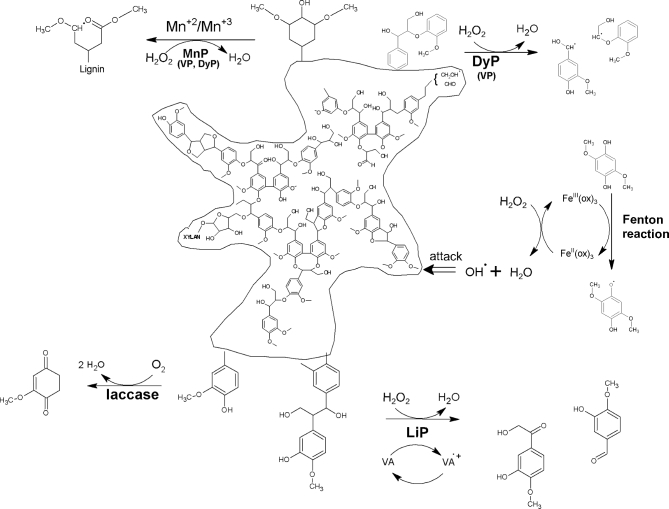
Extensive research efforts have been dedicated to describing degradation of wood, which is a complex process; hence, microorganisms have evolved different enzymatic and non-enzymatic strategies to utilize this plentiful plant material. This review describes a number of fungal and bacterial organisms which have developed both competitive and mutualistic strategies for the decomposition of wood and to thrive in different ecological niches. Through the analysis of the enzymatic machinery engaged in wood degradation, it was possible to elucidate different strategies of wood decomposition which often depend on ecological niches inhabited by given organism. Moreover, a detailed description of low molecular weight compounds is presented, which gives these organisms not only an advantage in wood degradation processes, but seems rather to be a new evolutionatory alternative to enzymatic combustion. Through analysis of genomics and secretomic data, it was possible to underline the probable importance of certain wood-degrading enzymes produced by different fungal organisms, potentially giving them advantage in their ecological niches. The paper highlights different fungal strategies of wood degradation, which possibly correlates to the number of genes coding for secretory enzymes. Furthermore, investigation of the evolution of wood-degrading organisms has been described.
大量的研究工作致力于描述木材的降解过程,这是一个复杂的过程;因此,微生物已经进化出不同的酶促和非酶促策略来利用这种丰富的植物材料。这篇综述描述了许多真菌和细菌有机体,它们已经开发出竞争性和共生性策略来分解木材并在不同的生态位中茁壮成长。通过对参与木材降解的酶机制的分析,有可能阐明木材分解的不同策略,这些策略通常取决于特定有机体所占据的生态位。此外,还介绍了低分子量化合物的详细情况,这些化合物不仅使这些有机体在木材降解过程中具有优势,而且似乎是酶促燃烧的一种新的进化替代方式。通过对基因组学和分泌组学数据的分析,有可能强调不同真菌有机体产生的某些木材降解酶的潜在重要性,这可能使它们在其生态位中具有优势。本文强调了木材降解的不同真菌策略,这可能与编码分泌酶的基因数量有关。此外,还描述了对木材降解有机体进化的研究。