Thiel Anna-Lena, Ragab Mohab, Wagner Anika E, Divanovic Senad, Derer Stefanie, Sina Christian
Institute of Nutritional Medicine, Molecular Gastroenterology, University Hospital Schleswig-Holstein, Campus Lübeck, Lübeck, Germany.
Institute of Nutritional Sciences, Nutrition and Immune System, Justus-Liebig University Giessen, Giessen, Germany.
Front Nutr. 2020 Dec 23;7:607937. doi: 10.3389/fnut.2020.607937. eCollection 2020.
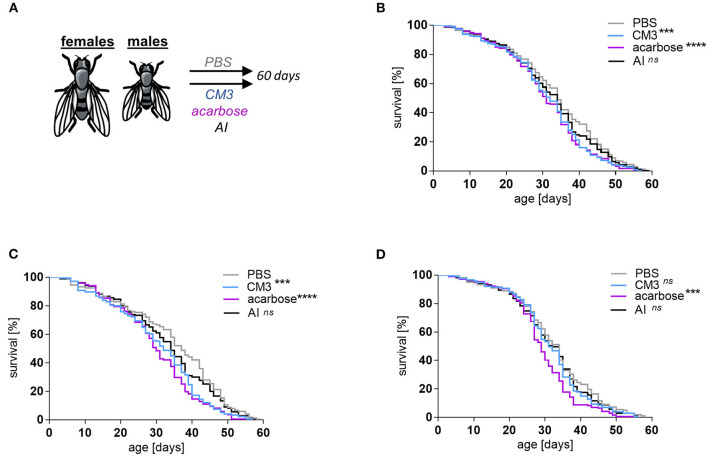
Non-celiac wheat sensitivity (NCWS) has been proposed to be an independent disease entity that is characterized by intestinal (e.g., abdominal pain, flatulence) and extra-intestinal symptoms (e.g., headache, fatigue), which are propagated following the ingestion of wheat products. Increased activity of amylase trypsin inhibitors (ATIs) in modern wheat is suggested to be major trigger of NCWS, while underlying mechanisms still remain elusive. Here, we aimed to generate and functionally characterize the most abundant ATI in modern wheat, chloroform/methanol-soluble protein 3 (CM3), and in . We demonstrate that CM3 displays α-glucosidase but not α-amylase or trypsin inhibitory activity . Moreover, fruit flies fed a sucrose-containing diet together with CM3 displayed significant overgrowth of intestinal bacteria in a sucrose-dependent manner while the consumption of α-amylase and α-glucosidase inhibitors was sufficient to limit bacterial quantities in the intestine. Notably, both CM3 and acarbose-treated flies showed a reduced lifespan. However, this effect was absent in amylase inhibitor (AI) treated flies. Together, given α-glucosidase is a crucial requirement for disaccharide digestion, we suggest that inhibition of α-glucosidase by CM3 enhances disaccharide load in the distal gastrointestinal tract, thereby promoting intestinal bacteria overgrowth. However, it remains speculative if this here described former unknown function of CM3 might contribute to the development of gastrointestinal symptoms observed in NCWS patients which are very similar to symptoms of patients with small intestinal bacterial overgrowth.
非乳糜泻性小麦敏感(NCWS)已被认为是一种独立的疾病实体,其特征为肠道症状(如腹痛、肠胃胀气)和肠外症状(如头痛、疲劳),这些症状在摄入小麦制品后会出现。现代小麦中淀粉酶胰蛋白酶抑制剂(ATIs)活性的增加被认为是NCWS的主要触发因素,但其潜在机制仍不清楚。在此,我们旨在生成并对现代小麦中最丰富的ATIs——氯仿/甲醇可溶性蛋白3(CM3)进行功能表征。我们证明CM3具有α-葡萄糖苷酶活性,但不具有α-淀粉酶或胰蛋白酶抑制活性。此外,喂食含蔗糖饮食并添加CM3的果蝇,其肠道细菌以蔗糖依赖的方式显著过度生长,而摄入α-淀粉酶和α-葡萄糖苷酶抑制剂足以限制肠道内细菌数量。值得注意的是,CM3处理组和阿卡波糖处理组的果蝇寿命均缩短。然而,淀粉酶抑制剂(AI)处理组的果蝇未出现这种现象。综上所述,鉴于α-葡萄糖苷酶是二糖消化的关键因素,我们认为CM3对α-葡萄糖苷酶的抑制作用会增加远端胃肠道中二糖的负荷,从而促进肠道细菌过度生长。然而,CM3这种此前未知的功能是否会导致NCWS患者出现胃肠道症状(与小肠细菌过度生长患者的症状非常相似),仍有待推测。