Section of Women's Mental Health, Health Service Research and Population Department, Institute of Psychiatry, Psychology and Neuroscience, King's College London, UK; and Department of Women and Children's Health, Faculty of Life Sciences and Medicine, King's College London, St Thomas' Hospital, UK.
Department of Women and Children's Health, Faculty of Life Sciences and Medicine, King's College London, St Thomas' Hospital, UK.
Br J Psychiatry. 2021 Sep;219(3):494-500. doi: 10.1192/bjp.2020.250.
Investigating obstetric near misses (life-threatening obstetric complications) provides crucial information to prevent maternal mortality and morbidity.
To investigate the rate and type of obstetric near misses among women with serious mental illness (SMI).
We conducted a historical cohort study, using de-identified electronic mental health records linked with maternity data from Hospital Episode Statistics. The English Maternal Morbidity Outcome Indicator was used to identify obstetric near misses at the time of delivery in two cohorts: (1) exposed cohort - all women with a live or still birth in 2007-2016, and a history of secondary mental healthcare before delivery in south-east London (n = 13 570); (2) unexposed cohort - all women with a live or still birth in 2007-2016, resident within south-east London, with no history of mental healthcare before delivery (n = 223 274).
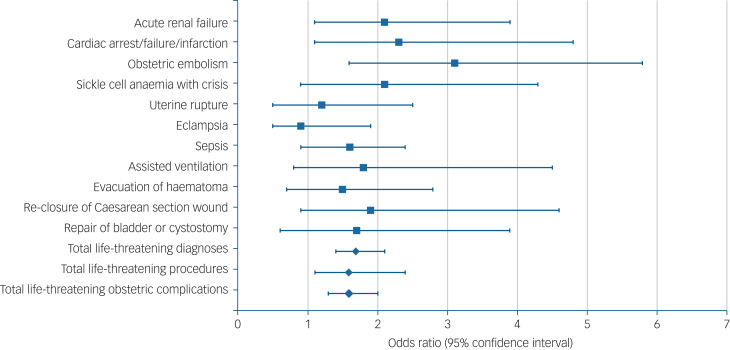
The rate of obstetric near misses was 884.3/100 000 (95% CI 733.2-1057.4) maternities in the exposed group compared with 575.1/100 000 (95% CI 544.0-607.4) maternities in the unexposed group (adjusted odds ratio 1.6, 95% CI 1.3-2.0, P < 0.001). Highest risks were for acute renal failure (adjusted odds ratio 2.1, 95% CI 1.1-3.8, P = 0.022); cardiac arrest, failure or infarction (adjusted odds ratio 2.3, 95% CI 1.1-4.8, P = 0.028); and obstetric embolism (adjusted odds ratio 3.1, 95% CI 1.6-5.8, P < 0.001).
Findings emphasise the importance of integrated physical and mental healthcare before and during pregnancy for women with SMI.
调查产科严重并发症(危及生命的产科并发症)为预防孕产妇死亡和发病提供了重要信息。
调查严重精神疾病(SMI)女性中的产科严重并发症发生率和类型。
我们进行了一项历史队列研究,使用从医院病例统计中链接的去识别电子心理健康记录,使用英国孕产妇发病率结局指标,在两个队列中识别分娩时的产科严重并发症:(1)暴露队列-2007-2016 年所有活产或死产的妇女,且在伦敦东南部产前有二级精神保健史(n=13570);(2)未暴露队列-2007-2016 年所有活产或死产的妇女,居住在伦敦东南部,产前无精神保健史(n=223274)。
暴露组的产科严重并发症发生率为 884.3/100000(95%CI 733.2-1057.4)分娩,未暴露组为 575.1/100000(95%CI 544.0-607.4)分娩(调整后的优势比 1.6,95%CI 1.3-2.0,P<0.001)。风险最高的是急性肾衰竭(调整后的优势比 2.1,95%CI 1.1-3.8,P=0.022);心搏骤停、衰竭或梗死(调整后的优势比 2.3,95%CI 1.1-4.8,P=0.028);和产科栓塞(调整后的优势比 3.1,95%CI 1.6-5.8,P<0.001)。
研究结果强调了 SMI 妇女在妊娠前和妊娠期间进行身体和精神保健综合管理的重要性。