Leonard Davis School of Gerontology, University of Southern California, Los Angeles, USA.
J Gerontol B Psychol Sci Soc Sci. 2022 Jul 5;77(7):e167-e178. doi: 10.1093/geronb/gbab009.
In response to the coronavirus disease 2019 (COVID-19) pandemic, older adults are advised to follow social distancing measures to prevent infection. However, such measures may increase the risk of loneliness. The current study aimed to investigate (a) whether social distancing measures, particularly limiting close social interactions, are associated with loneliness among older adults, and (b) whether the association between social distancing measures and loneliness is moderated by sociodemographic characteristics.
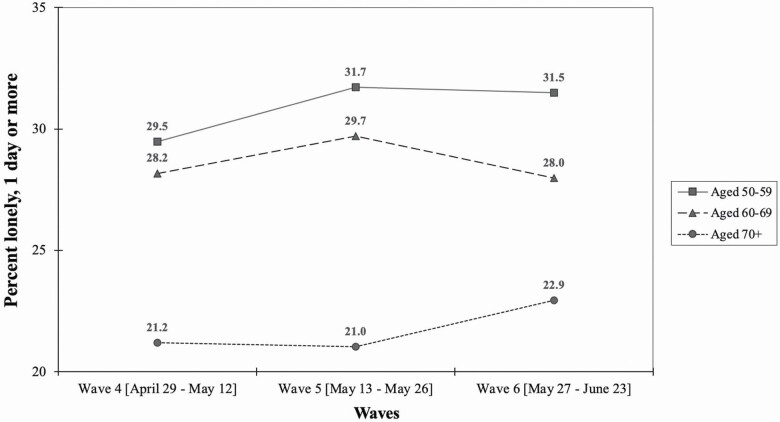
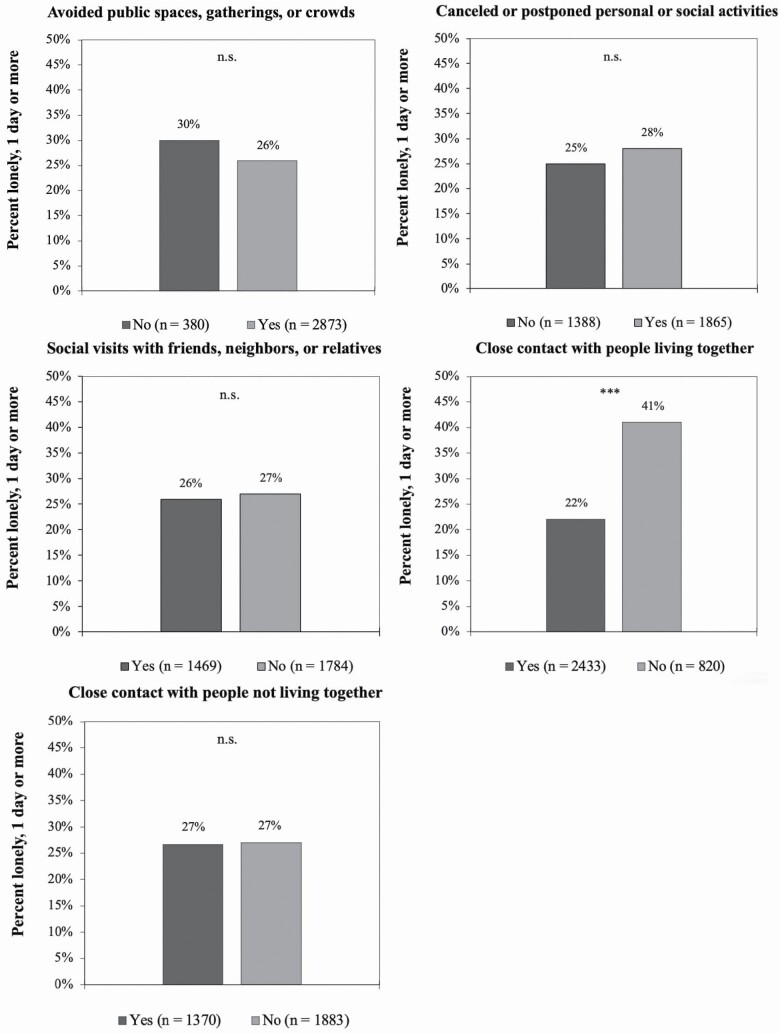
Data were from the fourth wave (April 29 to May 26, 2020) of the nationally representative Understanding America Study COVID-19 Survey. We used data on adults 50 years or older (N = 3,253). Logistic regression models of loneliness were performed. Five indicators of social distancing measures were considered: (a) avoiding public spaces, gatherings, or crowds; (b) canceling or postponing social activities; (c) social visits; (d) no close contact (within 6 feet) with people living together; and (e) with people not living together.
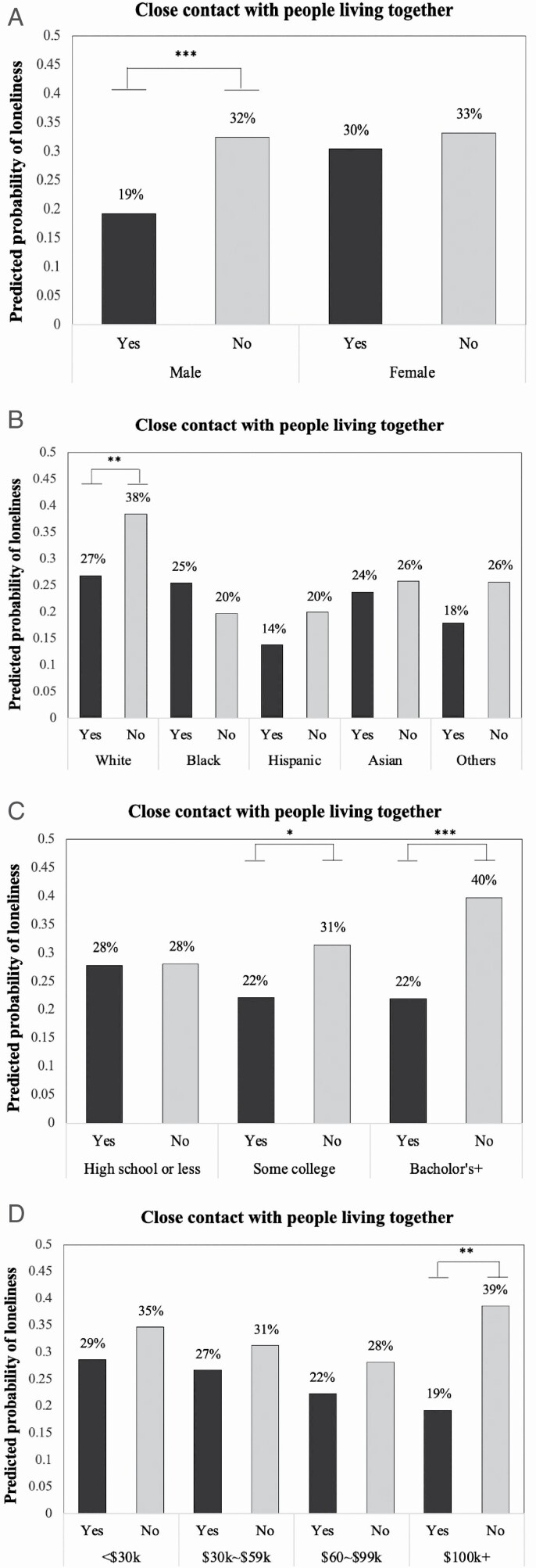
Cancelling or postponing social activities and avoiding close contact with people living together were associated with 33% (odds ratio [OR] = 1.33, confidence interval [CI] = 1.06-1.68, p < .05) and 47% (OR = 1.47, CI = 1.09-1.99, p < .05) greater odds of loneliness, respectively. Furthermore, limiting close contact with coresidents increased the probability of loneliness more for males, non-Hispanic Whites, and those with higher levels of education and income.
Efforts should be made to help older adults maintain social connectedness with close others by virtual communication methods. Our findings also call special attention to vulnerable groups at elevated risks of loneliness, emphasizing the need for tailored interventions.
针对 2019 年冠状病毒病(COVID-19)大流行,建议老年人采取保持社交距离措施以预防感染。然而,这些措施可能会增加孤独感的风险。本研究旨在调查:(a)保持社交距离措施,特别是限制密切社交互动,是否与老年人的孤独感有关;以及(b)社交距离措施与孤独感之间的关联是否受社会人口特征的调节。
数据来自具有全国代表性的理解美国研究 COVID-19 调查的第四波(2020 年 4 月 29 日至 5 月 26 日)。我们使用了 50 岁及以上成年人的数据(N=3253)。进行了孤独感的逻辑回归模型分析。考虑了五个社会距离措施指标:(a)避免公共场所、聚会或人群;(b)取消或推迟社交活动;(c)社交访问;(d)与同住者不进行密切接触;以及(e)与非同住者不进行密切接触。
取消或推迟社交活动以及避免与同住者密切接触,分别与孤独感增加 33%(比值比[OR] = 1.33,置信区间[CI] = 1.06-1.68,p <.05)和 47%(OR = 1.47,CI = 1.09-1.99,p <.05)相关。此外,限制与核心居住者的密切接触对男性、非西班牙裔白人以及受教育程度和收入较高的人增加孤独感的可能性更大。
应努力通过虚拟沟通方式帮助老年人与亲密他人保持社交联系。我们的研究结果还特别关注孤独感风险较高的弱势群体,强调需要有针对性的干预措施。