Department of Emergency Medicine, University of Pittsburgh School of Medicine, Pittsburgh, PA, United States of America.
Division of Emergency Medicine, Ann & Robert H. Lurie Children's Hospital of Chicago, Northwestern University Feinberg School of Medicine, Chicago, IL, United States of America.
Am J Emerg Med. 2021 Apr;42:1-8. doi: 10.1016/j.ajem.2020.12.078. Epub 2020 Dec 31.
The COVID-19 pandemic may affect both use of 9-1-1 systems and prehospital treatment and transport practices. We evaluated EMS responses in an EMS region when it experienced low to moderate burden of COVID-19 disease to assess overall trends, response and management characteristics, and non-transport rates. Our goal is to inform current and future pandemic response in similar regions.
We performed a retrospective review of prehospital EMS responses from 22 urban, suburban, and rural EMS agencies in Western Pennsylvania. To account for seasonal variation, we compared demographic, response, and management characteristics for the 2-month period of March 15 to May 15, 2020 with the corresponding 2-month periods in 2016-2019. We then tested for an association between study period (pandemic vs historical control) and incidence of non-transport in unadjusted and adjusted regression. Finally, we described the continuous trends in responses and non-transports that occurred during the year before and initial phase of the COVID-19 pandemic from January 1, 2019 to May 31, 2020.
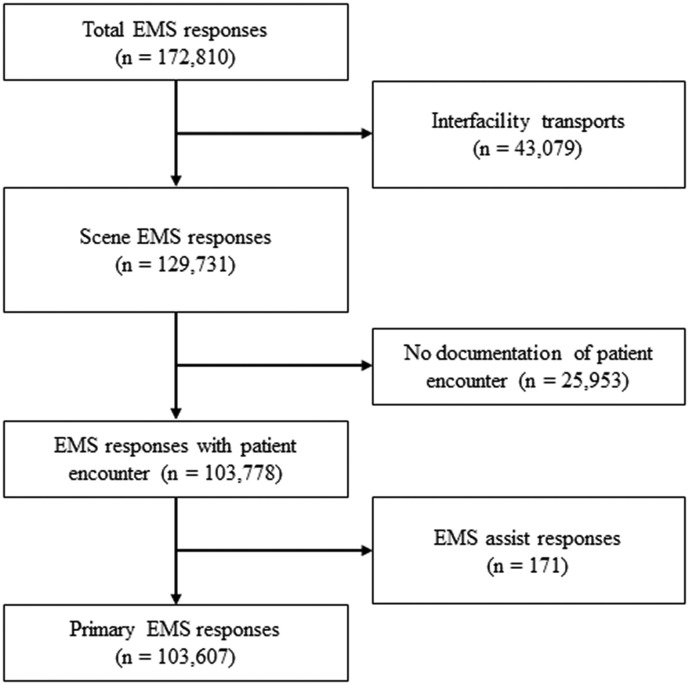
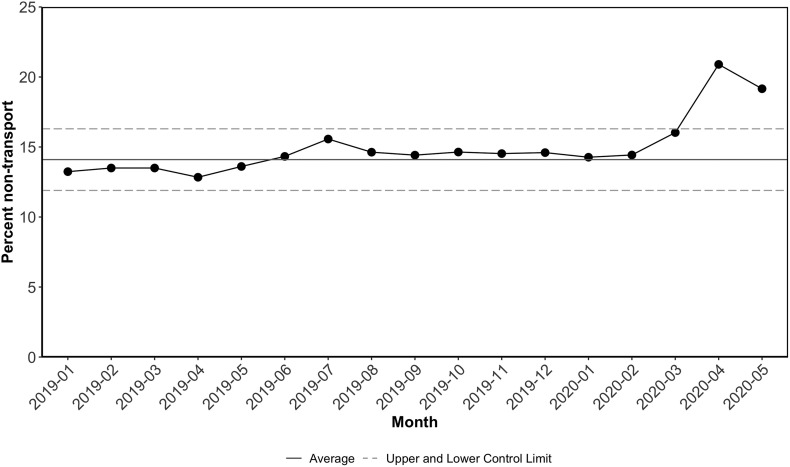
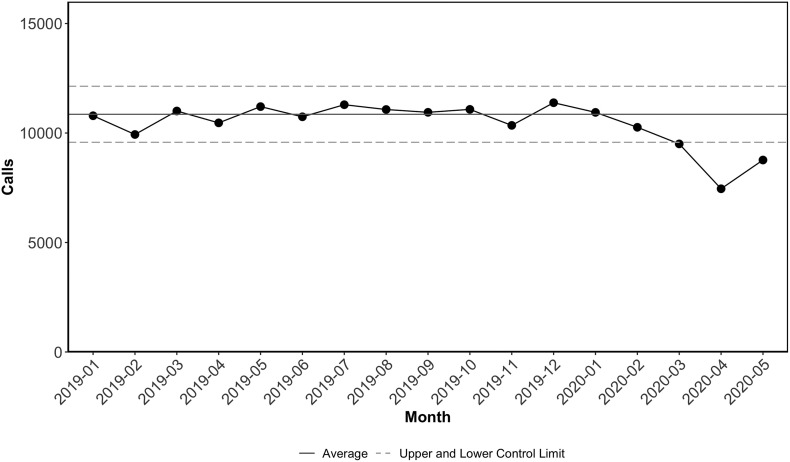
Among 103,607 EMS responses in the 2-month comparative periods of March 15 to May 15, 2016-2020, we found a 26.5% [95% CI 26.9%, 27.1%] decrease in responses in 2020 compared to the same months from the four prior years. There was a small increase in respiratory cases (0.6% [95%CI 0.1%, 1.1%]) and greater frequency of abnormal vital signs suggesting a sicker patient cohort. There was a relative increase (46.6%) in non-transports between periods. The pandemic period was independently associated with an increase in non-transport (adjusted OR 1.68; 95%CI 1.59, 1.78). Among 177,194 EMS responses occurring in the year before and during the early period of the pandemic, between January 1, 2019, and May 31, 2020, we identified a 31% decrease in responses and a 48% relative increase in non-transports for April 2020 compared to the previous year's monthly averages.
Despite a low to moderate burden of infection during the initial period of the COVID-19 pandemic, we found a decline in overall EMS response volumes and an increase in the rate of non-transports independent of patient demographics and other response characteristics.
COVID-19 大流行可能会影响 9-1-1 系统的使用以及院前治疗和转运实践。我们评估了在 COVID-19 疾病负担较低至中等的 EMS 区域的 EMS 反应,以评估总体趋势、反应和管理特征以及非转运率。我们的目标是为类似地区的当前和未来大流行应对提供信息。
我们对宾夕法尼亚州西部 22 个城市、郊区和农村 EMS 机构的院前 EMS 反应进行了回顾性研究。为了考虑季节性变化,我们将 2020 年 3 月 15 日至 5 月 15 日的两个月期间与 2016-2019 年同期的人口统计学、反应和管理特征进行了比较。然后,我们在未调整和调整后的回归分析中,测试了研究期间(大流行与历史对照)与非转运发生率之间的关联。最后,我们描述了 2019 年 1 月 1 日至 2020 年 5 月 31 日期间 COVID-19 大流行之前和初始阶段连续发生的反应和非转运趋势。
在 2016-2020 年 3 月 15 日至 5 月 15 日的两个月比较期间,在 103607 例 EMS 反应中,我们发现 2020 年的反应比前四年同期下降了 26.5%[95%CI 26.9%,27.1%]。呼吸道病例略有增加(0.6%[95%CI 0.1%,1.1%]),生命体征异常频率更高,表明患者群体病情更严重。非转运的相对频率增加(46.6%)。大流行期间与非转运的增加独立相关(调整后的 OR 1.68;95%CI 1.59,1.78)。在 2019 年 1 月 1 日至 2020 年 5 月 31 日期间的大流行早期之前和期间,我们发现 2020 年 4 月的反应下降了 31%,而非转运的相对频率增加了 48%,与前一年的每月平均值相比。
尽管 COVID-19 大流行初期感染负担较低,但我们发现整体 EMS 反应量下降,非转运率上升,这与患者人口统计学和其他反应特征无关。