Department of Medicine I (Hematology, Oncology and Stem Cell Transplantation), Freiburg University Medical Center, Freiburg, Germany.
Department of Medical Oncology and Hematology, Zurich University Hospital, Raemistrasse 100, 8091, Zürich, Switzerland.
BMC Cancer. 2021 Jan 11;21(1):49. doi: 10.1186/s12885-020-07736-x.
Novel biomarkers and molecular monitoring tools hold potential to improve outcome for patients following resection of pancreatic ductal adenocarcinoma (PDAC). We hypothesized that the combined longitudinal analysis of mutated cell-free plasma KRAS (cfKRAS) and CA 19-9 during adjuvant treatment and follow-up might more accurately predict disease course than hitherto available parameters.
Between 07/2015 and 10/2018, we collected 134 plasma samples from 25 patients after R0/R1-resection of PDAC during adjuvant chemotherapy and post-treatment surveillance at our institution. Highly sensitive discriminatory multi-target ddPCR assays were employed to screen plasma samples for cfKRAS. cfKRAS and CA 19-9 dynamics were correlated with recurrence-free survival (RFS) and overall survival (OS). Patients were followed-up until 01/2020.
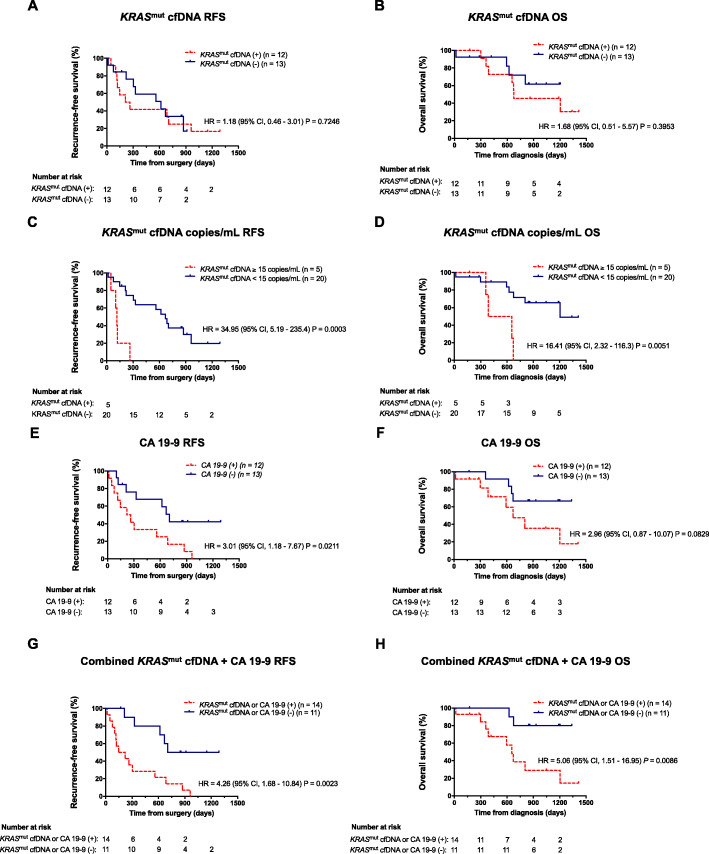
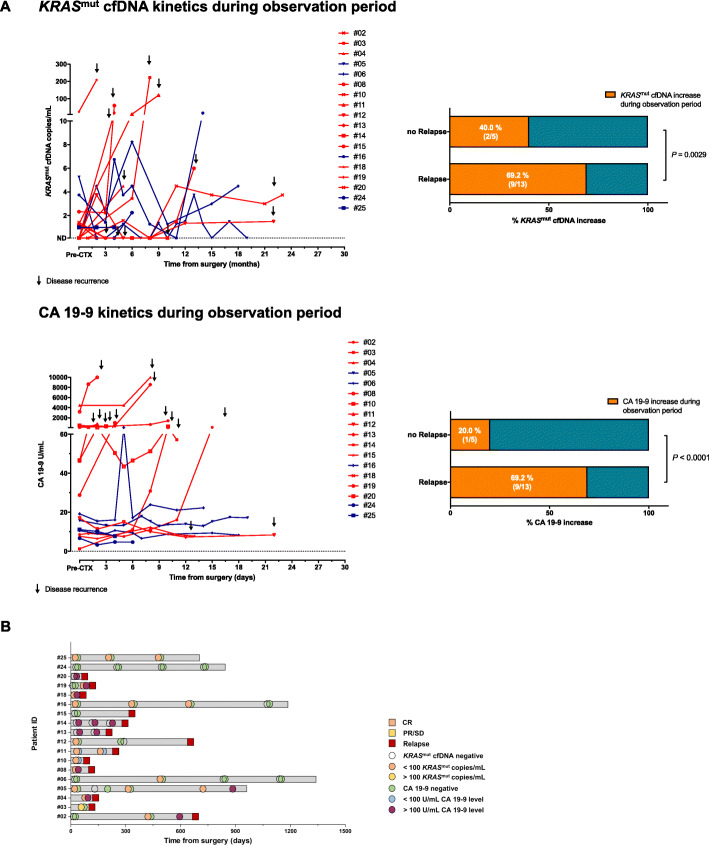
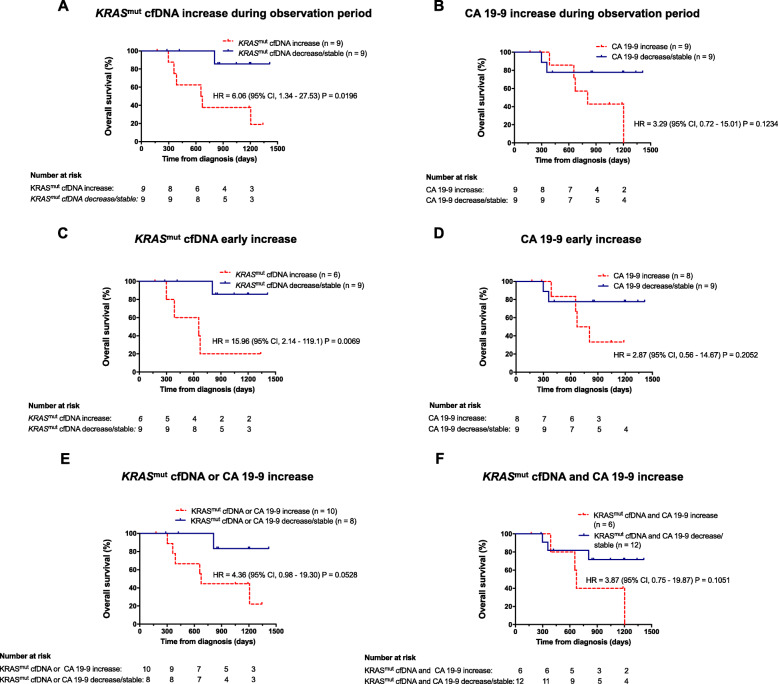
Out of 25 enrolled patients, 76% had undergone R0 resection and 48% of resected PDACs were pN0. 17/25 (68%) of patients underwent adjuvant chemotherapy. Median follow-up was 22.0 months, with 19 out of 25 (76%) patients relapsing during study period. Median RFS was 10.0 months, median OS was 22.0 months. Out of clinicopathologic variables, only postoperative CA 19-9 levels and administration of adjuvant chemotherapy correlated with survival endpoints. cfKRAS was detected in 12/25 (48%) of patients, and detection of high levels inversely correlated with survival endpoint. Integration of cfKRAS and CA 19-9 levels outperformed either individual marker. cfKRAS outperformed CA 19-9 as dynamic marker since increase during adjuvant chemotherapy and follow-up was highly predictive of early relapse and poor OS.
Integrated analysis of cfKRAS and CA 19-9 levels is a promising approach for molecular monitoring of patients following resection of PDAC. Larger prospective studies are needed to further develop this approach and dissect each marker's specific potential.
新型生物标志物和分子监测工具有可能改善胰腺导管腺癌(PDAC)患者手术后的预后。我们假设,在辅助治疗和随访过程中对游离血浆 KRAS 突变(cfKRAS)和 CA 19-9 的联合纵向分析可能比迄今为止可用的参数更能准确预测疾病进程。
在我们的机构中,我们在 2015 年 7 月至 2018 年 10 月期间,对 25 例 PDAC 患者接受 RO/R1 切除术后,在辅助化疗和治疗后监测期间收集了 134 份血浆样本。我们采用高灵敏度的区分性多靶 ddPCR 检测法来筛选 cfKRAS 血浆样本。cfKRAS 和 CA 19-9 的动态变化与无复发生存(RFS)和总生存(OS)相关。患者随访至 2020 年 1 月。
在纳入的 25 例患者中,76%接受了 RO 切除术,48%的 PDAC 患者为 pN0。25 例患者中有 17 例(68%)接受了辅助化疗。中位随访时间为 22.0 个月,研究期间 25 例患者中有 19 例(76%)复发。中位 RFS 为 10.0 个月,中位 OS 为 22.0 个月。在临床病理变量中,只有术后 CA 19-9 水平和辅助化疗的应用与生存终点相关。25 例患者中有 12 例(48%)检测到 cfKRAS,高水平的 cfKRAS 检测与生存终点呈负相关。cfKRAS 和 CA 19-9 水平的整合优于单独的标志物。cfKRAS 作为动态标志物优于 CA 19-9,因为辅助化疗和随访期间的增加高度预测早期复发和较差的 OS。
cfKRAS 和 CA 19-9 水平的综合分析是监测 PDAC 患者术后分子变化的一种很有前途的方法。需要更大的前瞻性研究来进一步开发这种方法,并剖析每个标志物的特定潜力。