Fan Ying, Gao Qiang, Guan Jia-Xin, Liu Lei, Hong Ming, Jun Li, Wang Li, Ding Hai-Feng, Jiang Li-Hong, Hou Bo-Yu, Li Mei, Song Zhi-Qiang, Sun De-Qin, Yan Chao-Qi, Ma Lan
Department of Geriatrics, The 2nd Affiliated Hospital of Harbin Medical University, Harbin, Heilongjiang Province, China.
Department of Geriatrics, Tongling Municipal Hospital, Tongling, Anhui Province, China.
Neural Regen Res. 2021 Aug;16(8):1592-1597. doi: 10.4103/1673-5374.303037.
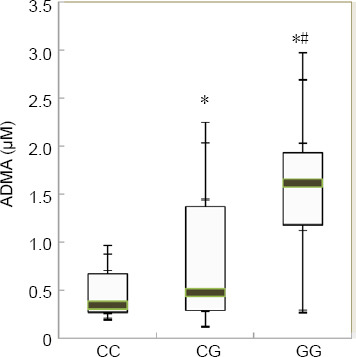
Cerebrovascular endothelial dysfunction is involved in the progression of leukoaraiosis. Asymmetric dimethylarginine is a competitive inhibitor of nitric oxide, which is highly expressed in patients with leukoaraiosis. Dimethylarginine dimethylaminohydrolase (DDAH) is a hydrolytic enzyme that is primarily responsible for eliminating asymmetric dimethylarginine, and it plays a role in the pathogenesis of cardiovascular and cerebrovascular diseases. The DDAH2 subtype is expressed in organs rich in induced nitric oxide synthase, including the heart, the placenta, and the cerebral endothelium during cerebral ischemia, in the stress state, or under neurotoxicity. Overexpression of the DDAH2 gene can inhibit asymmetric dimethylarginine-induced peripheral circulating endothelial cell dysfunction. However, it is unknown whether this polymorphism regulates plasma asymmetric dimethylarginine levels in patients with leukoaraiosis. In this double-blind study, we recruited 46 patients with leukoaraiosis and 46 healthy, matched controls. Plasma asymmetric dimethylarginine levels were determined using enzyme-linked immunoassays. Genomic DNA was isolated from whole blood samples, and polymerase chain reaction, SmaI restriction enzyme digestion, restriction fragment length polymorphisms, and agarose electrophoresis were used to detect DDAH2 (-449 G/C) gene polymorphisms. The results revealed that 95.65% of leukoaraiosis patients had recessive genetic models (GG and CG), while 89.13% of healthy control subjects had dominant genetic models (CC and CG). There was a significant difference in the genotype composition ratio between leukoaraiosis patients and healthy controls (P = 0.0002). The frequency of G alleles in the leukoaraiosis patients (71.74%) was significantly higher than in healthy controls, whereas the frequency of C alleles was lower (χ = 13.9580, P = 0.0002). Furthermore, asymmetric dimethylarginine concentrations in subjects with the GG genotype were significantly higher than in subjects with the CG and CC genotypes (Kruskal-Wallis H = 24.5955, P < 0.0001). In addition, the GG genotype of DDAH2 (-449 G/C) was more common in patients with leukoaraiosis. These findings suggest that the G allele of DDAH2 (-449 G/C) is a risk factor for leukoaraiosis morbidity and is correlated with high levels of asymmetric dimethylarginine. This study was approved by the Institutional Ethics Committee of The 2nd Affiliated Hospital of Harbin Medical University of China (approval No. KY2016-177) on July 28, 2016.
脑血管内皮功能障碍参与了脑白质疏松症的进展。不对称二甲基精氨酸是一氧化氮的竞争性抑制剂,在脑白质疏松症患者中高度表达。二甲基精氨酸二甲胺水解酶(DDAH)是一种水解酶,主要负责清除不对称二甲基精氨酸,它在心血管和脑血管疾病的发病机制中起作用。DDAH2亚型在富含诱导型一氧化氮合酶的器官中表达,包括心脏、胎盘以及脑缺血、应激状态或神经毒性作用下的脑内皮。DDAH2基因的过表达可抑制不对称二甲基精氨酸诱导的外周循环内皮细胞功能障碍。然而,这种多态性是否调节脑白质疏松症患者血浆中不对称二甲基精氨酸水平尚不清楚。在这项双盲研究中,我们招募了46例脑白质疏松症患者和46名健康匹配对照。使用酶联免疫分析法测定血浆中不对称二甲基精氨酸水平。从全血样本中分离基因组DNA,采用聚合酶链反应、SmaI限制性内切酶消化、限制性片段长度多态性和琼脂糖电泳检测DDAH2(-449 G/C)基因多态性。结果显示,95.65%的脑白质疏松症患者具有隐性遗传模式(GG和CG),而89.13%的健康对照者具有显性遗传模式(CC和CG)。脑白质疏松症患者与健康对照者的基因型组成比例存在显著差异(P = 0.0002)。脑白质疏松症患者中G等位基因频率(71.74%)显著高于健康对照者,而C等位基因频率较低(χ = 13.9580,P = 0.0002)。此外,GG基因型受试者的不对称二甲基精氨酸浓度显著高于CG和CC基因型受试者(Kruskal-Wallis H = 24.5955,P < 0.0001)。另外,DDAH2(-449 G/C)的GG基因型在脑白质疏松症患者中更为常见。这些发现表明,DDAH2(-449 G/C)的G等位基因是脑白质疏松症发病的危险因素,且与高水平的不对称二甲基精氨酸相关。本研究于2016年7月28日获得中国哈尔滨医科大学附属第二医院机构伦理委员会批准(批准号KY2016-177)。