Department of Knowledge Integration, University of Waterloo, Waterloo, ON, Canada.
Nuffield Department of Primary Care Health Sciences, University of Oxford, Oxford, United Kingdom.
J Med Internet Res. 2021 Jan 26;23(1):e23775. doi: 10.2196/23775.
COVID-19 has thrust video consulting into the limelight, as health care practitioners worldwide shift to delivering care remotely. Evidence suggests that video consulting is acceptable, safe, and effective in selected conditions and settings. However, research to date has mostly focused on initial adoption, with limited consideration of how video consulting can be mainstreamed and sustained.
This study sought to do the following: (1) review and synthesize reported opportunities, challenges, and lessons learned in the scale-up, spread, and sustainability of video consultations, and (2) identify transferable insights that can inform policy and practice.
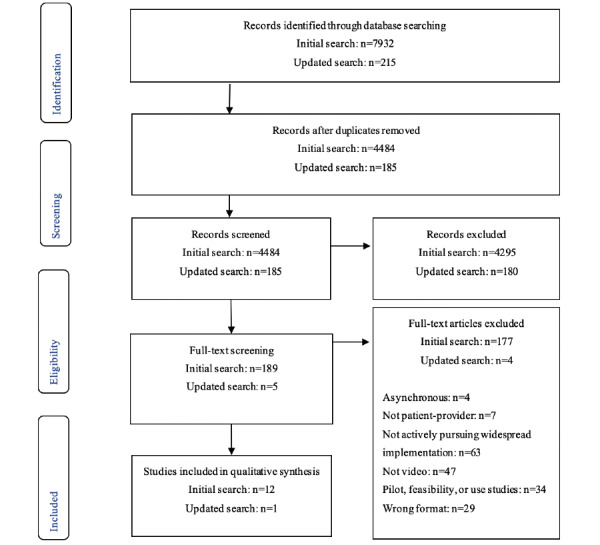
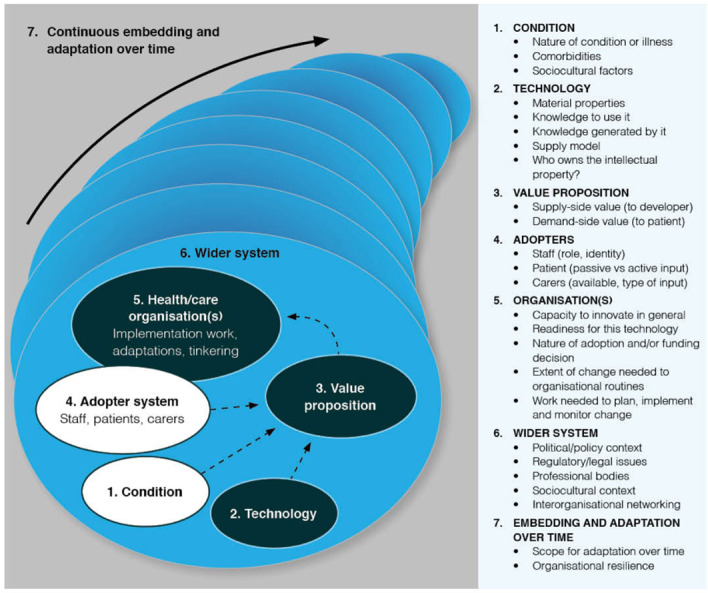
We identified papers through systematic searches in PubMed, CINAHL, and Web of Science. Included articles reported on synchronous, video-based consultations that had spread to more than one setting beyond an initial pilot or feasibility stage, and were published since 2010. We used the Nonadoption, Abandonment, and challenges to the Scale-up, Spread, and Sustainability (NASSS) framework to synthesize findings relating to 7 domains: an understanding of the health condition(s) for which video consultations were being used, the material properties of the technological platform and relevant peripherals, the value proposition for patients and developers, the role of the adopter system, organizational factors, wider macro-level considerations, and emergence over time.
We identified 13 papers describing 10 different video consultation services in 6 regions, covering the following: (1) video-to-home services, connecting providers directly to the patient; (2) hub-and-spoke models, connecting a provider at a central hub to a patient at a rural center; and (3) large-scale top-down evaluations scaled up or spread across a national health administration. Services covered rehabilitation, geriatrics, cancer surgery, diabetes, and mental health, as well as general specialist care and primary care. Potential enablers of spread and scale-up included embedded leadership and the presence of a telehealth champion, appropriate reimbursement mechanisms, user-friendly technology, pre-existing staff relationships, and adaptation (of technology and services) over time. Challenges tended to be related to service development, such as the absence of a long-term strategic plan, resistance to change, cost and reimbursement issues, and the technical experience of staff. There was limited articulation of the challenges to scale-up and spread of video consultations. This was combined with a lack of theorization, with papers tending to view spread and scale-up as the sum of multiple technical implementations, rather than theorizing the distinct processes required to achieve widespread adoption.
There remains a significant lack of evidence that can support the spread and scale-up of video consulting. Given the recent pace of change due to COVID-19, a more definitive evidence base is urgently needed to support global efforts and match enthusiasm for extending use.
由于全球各地的医疗从业者都在转向远程提供护理,COVID-19 已将视频咨询推向了聚光灯下。有证据表明,在某些情况下和环境中,视频咨询是可以接受、安全且有效的。但是,迄今为止的研究主要集中在初始采用上,而很少考虑如何将视频咨询推广和维持下去。
本研究旨在:(1)审查并综合报告在视频咨询的扩展、传播和可持续性方面所面临的机会、挑战和经验教训;(2)确定可用于为政策和实践提供信息的可转移的见解。
我们通过在 PubMed、CINAHL 和 Web of Science 中进行系统搜索来确定论文。纳入的文章报告了同步的基于视频的咨询,这些咨询已经在初始试点或可行性阶段之后扩展到了一个以上的环境,并且是在 2010 年以后发表的。我们使用非采用、放弃和对扩展、传播和可持续性的挑战(NASSS)框架来综合与以下 7 个领域相关的发现:对视频咨询使用的健康状况的理解、技术平台和相关外围设备的物质属性、对患者和开发者的价值主张、采用者系统的作用、组织因素、更广泛的宏观层面考虑因素以及随时间的出现。
我们确定了 13 篇描述了在 6 个地区的 10 种不同视频咨询服务的文章,涵盖了以下内容:(1)视频到家庭服务,将提供者直接连接到患者;(2)中心辐射模型,将中心的提供者与农村中心的患者连接起来;(3)大规模自上而下的评估扩展或传播到国家卫生管理机构。服务涵盖康复、老年医学、癌症手术、糖尿病和心理健康,以及普通专科护理和初级保健。潜在的扩展和扩展因素包括嵌入式领导和远程医疗拥护者的存在、适当的报销机制、用户友好的技术、现有的员工关系以及随着时间的推移进行的调整(技术和服务)。挑战往往与服务开发有关,例如缺乏长期战略计划、对变革的抵制、成本和报销问题以及员工的技术经验。对视频咨询扩展和传播的挑战的阐述有限。这与缺乏理论化相结合,这些论文往往将扩展和推广视为多个技术实现的总和,而不是对实现广泛采用所需的不同过程进行理论化。
目前仍缺乏能够支持视频咨询扩展和推广的证据。鉴于 COVID-19 带来的最近变化速度,迫切需要更明确的证据基础来支持全球努力并与扩展使用的热情相匹配。