Department of Radiation Oncology, Shandong Cancer Hospital and Institute, Shandong First Medical University and Shandong Academy of Medical Sciences, 440 Jiyan Road, Jinan, 250117, Shandong, China.
Radiat Oncol. 2021 Jan 13;16(1):9. doi: 10.1186/s13014-020-01735-9.
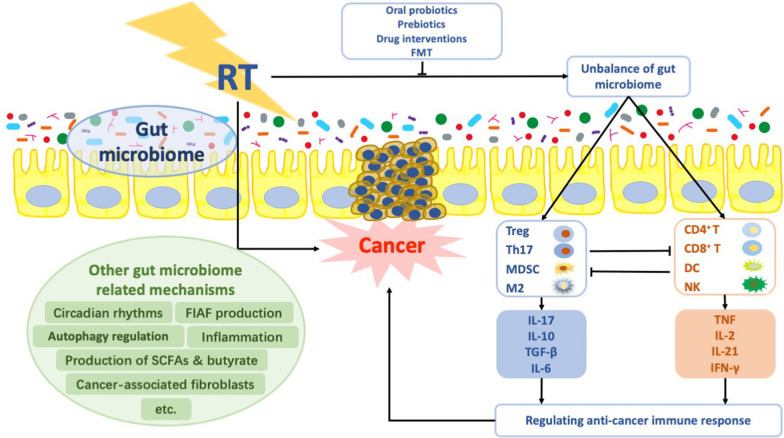
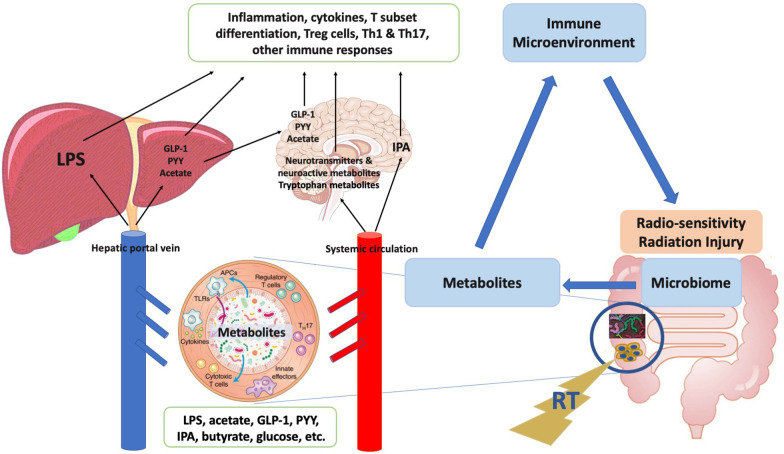
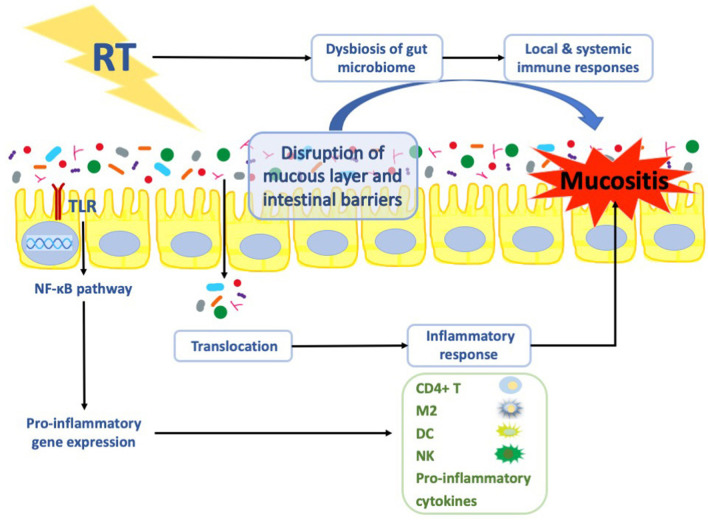
An ever-growing body of evidence has linked the gut microbiome with both the effectiveness and the toxicity of cancer therapies. Radiotherapy is an effective way to treat tumors, although large variations exist among patients in tumor radio-responsiveness and in the incidence and severity of radiotherapy-induced side effects. Relatively little is known about whether and how the microbiome regulates the response to radiotherapy. Gut microbiota may be an important player in modulating "hot" versus "cold" tumor microenvironment, ultimately affecting treatment efficacy. The interaction of the gut microbiome and radiotherapy is a bidirectional function, in that radiotherapy can disrupt the microbiome and those disruptions can influence the effectiveness of the anticancer treatments. Limited data have shown that interactions between the radiation and the microbiome can have positive effects on oncotherapy. On the other hand, exposure to ionizing radiation leads to changes in the gut microbiome that contribute to radiation enteropathy. The gut microbiome can influence radiation-induced gastrointestinal mucositis through two mechanisms including translocation and dysbiosis. We propose that the gut microbiome can be modified to maximize the response to treatment and minimize adverse effects through the use of personalized probiotics, prebiotics, or fecal microbial transplantation. 16S rRNA sequencing is the most commonly used approach to investigate distribution and diversity of gut microbiome between individuals though it only identifies bacteria level other than strain level. The functional gut microbiome can be studied using methods involving metagenomics, metatranscriptomics, metaproteomics, as well as metabolomics. Multiple '-omic' approaches can be applied simultaneously to the same sample to obtain integrated results. That said, challenges and remaining unknowns in the future that persist at this time include the mechanisms by which the gut microbiome affects radiosensitivity, interactions between the gut microbiome and combination treatments, the role of the gut microbiome with regard to predictive and prognostic biomarkers, the need for multi "-omic" approach for in-depth exploration of functional changes and their effects on host-microbiome interactions, and interactions between gut microbiome, microbial metabolites and immune microenvironment.
越来越多的证据表明,肠道微生物群与癌症治疗的疗效和毒性都有关联。放射疗法是治疗肿瘤的一种有效方法,尽管患者之间的肿瘤放射敏感性以及放疗引起的副作用的发生率和严重程度存在很大差异。关于肠道微生物组是否以及如何调节对放疗的反应,人们知之甚少。肠道微生物群可能是调节“热”肿瘤微环境与“冷”肿瘤微环境的重要因素,最终影响治疗效果。肠道微生物群与放射疗法的相互作用是一种双向功能,因为放射疗法可以破坏微生物组,而这些破坏会影响抗癌治疗的效果。有限的数据表明,辐射与微生物组之间的相互作用可以对肿瘤治疗产生积极影响。另一方面,暴露于电离辐射会导致肠道微生物组发生变化,从而导致放射性肠炎。肠道微生物群可以通过两种机制影响放射性胃肠黏膜炎,即移位和失调。我们提出,可以通过使用个性化益生菌、益生元和粪便微生物移植来改变肠道微生物群,以最大限度地提高对治疗的反应,减少不良反应。16S rRNA 测序是研究个体之间肠道微生物组分布和多样性的最常用方法,但它只能识别细菌水平,而不能识别菌株水平。可以使用涉及宏基因组学、宏转录组学、宏蛋白质组学以及代谢组学的方法来研究功能肠道微生物组。可以同时将多种“组学”方法应用于同一个样本,以获得综合结果。也就是说,目前仍然存在一些挑战和未知问题,包括肠道微生物组影响放射敏感性的机制、肠道微生物组与联合治疗的相互作用、肠道微生物组在预测和预后生物标志物方面的作用、需要多“组学”方法深入探索功能变化及其对宿主-微生物组相互作用的影响,以及肠道微生物组、微生物代谢物和免疫微环境之间的相互作用。