Department of Hepatobiliary Surgery, Nanfang Hospital, Southern Medical University, 1838 Guangzhou North Ave, Guangzhou, 510515, Guangdong Province, China.
World J Surg Oncol. 2021 Jan 12;19(1):11. doi: 10.1186/s12957-020-02115-z.
To investigate the prognostic factors of patients with pancreatic neuroendocrine tumor (pNETs) after surgical resection, and to analyze the value of enucleation for pNETs without distant metastasis that are well-differentiated (G1) and have a diameter ≤ 4 cm.
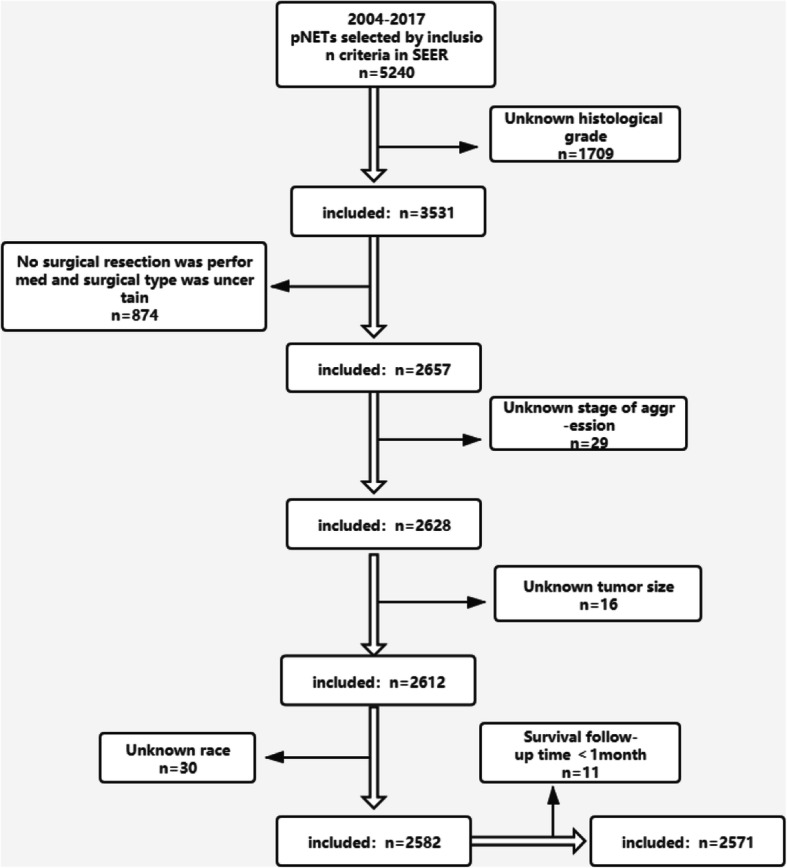
Data from pNET patients undergoing surgical resection between 2004 and 2017 were collected from the Surveillance, Epidemiology, and End Results (SEER) database. Kaplan-Meier analysis and log-rank testing were used for the survival comparisons. Adjusted HRs with 95% CIs were calculated using univariate and multivariate Cox regression models to estimate the prognostic factors. P < 0.05 was regarded as statistically significant.
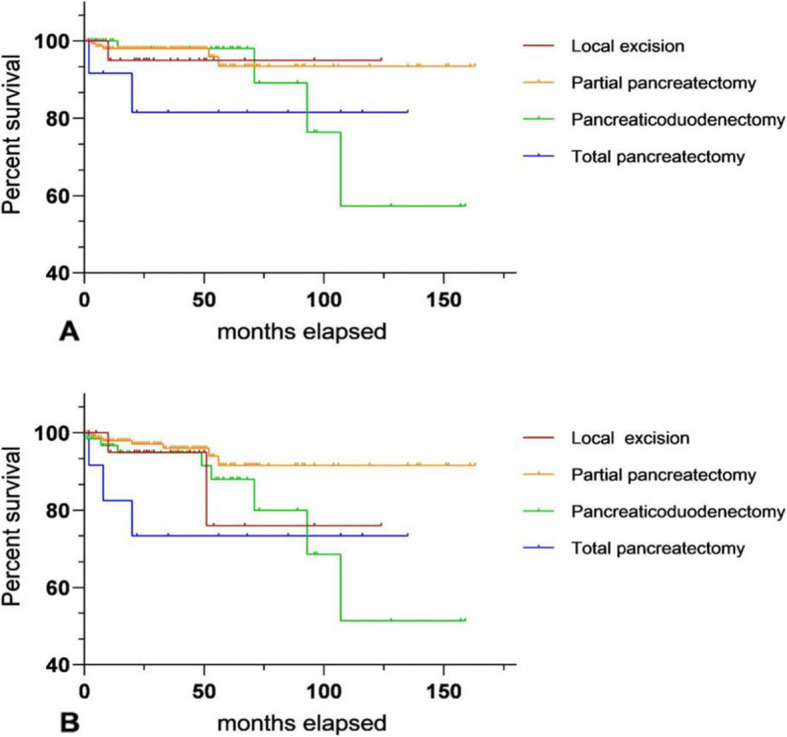
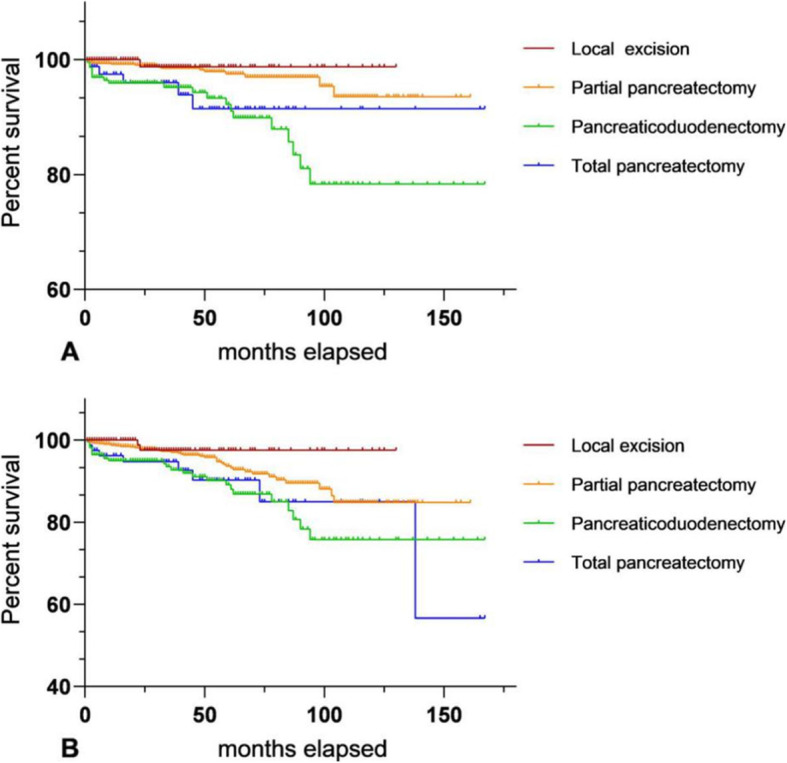
This study found that female, cases diagnosed after 2010, and pancreatic body/tail tumors were protective factors for good survival, while histological grade G3, a larger tumor size, distant metastasis, AJCC 8th stage III-IV and age over 60 were independent prognostic factors for a worse OS/CSS. For the pNETs that were well-differentiated (G1) and had a tumor diameter ≤ 4 cm, the type of surgery was an independent factor for the long-term prognosis of this group. Compared with pancreaticoduodenectomy and total pancreatectomy, patients who were accepted enucleation had better OS/CSS.
For pNETs patients undergoing surgical resection, sex, year of diagnosis, tumor location, pathological grade, tumor size, distant metastasis, race, and age were independent prognostic factors associated with the OS/CSS of patients. For pNETs patients with G1 and a tumor diameter less than 4 cm, if the tumor was located over 3 mm from the pancreatic duct, enucleation may be a wise choice.
探讨胰腺神经内分泌肿瘤(pNETs)患者手术后的预后因素,并分析对于无远处转移、分化良好(G1)且直径≤4cm 的 pNETs 行剜除术的价值。
从 SEER 数据库中收集了 2004 年至 2017 年间接受手术切除的 pNET 患者的数据。采用 Kaplan-Meier 分析和对数秩检验进行生存比较。使用单因素和多因素 Cox 回归模型计算调整后的 HR 及其 95%CI,以评估预后因素。P<0.05 为统计学显著差异。
本研究发现,女性、2010 年后诊断的病例以及胰腺体/尾部肿瘤是良好生存的保护因素,而组织学分级 G3、肿瘤较大、远处转移、AJCC 第 8 版分期 III-IV 期和年龄大于 60 岁是总生存/无进展生存期(CSS)较差的独立预后因素。对于分化良好(G1)且肿瘤直径≤4cm 的 pNETs,手术类型是该组患者长期预后的独立因素。与胰十二指肠切除术和全胰切除术相比,接受剜除术的患者具有更好的 OS/CSS。
对于接受手术切除的 pNETs 患者,性别、诊断年份、肿瘤位置、病理分级、肿瘤大小、远处转移、种族和年龄是与 OS/CSS 相关的独立预后因素。对于 G1 且肿瘤直径小于 4cm 的 pNETs 患者,如果肿瘤距离胰管超过 3mm,剜除术可能是明智的选择。