Cho Do-Yeon, Skinner Daniel, Zhang Shaoyan, Lazrak Ahmed, Lim Dong Jin, Weeks Christopher G, Banks Catherine G, Han Chang Kyun, Kim Si-Kwan, Tearney Guillermo J, Matalon Sadis, Rowe Steven M, Woodworth Bradford A
Department of Otolaryngology Head & Neck Surgery, University of Alabama at Birmingham, Birmingham, Alabama, United States.
Gregory Fleming James Cystic Fibrosis Research Center, University of Alabama at Birmingham, Birmingham, Alabama, United States.
J Ginseng Res. 2021 Jan;45(1):66-74. doi: 10.1016/j.jgr.2019.09.001. Epub 2019 Sep 13.
Abnormal chloride (Cl) transport has a detrimental impact on mucociliary clearance in both cystic fibrosis (CF) and non-CF chronic rhinosinusitis. Ginseng is a medicinal plant noted to have anti-inflammatory and antimicrobial properties. The present study aims to assess the capability of red ginseng aqueous extract (RGAE) to promote transepithelial Cl secretion in nasal epithelium.
Primary murine nasal septal epithelial (MNSE) [wild-type (WT) and transgenic CFTR], fisher-rat-thyroid (FRT) cells expressing human WT CFTR, and TMEM16A-expressing human embryonic kidney cultures were utilized for the present experiments. Ciliary beat frequency (CBF) and airway surface liquid (ASL) depth measurements were performed using micro-optical coherence tomography (μOCT). Mechanisms underlying transepithelial Cl transport were determined using pharmacologic manipulation in Ussing chambers and whole-cell patch clamp analysis.
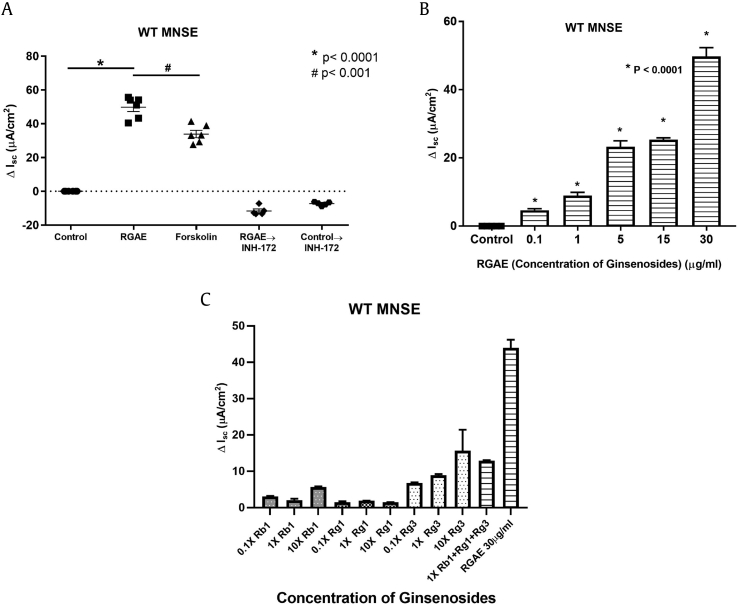
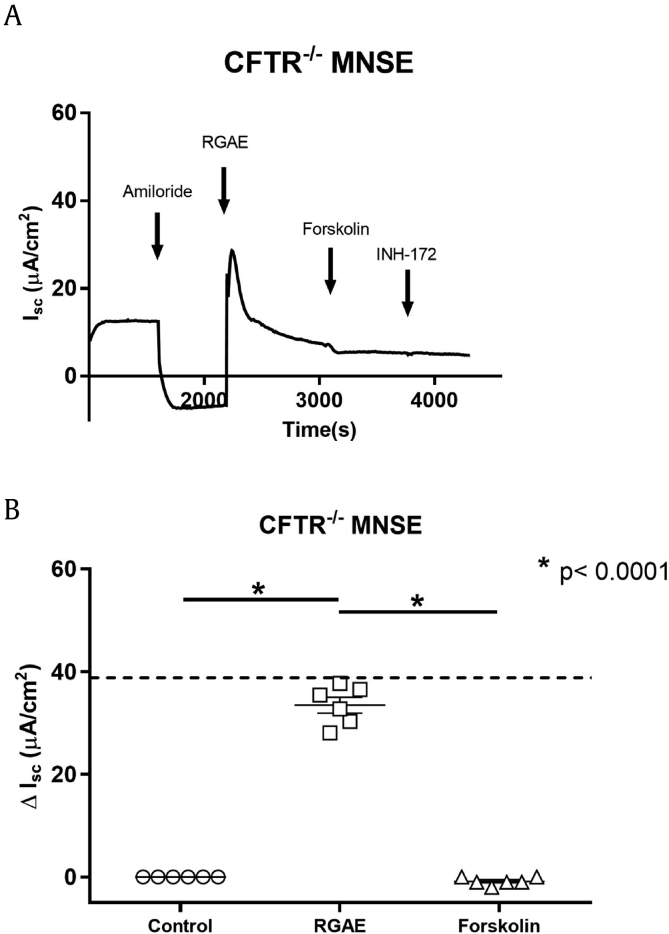
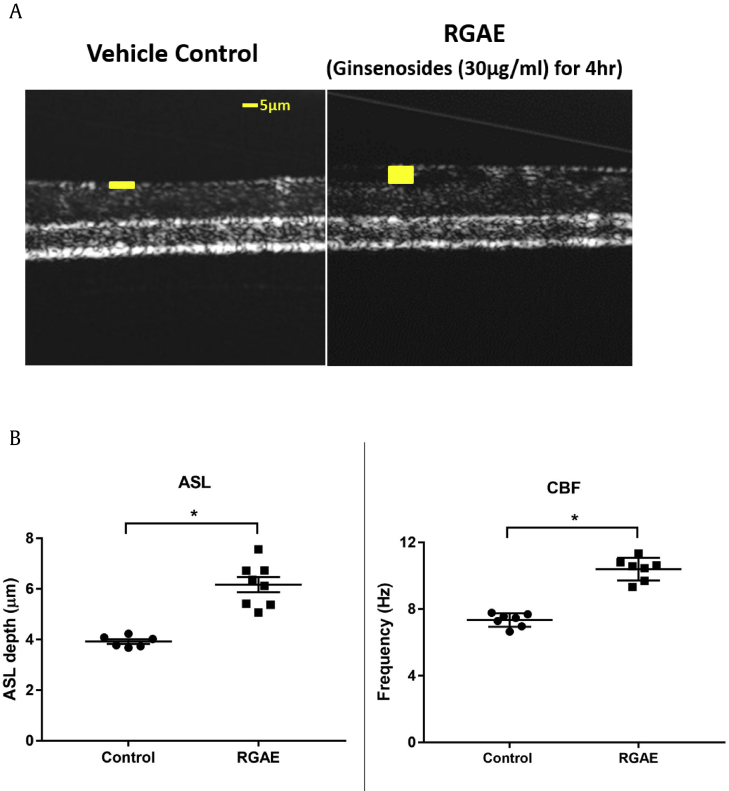
RGAE (at 30μg/mL of ginsenosides) significantly increased Cl transport [measured as change in short-circuit current (ΔI = μA/cm)] when compared with control in WT and CFTR MNSE (WT vs control = 49.8±2.6 vs 0.1+/-0.2, CFTR = 33.5±1.5 vs 0.2±0.3, p < 0.0001). In FRT cells, the CFTR-mediated ΔI attributed to RGAE was small (6.8 ± 2.5 vs control, 0.03 ± 0.01, p < 0.05). In patch clamp, TMEM16A-mediated currents were markedly improved with co-administration of RGAE and uridine 5-triphosphate (8406.3 +/- 807.7 pA) over uridine 5-triphosphate (3524.1 +/- 292.4 pA) or RGAE alone (465.2 +/- 90.7 pA) (p < 0.0001). ASL and CBF were significantly greater with RGAE (6.2+/-0.3 m vs control, 3.9+/-0.09 m; 10.4+/-0.3 Hz vs control, 7.3 ± 0.2 Hz; < 0.0001) in MNSE.
RGAE augments ASL depth and CBF by stimulating Cl secretion through CaCC, which suggests therapeutic potential in both CF and non-CF chronic rhinosinusitis.
异常的氯离子(Cl)转运对囊性纤维化(CF)和非CF慢性鼻-鼻窦炎的黏液纤毛清除功能有不利影响。人参是一种具有抗炎和抗菌特性的药用植物。本研究旨在评估红参水提取物(RGAE)促进鼻上皮细胞跨上皮Cl分泌的能力。
本实验使用原代小鼠鼻中隔上皮细胞(MNSE)[野生型(WT)和转基因CFTR]、表达人WT CFTR的Fisher大鼠甲状腺(FRT)细胞以及表达TMEM16A的人胚肾培养物。使用微光学相干断层扫描(μOCT)测量纤毛摆动频率(CBF)和气道表面液体(ASL)深度。通过在尤斯灌流小室中进行药理学操作和全细胞膜片钳分析来确定跨上皮Cl转运的机制。
与WT和CFTR MNSE中的对照组相比,RGAE(人参皂苷浓度为30μg/mL)显著增加了Cl转运[以短路电流变化(ΔI = μA/cm)衡量](WT组与对照组相比:49.8±2.6对0.1±0.2,CFTR组:33.5±1.5对0.2±0.3,p < 0.0001)。在FRT细胞中,RGAE引起的CFTR介导的ΔI较小(6.8±2.5对对照组0.03±0.01,p < 0.05)。在膜片钳实验中,RGAE与尿苷5-三磷酸共同给药时,TMEM16A介导的电流明显改善(8406.3±807.7 pA),优于单独使用尿苷5-三磷酸(3524.1±292.4 pA)或RGAE(465.2±90.7 pA)(p < 0.0001)。在MNSE中,RGAE处理后ASL和CBF显著增加(ASL:6.2±0.3 m对对照组3.9±0.09 m;CBF:10.4±0.3 Hz对对照组7.3±0.2 Hz;p < 0.0001)。
RGAE通过刺激CaCC促进Cl分泌,从而增加ASL深度和CBF,这表明其在CF和非CF慢性鼻-鼻窦炎中均具有治疗潜力。