Kidney Research Institute, Division of Nephrology, University of Washington, Seattle.
Division of Nephrology, University of Washington, Seattle.
JAMA Netw Open. 2021 Jan 4;4(1):e2034004. doi: 10.1001/jamanetworkopen.2020.34004.
Kidney transplant is associated with improved survival and quality of life among patients with kidney failure; however, significant racial disparities have been noted in transplant access. Common equations that estimate glomerular filtration rate (eGFR) include adjustment for Black race; however, how inclusion of the race coefficient in common eGFR equations corresponds with measured GFR and whether it is associated with delayed eligibility for kidney transplant listing are unknown.
To compare eGFR with measured GFR and evaluate the association between eGFR calculated with vs without a coefficient for race and time to eligibility for kidney transplant.
DESIGN, SETTING, AND PARTICIPANTS: This prospective cohort study used data from the Chronic Renal Insufficiency Cohort, a multicenter cohort study of participants with chronic kidney disease (CKD). Self-identified Black participants from that study were enrolled between April 2003 and September 2008, with follow-up through December 2018. Statistical analyses were completed on November 11, 2020.
Estimated GFR, measured annually and estimated using the creatinine-based Chronic Kidney Disease-Epidemiology (CKD-EPI) equation with and without a race coefficient.
Iothalamate GFR (iGFR) measured in a subset of participants (n = 311) and time to achievement of an eGFR less than 20 mL/min/1.73 m2, an established threshold for kidney transplant referral and listing.
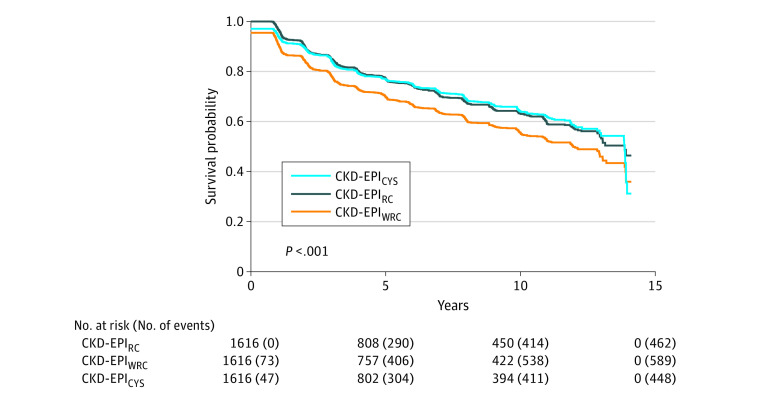
Among 1658 self-identified Black participants, mean (SD) age was 58 (11) years, 848 (51%) were female, and mean (SD) eGFR was 44 (15) mL/min/1.73 m2. The CKD-EPI eGFR with the race coefficient overestimated iGFR by a mean of 3.1 mL/min/1.73 m2 (95% CI, 2.2-3.9 mL/min/1.73 m2; P < .001). The mean difference between CKD-EPI eGFR without the race coefficient and iGFR was of smaller magnitude (-1.7 mL/min/1.73 m2; 95% CI, -2.5 to -0.9 mL/min/1.73 m2). For participants with an iGFR of 20 to 25 mL/min/1.73 m2, the mean difference in eGFR with vs without the race coefficient and iGFR was 5.1 mL/min/1.73 m2 (95% CI, 3.3-6.9 mL/min/1.73 m2) vs 1.3 mL/min/1.73 m2 (95% CI, -0.3 to 2.9 mL/min/1.73 m2). Over a median follow-up time of 4 years (interquartile range, 1-10 years), use of eGFR calculated without vs with the race coefficient was associated with a 35% (95% CI, 29%-41%) higher risk of achieving an eGFR less than 20 mL/min/1.73 m2 and a shorter median time to this end point of 1.9 years.
In this cohort study, inclusion of the race coefficient in the estimation of GFR was associated with greater bias in GFR estimation and with delayed achievement of a clinical threshold for kidney transplant referral and eligibility. These findings suggest that nephrologists and transplant programs should be cautious when using current estimating equations to determine kidney transplant eligibility.
肾移植可改善肾衰竭患者的生存和生活质量;然而,在移植机会方面存在显著的种族差异。常用的肾小球滤过率(eGFR)估算方程包括对黑种人的调整;然而,在常见 eGFR 方程中包含种族系数与测量肾小球滤过率的对应关系,以及它是否与延迟获得肾脏移植资格有关尚不清楚。
比较 eGFR 与测量肾小球滤过率,并评估使用种族系数和不使用种族系数计算 eGFR 与获得肾脏移植资格时间之间的关系。
设计、地点和参与者:这项前瞻性队列研究使用了慢性肾功能不全队列(一项多中心慢性肾脏病患者队列研究)的数据。该研究中的自我认定为黑人的参与者于 2003 年 4 月至 2008 年 9 月期间入组,随访至 2018 年 12 月。统计分析于 2020 年 11 月 11 日完成。
估计肾小球滤过率,每年测量一次,并使用基于肌酐的慢性肾脏病-流行病学(CKD-EPI)方程进行估计,包括和不包括种族系数。
在一部分参与者(n=311)中测量碘海醇肾小球滤过率(iGFR),并评估达到 eGFR 低于 20 mL/min/1.73 m2 的时间,这是肾脏移植转诊和资格的既定阈值。
在 1658 名自我认定为黑人的参与者中,平均(SD)年龄为 58(11)岁,848 名(51%)为女性,平均(SD)eGFR 为 44(15)mL/min/1.73 m2。包含种族系数的 CKD-EPI eGFR 高估了 iGFR,平均高出 3.1 mL/min/1.73 m2(95%CI,2.2-3.9 mL/min/1.73 m2;P<0.001)。不包含种族系数的 CKD-EPI eGFR 与 iGFR 的平均差值较小(-1.7 mL/min/1.73 m2;95%CI,-2.5 至-0.9 mL/min/1.73 m2)。对于 iGFR 在 20 至 25 mL/min/1.73 m2 的参与者,使用种族系数与不使用种族系数和 iGFR 的 eGFR 之间的平均差值为 5.1 mL/min/1.73 m2(95%CI,3.3-6.9 mL/min/1.73 m2)与 1.3 mL/min/1.73 m2(95%CI,-0.3 至 2.9 mL/min/1.73 m2)。在中位数为 4 年(四分位距,1-10 年)的中位随访期间,与不使用种族系数相比,使用计算 eGFR 时使用种族系数与达到 eGFR 低于 20 mL/min/1.73 m2 的风险增加 35%(95%CI,29%-41%),达到该终点的中位时间提前 1.9 年。
在这项队列研究中,在肾小球滤过率的估计中包含种族系数与肾小球滤过率估计的偏差更大,并与延迟达到肾脏移植转诊和资格的临床阈值有关。这些发现表明,肾病学家和移植项目在使用当前估算方程来确定肾脏移植资格时应谨慎。
