Robinson Claire M, Talty Aaron, Logue Susan E, Mnich Katarzyna, Gorman Adrienne M, Samali Afshin
Apoptosis Research Centre, School of Natural Sciences, National University of Ireland, H91 W2TY Galway, Ireland.
Department of Human Anatomy and Cell Science, Rady Faculty of Health Sciences, Max Rady College of Medicine, University of Manitoba, Winnipeg, MB R3E 0J9, Canada.
Cancers (Basel). 2021 Jan 12;13(2):261. doi: 10.3390/cancers13020261.
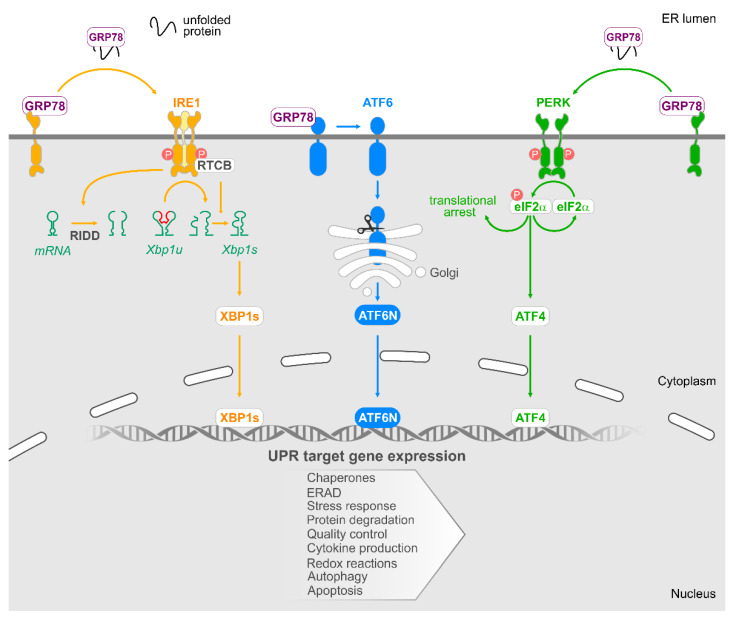
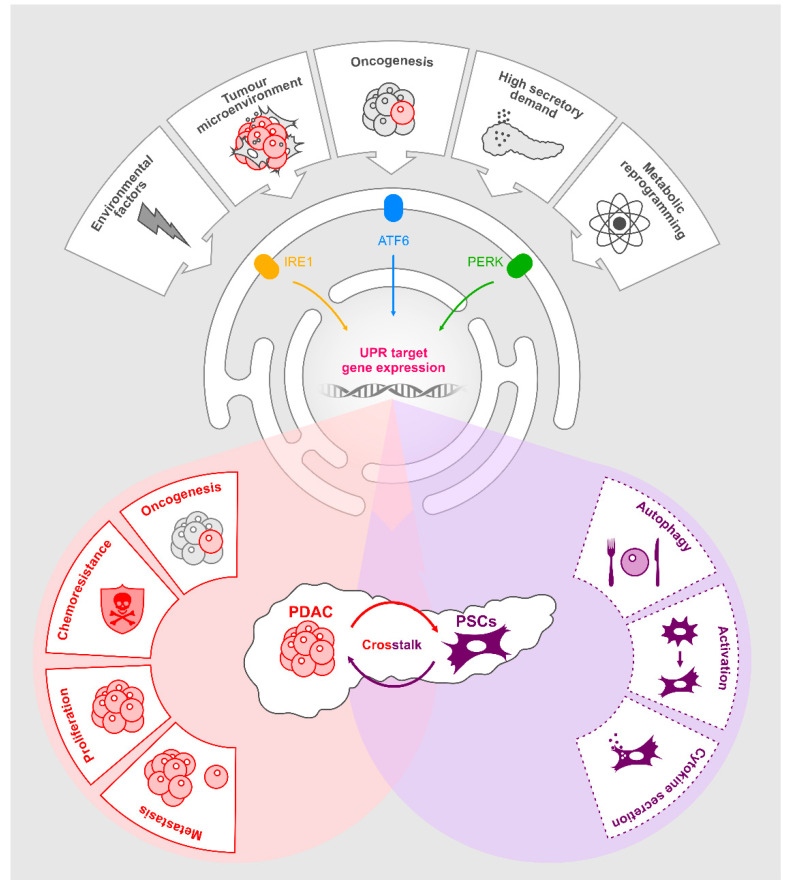
Pancreatic ductal adenocarcinoma (PDAC) is the most common form of pancreatic cancer and one of the leading causes of cancer-associated deaths in the world. It is characterised by dismal response rates to conventional therapies. A major challenge in treatment strategies for PDAC is the presence of a dense stroma that surrounds the tumour cells, shielding them from treatment. This unique tumour microenvironment is fuelled by paracrine signalling between pancreatic cancer cells and supporting stromal cell types including the pancreatic stellate cells (PSC). While our molecular understanding of PDAC is improving, there remains a vital need to develop effective, targeted treatments. The unfolded protein response (UPR) is an elaborate signalling network that governs the cellular response to perturbed protein homeostasis in the endoplasmic reticulum (ER) lumen. There is growing evidence that the UPR is constitutively active in PDAC and may contribute to the disease progression and the acquisition of resistance to therapy. Given the importance of the tumour microenvironment and cytokine signalling in PDAC, and an emerging role for the UPR in shaping the tumour microenvironment and in the regulation of cytokines in other cancer types, this review explores the importance of the UPR in PDAC biology and its potential as a therapeutic target in this disease.
胰腺导管腺癌(PDAC)是胰腺癌最常见的形式,也是全球癌症相关死亡的主要原因之一。其特点是对传统疗法的反应率很低。PDAC治疗策略的一个主要挑战是肿瘤细胞周围存在致密的基质,使其免受治疗。这种独特的肿瘤微环境是由胰腺癌细胞与包括胰腺星状细胞(PSC)在内的支持性基质细胞类型之间的旁分泌信号驱动的。虽然我们对PDAC的分子理解正在提高,但仍然迫切需要开发有效的靶向治疗方法。未折叠蛋白反应(UPR)是一个复杂的信号网络,它控制细胞对内质网(ER)腔内蛋白质稳态受到干扰的反应。越来越多的证据表明,UPR在PDAC中持续活跃,可能促进疾病进展并导致对治疗产生耐药性。鉴于肿瘤微环境和细胞因子信号在PDAC中的重要性,以及UPR在塑造肿瘤微环境和调节其他癌症类型中的细胞因子方面的新作用,本综述探讨了UPR在PDAC生物学中的重要性及其作为该疾病治疗靶点的潜力。