Department of Gynecology, Obstetrics and Gynecology Hospital, Fudan University, No.419, Fangxie Road, Shanghai, 200011, China.
Shanghai Key Laboratory of Female Reproductive Endocrine Related Diseases, Shanghai, 200011, China.
BMC Cancer. 2021 Jan 14;21(1):67. doi: 10.1186/s12885-021-07785-w.
The role of nicotinamide N-methyltransferase (NNMT) in ovarian cancer is still elusive. Our aim is to explore the expression of NNMT in ovarian cancer and to assess its association with patient prognosis and treatment response.
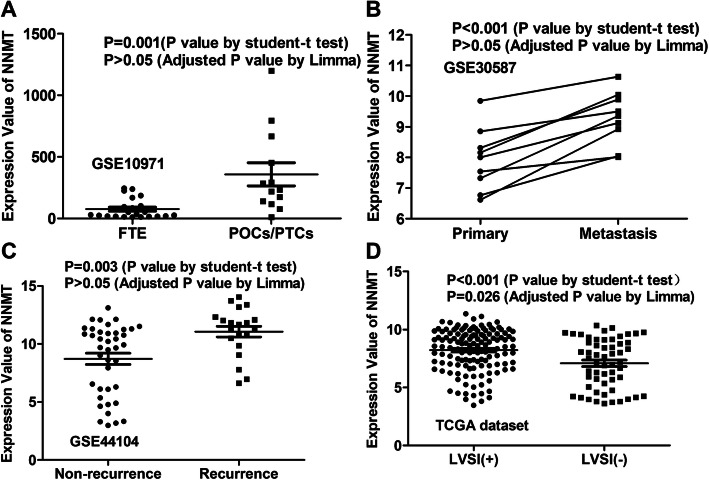
We first analyzed the differential expression of NNMT among fallopian tube epithelium, primary ovarian cancers, metastatic ovarian cancers, and recurrent ovarian cancers using Gene Expression Ominus (GEO) database (GSE10971, GSE30587, GSE44104 and TCGA datasets). Then, we assessed the association of NNMT expression with clinical and molecular parameters using CSIOVDB database and GSE28739 dataset. Next, we evaluate the association of NNMT expression with the prognosis of ovarian cancer patients in both GSE9891 dataset and TCGA dataset. Finally, GSE140082 dataset was used to explore the association of NNMT expression with bevacizumab response.
NNMT expression was significantly elevated in lymphovascular space invasion (LVSI)-positive ovarian cancers compared with that in LVSI-negative ovarian cancers (TCGA dataset, P < 0.05), Moreover, increased expression of NNMT was associated with increased tumor stage, grade, and mesenchymal molecular subtype (CSIOVDB database). Survival analysis indicated that increased expression of NNMT was associated with a reduced OS in both GSE9891 dataset (HR: 2.28, 95%CI: 1.51-3.43, Log-rank P < 0.001) and TCGA dataset (HR: 1.55, 95%CI: 1.02-2.36, Log-rank P = 0.039). Multivariate analysis further confirmed the negative impact of NNMT expression on OS in ovarian cancer patients in those two datasets. Furthermore, the NNMT-related nomogram showed that NNMT shared a larger contribution to OS, compared with debulking status. More interestingly, bevacizumab conferred significant improvements in OS for patients with low NNMT expression (HR: 0.56, 95%CI: 0.31-0.99, Log-rank P = 0.049). In contrast, patients with high NNMT expression didn't benefit from bevacizumab treatment significantly (HR: 0.85, 95%CI: 0.48-1.49, Log-rank P = 0.561). NNMT expression was positively correlated with the expression of genes, LDHA and PGAM1, involved in Warburg effect.
In conclusion, NNMT expression is associated with the aggressive behavior of ovarian cancer, correlates with a poor prognosis, and is predictive of sensitivity to bevacizumab treatment.
烟酰胺 N-甲基转移酶(NNMT)在卵巢癌中的作用仍不清楚。我们的目的是探讨 NNMT 在卵巢癌中的表达,并评估其与患者预后和治疗反应的关系。
我们首先使用基因表达 Omnibus(GEO)数据库(GSE10971、GSE30587、GSE44104 和 TCGA 数据集)分析 NNMT 在输卵管上皮、原发性卵巢癌、转移性卵巢癌和复发性卵巢癌中的差异表达。然后,我们使用 CSIOVDB 数据库和 GSE28739 数据集评估 NNMT 表达与临床和分子参数的关联。接下来,我们在 GSE9891 数据集和 TCGA 数据集中评估 NNMT 表达与卵巢癌患者预后的关系。最后,使用 GSE140082 数据集探讨 NNMT 表达与贝伐单抗反应的关系。
与 LVSI 阴性卵巢癌相比,NNMT 在 LVSI 阳性卵巢癌中的表达显著升高(TCGA 数据集,P<0.05)。此外,NNMT 表达的增加与肿瘤分期、分级和间质分子亚型增加有关(CSIOVDB 数据库)。生存分析表明,在 GSE9891 数据集(HR:2.28,95%CI:1.51-3.43,对数秩 P<0.001)和 TCGA 数据集(HR:1.55,95%CI:1.02-2.36,对数秩 P=0.039)中,NNMT 表达的增加与 OS 降低相关。多变量分析进一步证实了 NNMT 表达对这两个数据集卵巢癌患者 OS 的负面影响。此外,NNMT 相关列线图显示,与减瘤状态相比,NNMT 对 OS 的影响更大。更有趣的是,对于低 NNMT 表达的患者,贝伐单抗显著改善了 OS(HR:0.56,95%CI:0.31-0.99,对数秩 P=0.049)。相比之下,高 NNMT 表达的患者并未从贝伐单抗治疗中显著获益(HR:0.85,95%CI:0.48-1.49,对数秩 P=0.561)。NNMT 表达与参与瓦伯格效应的基因 LDHA 和 PGAM1 的表达呈正相关。
总之,NNMT 表达与卵巢癌的侵袭性行为有关,与不良预后相关,并预测对贝伐单抗治疗的敏感性。