Manzar Md Dilshad, Salahuddin Mohammed, Pandi-Perumal Seithikurippu R, Bahammam Ahmed S
Department of Nursing, College of Applied Medical Sciences, Majmaah University, Al Majmaah 11952, Saudi Arabia.
Department of Pharmacy, College of Medicine and Health Sciences, Mizan-Tepi University (Mizan Campus), Mizan-Aman, Ethiopia.
Nat Sci Sleep. 2021 Jan 8;13:31-38. doi: 10.2147/NSS.S278988. eCollection 2021.
High perceived stress and anxiety disorders are usually comorbid with each other, with stress often sequentially preceding the development of anxiety. While prior findings showed a causal role of sleep problems in anxiety, no study has assessed the role of insomnia as a mediator in the relationship between stress and anxiety.
A cross-sectional study on university students (n = 475, age = 21.1+2.6 years) was conducted over 3 months. Participants completed self-report measures of Leeds Sleep Evaluation Questionnaire-Mizan (LSEQ-M), Perceived Stress Scale-10 (PSS-10), generalized anxiety disorder-7 scale (GAD-7), and a sociodemographic tool. The mediation effect model given by Baron and Kelly was used to determine the relationship.
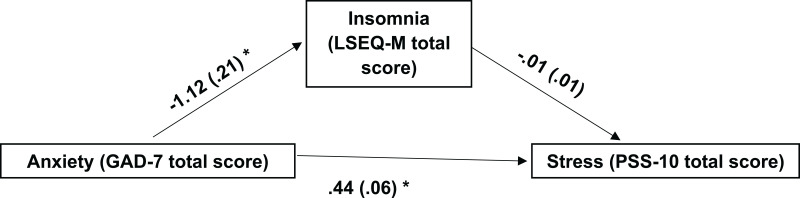
The prevalence of insomnia and anxiety disorder was 43.6% and 21.9%, respectively. Stress was significantly associated with LSEQ-M (insomnia measure) (b = -.44, SE = 0.16, p<0.01), and high levels of anxiety (b = 0.25, SE = 0.03, p < 0.01). The indirect effect of stress on anxiety through LSEQ-M (insomnia measure) was significant (95% confidence interval [0.01, 0.04]). However, the indirect effect of anxiety on stress through LSEQ-M (insomnia measure) was non-significant (95% confidence interval [-.01, 0.04]).
Students having higher perceived stress levels and comorbid insomnia were also likely to have a higher anxiety level.
高感知压力与焦虑症通常相互并存,压力往往在焦虑症发生之前就已出现。虽然先前的研究结果显示睡眠问题在焦虑症中具有因果作用,但尚无研究评估失眠在压力与焦虑关系中作为中介因素的作用。
对大学生(n = 475,年龄 = 21.1±2.6岁)进行了为期3个月的横断面研究。参与者完成了利兹睡眠评估问卷 - 米赞(LSEQ - M)、感知压力量表 - 10(PSS - 10)、广泛性焦虑症 - 7量表(GAD - 7)的自我报告测量以及一份社会人口统计学工具。采用Baron和Kelly给出的中介效应模型来确定两者关系。
失眠症和焦虑症的患病率分别为43.6%和21.9%。压力与LSEQ - M(失眠测量指标)显著相关(b = -0.44,标准误 = 0.16,p < 0.01),与高水平焦虑也显著相关(b = 0.25,标准误 = 0.03,p < 0.01)。压力通过LSEQ - M(失眠测量指标)对焦虑的间接效应显著(95%置信区间[0.01, 0.04])。然而,焦虑通过LSEQ - M(失眠测量指标)对压力的间接效应不显著(95%置信区间[-0.01, 0.04])。
感知压力水平较高且合并失眠的学生也可能有较高的焦虑水平。