Laboratory of Pharmacy Practice and Science 1, Division of Clinical Pharmacy, Research and Education Center for Clinical Pharmacy, Kitasato University School of Pharmacy, Kanagawa, Japan.
Department of Endocrinology and Diabetes, School of Medicine, Saitama Medical University, Saitama, Japan.
J Diabetes Investig. 2021 Sep;12(9):1586-1593. doi: 10.1111/jdi.13506. Epub 2021 Feb 16.
AIMS/INTRODUCTION: This study aimed to investigate the risk of diabetic ketoacidosis (DKA) in insulin-treated type 1 diabetes patients administered sodium-glucose cotransporter 2 (SGLT2) inhibitors in real-world clinical practice.
We carried out a real-world, retrospective, observational cohort study using Japanese Medical Data Vision, a diagnosis procedure combination database. We identified insulin-treated adult type 1 diabetes patients enrolled from December 2018 to October 2019. We assessed the incidence and risk of DKA in type 1 diabetes patients using SGLT2 inhibitors in an 'on-label' manner. Cox multivariate regression analyses were carried out to determine clinical factors linked to SGLT2 inhibitor-associated DKA.
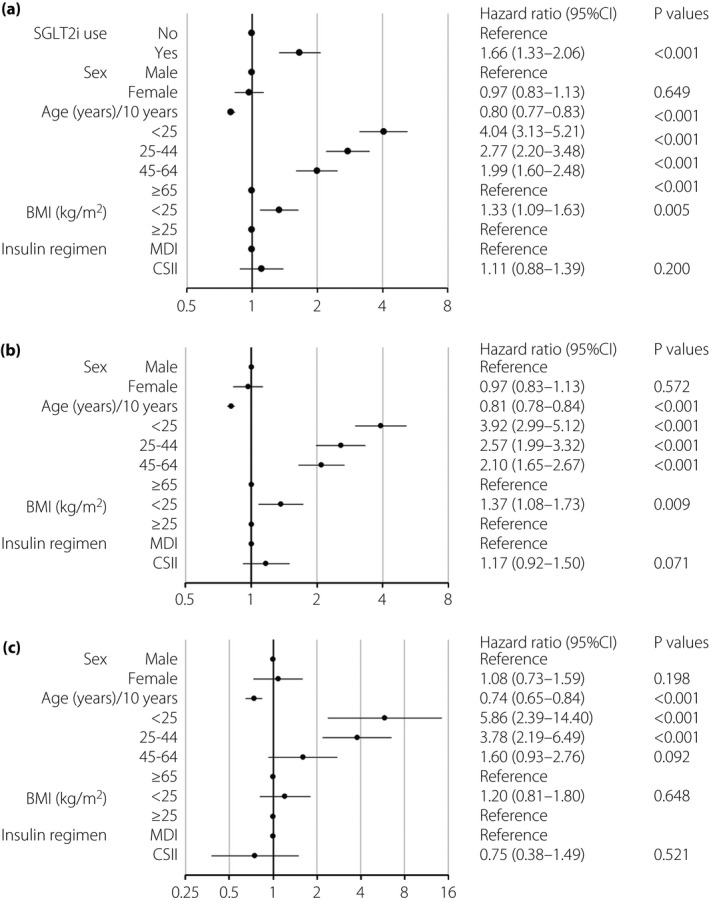
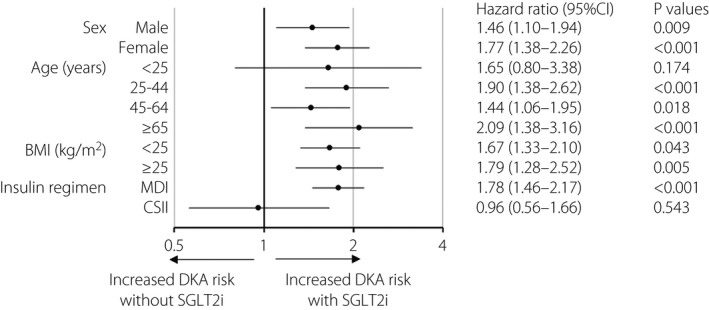
Of 11,475 type 1 diabetes patients, 1,898 (16.5%) were prescribed SGLT2 inhibitors. DKA occurred in 139 (7.3%) of these patients, with 20.2 incidences per 100 person-years. These patients also showed significantly higher DKA rates than did those not receiving SGLT2 inhibitors (hazard ratio 1.66, 95% confidence interval 1.33-2.06; P < 0.001). The mean time until DKA onset in SGLT2 inhibitor-treated type 1 diabetes patients was 30.6 ± 30.1 days. The risk of SGLT2 inhibitor-associated DKA increased in type 1 diabetes patients irrespective of sex, age or body mass index. However, the risk did not increase in type 1 diabetes patients receiving continuous subcutaneous insulin infusion, which warrants further investigation because of the small number of type 1 diabetes patients receiving continuous subcutaneous insulin infusion.
'On-label' SGLT2 inhibitor use might increase DKA risk among insulin-treated type 1 diabetes patients irrespective of sex, age or body mass index. Both type 1 diabetes patients and healthcare providers should be wary of DKA, especially during the first month of initiating SGLT2 inhibitors.
目的/引言:本研究旨在探讨在真实临床实践中,接受钠-葡萄糖共转运蛋白 2(SGLT2)抑制剂治疗的 1 型糖尿病患者发生糖尿病酮症酸中毒(DKA)的风险。
我们使用日本医疗数据视觉(Medical Data Vision)进行了一项真实的、回顾性、观察性队列研究,这是一个诊断程序组合数据库。我们确定了 2018 年 12 月至 2019 年 10 月期间接受胰岛素治疗的成年 1 型糖尿病患者。我们评估了 1 型糖尿病患者以“标签内”方式使用 SGLT2 抑制剂的 DKA 发生率和风险。采用 Cox 多变量回归分析确定与 SGLT2 抑制剂相关 DKA 相关的临床因素。
在 11475 例 1 型糖尿病患者中,有 1898 例(16.5%)接受了 SGLT2 抑制剂治疗。其中 139 例(7.3%)患者发生了 DKA,每 100 人年发生 20.2 例。与未接受 SGLT2 抑制剂治疗的患者相比,这些患者的 DKA 发生率明显更高(风险比 1.66,95%置信区间 1.33-2.06;P<0.001)。SGLT2 抑制剂治疗的 1 型糖尿病患者发生 DKA 的平均时间为 30.6±30.1 天。无论性别、年龄或体重指数如何,SGLT2 抑制剂治疗的 1 型糖尿病患者的 SGLT2 抑制剂相关 DKA 风险均增加。然而,在接受连续皮下胰岛素输注的 1 型糖尿病患者中,风险并未增加,这需要进一步研究,因为接受连续皮下胰岛素输注的 1 型糖尿病患者数量较少。
在真实临床实践中,无论性别、年龄或体重指数如何,接受“标签内”SGLT2 抑制剂治疗的 1 型糖尿病患者发生 DKA 的风险可能增加。1 型糖尿病患者和医疗保健提供者都应警惕 DKA,尤其是在开始使用 SGLT2 抑制剂的第一个月。