Department of Neurology, Albert Einstein College of Medicine, Bronx, NY, USA.
Department of Neurology, Montefiore Medical Center, Bronx, NY, USA.
Headache. 2020 Sep;60(8):1683-1696. doi: 10.1111/head.13914. Epub 2020 Aug 16.
To examine the influences of depression and anxiety on headache-related disability in people with episodic migraine or chronic migraine.
Depression and anxiety are common comorbidities in people with migraine, especially among those with chronic migraine.
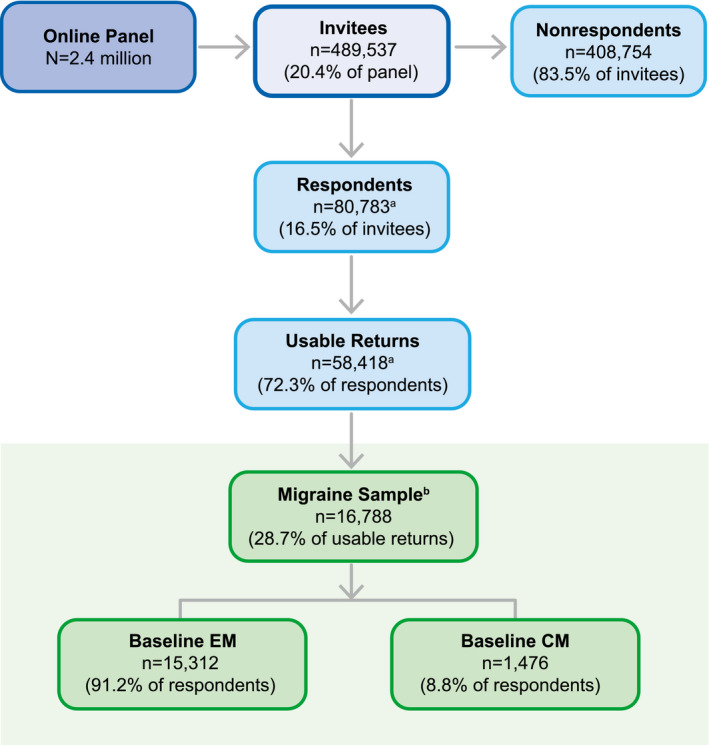
This cross-sectional analysis of data from the longitudinal, internet-based Chronic Migraine Epidemiology and Outcomes Study assessed sociodemographic and headache features, and headache-related disability (Migraine Disability Assessment Scale). Four groups were defined based on scores from validated screeners for depression (9-item Patient Health Questionnaire) and anxiety (7-item Generalized Anxiety Disorder Scale): depression alone, anxiety alone, both, or neither.
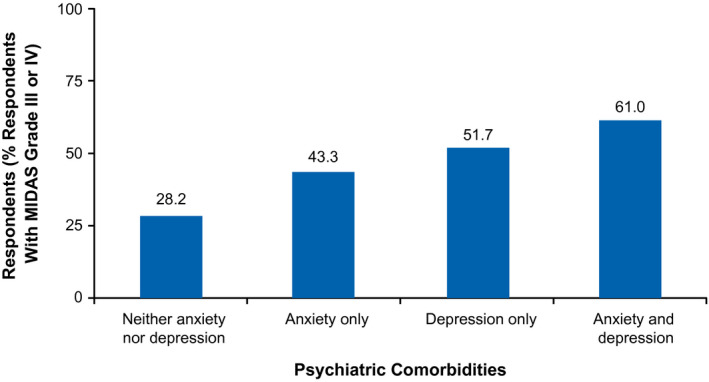
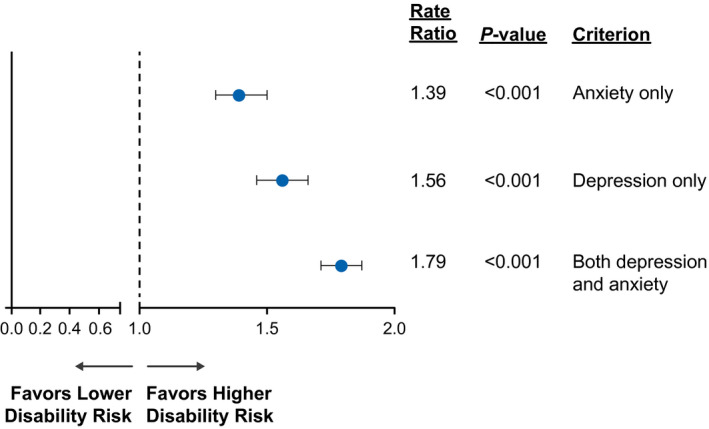
Respondents (N = 16,788) were predominantly women (74.4% [12,494/16,788]) and white (84.0% [14,044/16,788]); mean age was 41 years. Depression was more likely in persons with chronic migraine vs episodic migraine (56.6% [836/1476] vs 30.0% [4589/15,312]; P < .001), as were anxiety (48.4% [715/1476] vs 28.1% 4307/15,312]; P < .001) and coexisting depression and anxiety (42.0% [620/1476] vs 20.8% [3192/15,312]; P < .001). After controlling for headache frequency and other covariates, depression alone, and anxiety alone were associated with 56.0% (rate ratio [RR], 1.56; 95% confidence interval [CI], 1.46-1.66) and 39.0% (RR, 1.39; 95% CI, 1.30-1.50) increased risks of moderate/severe migraine-related disability (both P < .001), respectively; the combination had an even greater effect on risk of moderate/severe disability (79.0% increase; RR, 1.79; 95% CI, 1.71-1.87; P < .001).
Depression alone and anxiety alone are associated with greater headache-related disability after controlling for sociodemographic and headache features. Coexisting depression and anxiety are more strongly associated with disability than either comorbidity in isolation. Interventions targeting depression and anxiety as well as migraine itself may improve headache-related disability in people with migraine.
研究抑郁和焦虑对发作性偏头痛或慢性偏头痛患者头痛相关残疾的影响。
抑郁和焦虑是偏头痛患者的常见共病,尤其是慢性偏头痛患者。
本横断面分析来自纵向、基于互联网的慢性偏头痛流行病学和结局研究的数据,评估了社会人口学和头痛特征,以及头痛相关残疾(偏头痛残疾评估量表)。根据经过验证的抑郁筛查器(9 项患者健康问卷)和焦虑筛查器(7 项广泛性焦虑症量表)的评分,将受访者分为以下 4 组:单纯抑郁、单纯焦虑、两者兼有或两者均无。
受访者(N=16788)主要为女性(74.4%[12494/16788])和白人(84.0%[14044/16788]);平均年龄为 41 岁。与发作性偏头痛相比,慢性偏头痛患者更易发生抑郁(56.6%[836/1476] vs 30.0%[4589/15312];P<.001)和焦虑(48.4%[715/1476] vs 28.1%[4307/15312];P<.001),以及同时存在抑郁和焦虑(42.0%[620/1476] vs 20.8%[3192/15312];P<.001)。在控制头痛频率和其他协变量后,单纯抑郁和单纯焦虑与中度/重度偏头痛相关残疾的风险分别增加 56.0%(RR,1.56;95%CI,1.46-1.66)和 39.0%(RR,1.39;95%CI,1.30-1.50)(均 P<.001);两者同时存在时对中度/重度残疾的风险影响更大(增加 79.0%;RR,1.79;95%CI,1.71-1.87;P<.001)。
在控制社会人口学和头痛特征后,单纯抑郁和单纯焦虑与更大的头痛相关残疾相关。同时存在抑郁和焦虑与单独存在任何一种共病相比,与残疾的相关性更强。针对抑郁和焦虑以及偏头痛本身的干预措施可能会改善偏头痛患者的头痛相关残疾。