Department of Clinical and Experimental Epilepsy, UCL Queen Square Institute of Neurology, London, United Kingdom.
School of Physiology, Pharmacology and Neuroscience, University of Bristol, Bristol, United Kingdom.
Mov Disord. 2021 May;36(5):1158-1169. doi: 10.1002/mds.28479. Epub 2021 Jan 15.
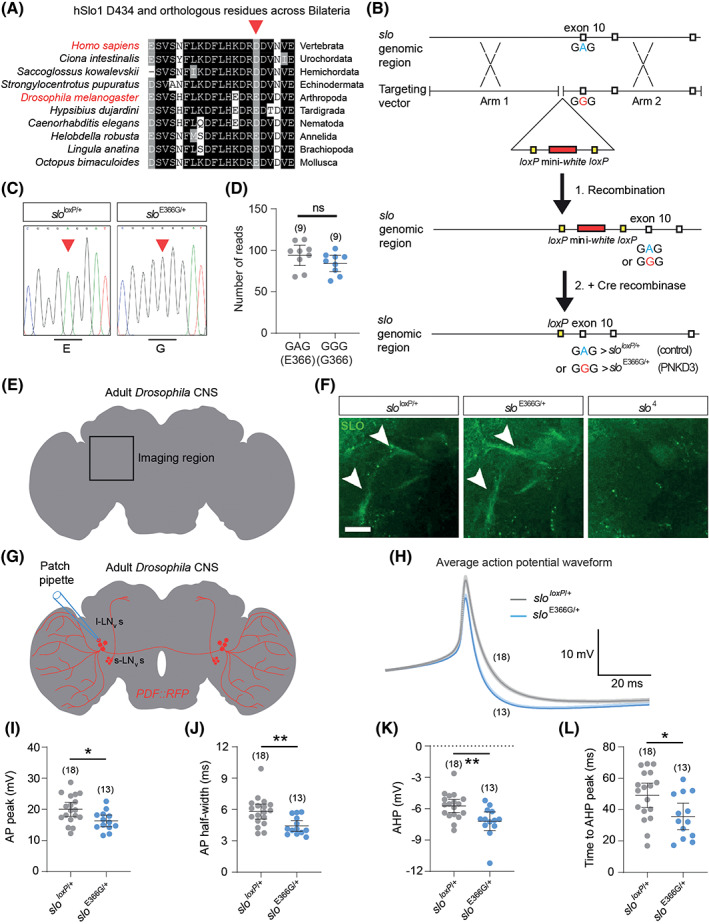
Paroxysmal dyskinesias (PxDs) are characterized by involuntary movements and altered pre-motor circuit activity. Causative mutations provide a means to understand the molecular basis of PxDs. Yet in many cases, animal models harboring corresponding mutations are lacking. Here we utilize the fruit fly, Drosophila, to study a PxD linked to a gain-of-function (GOF) mutation in the KCNMA1/hSlo1 BK potassium channel.
We aimed to recreate the equivalent BK (big potassium) channel mutation in Drosophila. We sought to determine how this mutation altered action potentials (APs) and synaptic release in vivo; to test whether this mutation disrupted pre-motor circuit function and locomotion; and to define neural circuits involved in locomotor disruption.
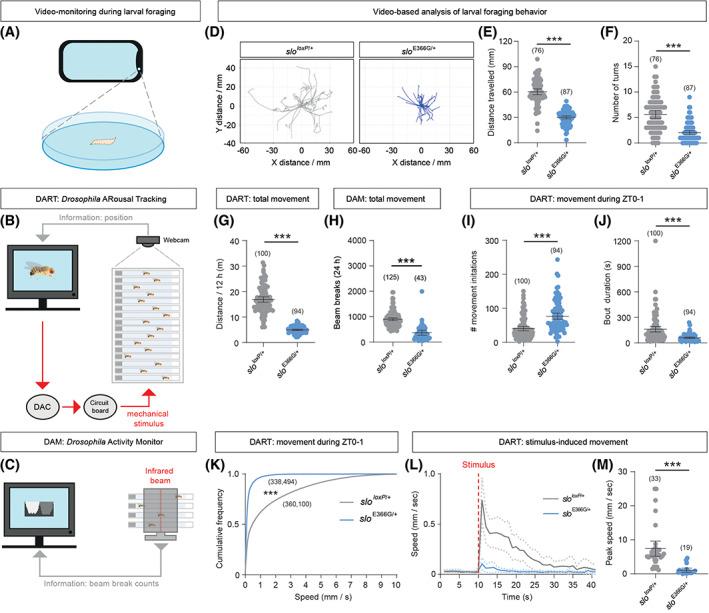
We generated a knock-in Drosophila model using homologous recombination. We used electrophysiological recordings and calcium-imaging to assess AP shape, neurotransmission, and the activity of the larval pre-motor central pattern generator (CPG). We used video-tracking and automated systems to measure movement, and developed a genetic method to limit BK channel expression to defined circuits.
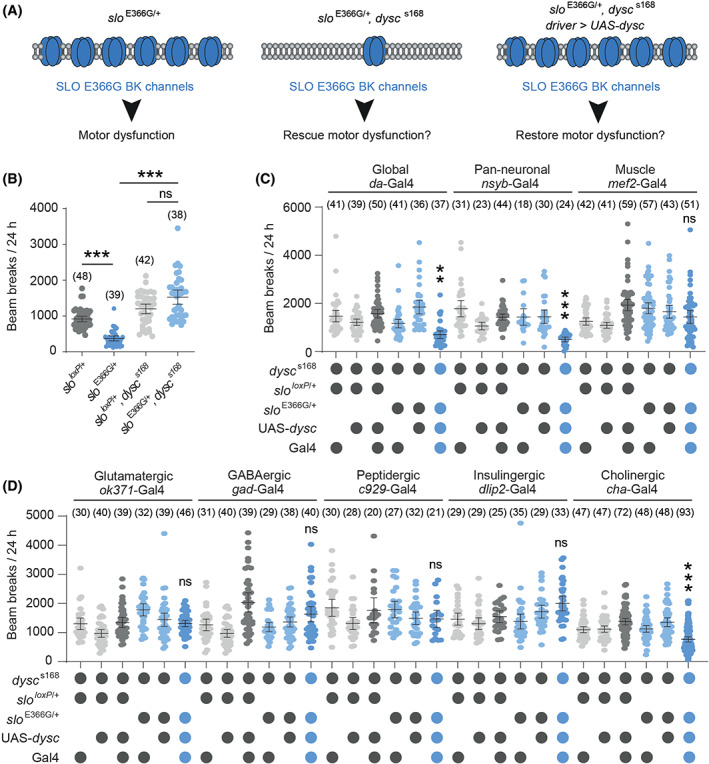
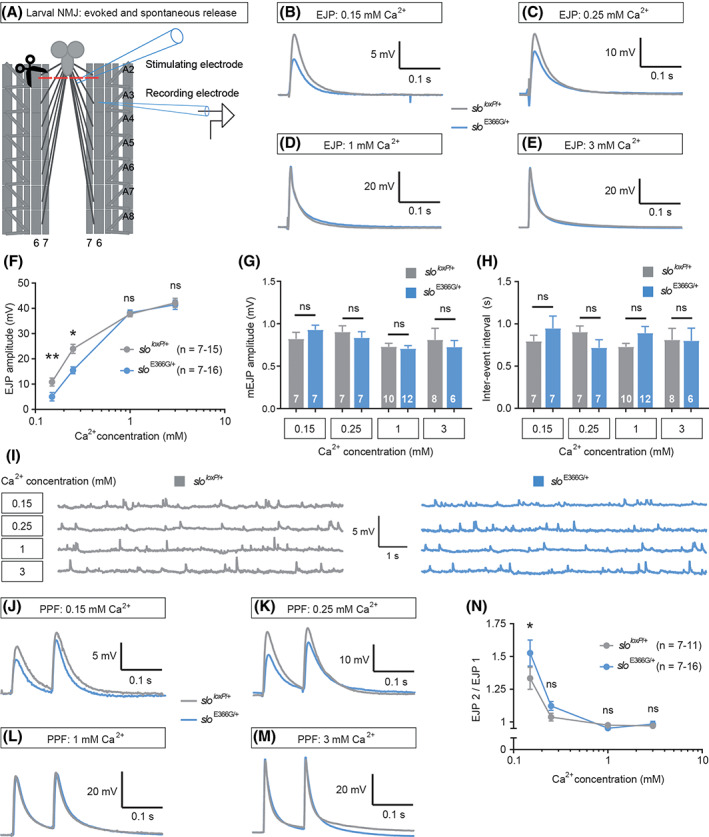
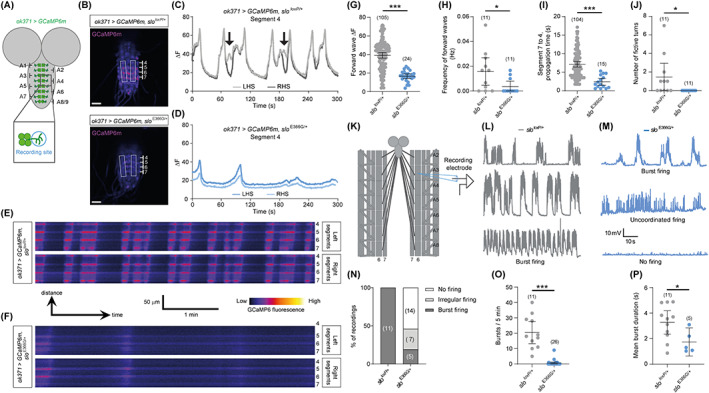
Neuronal APs exhibited reduced width and an enhanced afterhyperpolarization in the PxD model. We identified calcium-dependent reductions in neurotransmitter release, dysfunction of the CPG, and corresponding alterations in movement, in model larvae. Finally, we observed aberrant locomotion and dyskinesia-like movements in adult model flies, and partially mapped the impact of GOF BK channels on movement to cholinergic neurons.
Our model supports a link between BK channel GOF and hyperkinetic movements, and provides a platform to dissect the mechanistic basis of PxDs. © 2021 The Authors. Movement Disorders published by Wiley Periodicals LLC on behalf of International Parkinson and Movement Disorder Society.
阵发性运动障碍(PxDs)的特征是不自主运动和前运动回路活动改变。致病突变提供了理解 PxDs 分子基础的一种手段。然而,在许多情况下,缺乏携带相应突变的动物模型。在这里,我们利用果蝇来研究与 KCNMA1/hSlo1 BK 钾通道功能获得性(GOF)突变相关的 PxD。
我们旨在在果蝇中重现等效的 BK(大钾)通道突变。我们试图确定该突变如何改变体内动作电位(APs)和突触释放;检验该突变是否破坏了前运动回路功能和运动;并定义涉及运动障碍的神经回路。
我们使用同源重组生成了一个 knock-in 果蝇模型。我们使用电生理记录和钙成像来评估 AP 形状、神经传递和幼虫前运动中枢模式发生器(CPG)的活性。我们使用视频跟踪和自动系统来测量运动,并开发了一种遗传方法将 BK 通道表达限制在特定的回路中。
PxD 模型中的神经元 APs 表现出宽度减小和后超极化增强。我们发现钙依赖性神经递质释放减少、CPG 功能障碍以及模型幼虫运动的相应改变。最后,我们观察到成年模型果蝇出现异常运动和运动障碍样运动,并部分将 GOF BK 通道对运动的影响映射到胆碱能神经元上。
我们的模型支持 BK 通道 GOF 与多动运动之间的联系,并提供了一个平台来剖析 PxD 的机制基础。