Exotic and Emerging Avian Viral Diseases Research Unit, Southeast Poultry Research Laboratory, U.S. National Poultry Research Center, USDA-ARS, 934 College Station Road, Athens, GA 30605, USA.
Biotechnology Research Institute, Kenya Agricultural and Livestock Research Organization, Kaptagat Road, Loresho, Nairobi P.O. Box 57811-00200, Kenya.
Viruses. 2021 Jan 13;13(1):103. doi: 10.3390/v13010103.
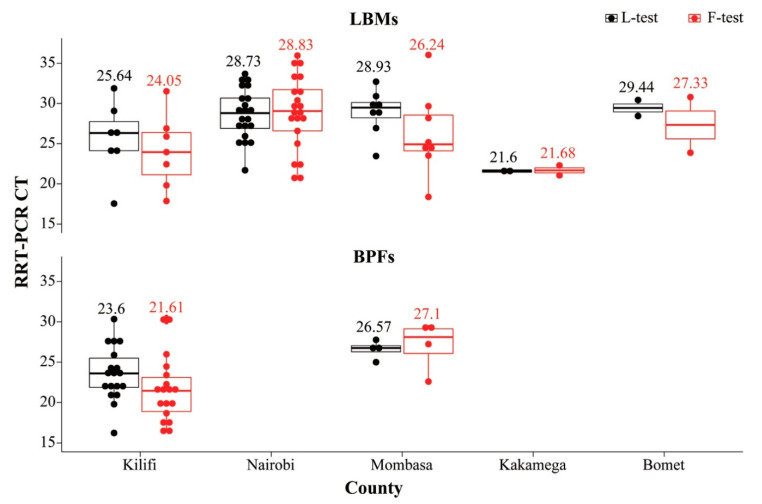
Kenyan poultry consists of 80% free-range indigenous chickens kept in small flocks (30 birds) on backyard poultry farms (BPFs) and they are traded via live bird markets (LBMs). Newcastle disease virus (NDV) was detected in samples collected from chickens, wild farm birds, and other domestic poultry species during a 2017-2018 survey conducted at 66 BPFs and 21 LBMs in nine Kenyan counties. NDV nucleic acids were detected by rRT-PCR L-test in 39.5% (641/1621) of 1621 analyzed samples, of which 9.67% (62/641) were NDV-positive by both the L-test and a fusion-test designed to identify the virulent virus, with a majority being at LBMs (64.5%; 40/62) compared to BPFs (25.5%; 22/62). Virus isolation and next-generation sequencing (NGS) on a subset of samples resulted in 32 complete NDV genome sequences with 95.8-100% nucleotide identities amongst themselves and 95.7-98.2% identity with other east African isolates from 2010-2016. These isolates were classified as a new sub-genotype, V.3, and shared 86.5-88.9% and 88.5-91.8% nucleotide identities with subgenotypes V.1 and V.2 viruses, respectively. The putative fusion protein cleavage site (R-Q-K-R↓F ) in all 32 isolates, and a 1.86 ICPI score of an isolate from a BPF chicken that had clinical signs consistent with Newcastle disease, confirmed the high virulence of the NDVs. Compared to genotypes V and VI viruses, the attachment (HN) protein of 18 of the 32 vNDVs had amino acid substitutions in the antigenic sites. A time-scaled phylogeographic analysis suggests a west-to-east dispersal of the NDVs via the live chicken trade, but the virus origins remain unconfirmed due to scarcity of continuous and systematic surveillance data. This study reveals the widespread prevalence of vNDVs in Kenyan backyard poultry, the central role of LBMs in the dispersal and possibly generation of new virus variants, and the need for robust molecular epidemiological surveillance in poultry and non-poultry avian species.
肯尼亚的家禽主要由 80%左右的本土散养鸡组成,这些鸡被饲养在小型鸡舍(约 30 只鸡)中,分布在庭院农场(BPF)中,通过活禽市场(LBM)进行交易。在 2017-2018 年期间,在肯尼亚的 9 个县的 66 个 BPF 和 21 个 LBM 中进行了一项调查,从鸡、野生农场鸟类和其他家禽物种的样本中检测到了新城疫病毒(NDV)。通过 rRT-PCR L 试验在分析的 1621 个样本中的 39.5%(641/1621)中检测到了 NDV 核酸,其中 9.67%(62/641)通过 L 试验和设计用于鉴定强毒病毒的融合试验均为 NDV 阳性,其中大部分来自 LBM(64.5%;40/62),而不是 BPF(25.5%;22/62)。对部分样本进行病毒分离和下一代测序(NGS)后,得到了 32 个完整的 NDV 基因组序列,它们之间的核苷酸同一性为 95.8-100%,与 2010-2016 年来自东非的其他分离株的核苷酸同一性为 95.7-98.2%。这些分离株被分类为一个新的亚基因组,V.3,与亚基因组 V.1 和 V.2 病毒的核苷酸同一性分别为 86.5-88.9%和 88.5-91.8%。所有 32 个分离株的融合蛋白裂解位点(R-Q-K-R↓F)和 BPF 鸡分离株的 1.86 ICPI 评分均与新城疫的临床症状一致,证实了 NDV 的高毒力。与基因型 V 和 VI 病毒相比,32 个 vNDV 中有 18 个的附着(HN)蛋白在抗原位点发生了氨基酸取代。时间尺度系统发育分析表明,NDV 通过活禽贸易从西向东传播,但由于连续和系统监测数据的缺乏,病毒的起源仍未得到证实。本研究揭示了 vNDV 在肯尼亚庭院家禽中的广泛流行,LBM 在病毒传播和可能产生新病毒变异方面的核心作用,以及在禽和非禽鸟类中进行稳健的分子流行病学监测的必要性。