Department of Psychology, Universidad Loyola Andalucía, Seville, Spain.
Department of Quantitative Methods, Universidad Loyola Andalucía, Seville, Spain.
BMC Psychiatry. 2021 Jan 15;21(1):43. doi: 10.1186/s12888-020-03015-y.
Mental health care systems have been dramatically affected by COVID-19. Containment measures have been imposed, with negative consequences on population mental health. Therefore, an increase in both symptomatology and mental disorder incidence is expected. This research aims to identify, describe and assess the empirical background on online strategies and recommendations developed by international organizations and governments to cope with the psychological impact of COVID-19 at a very early stage of the pandemic.
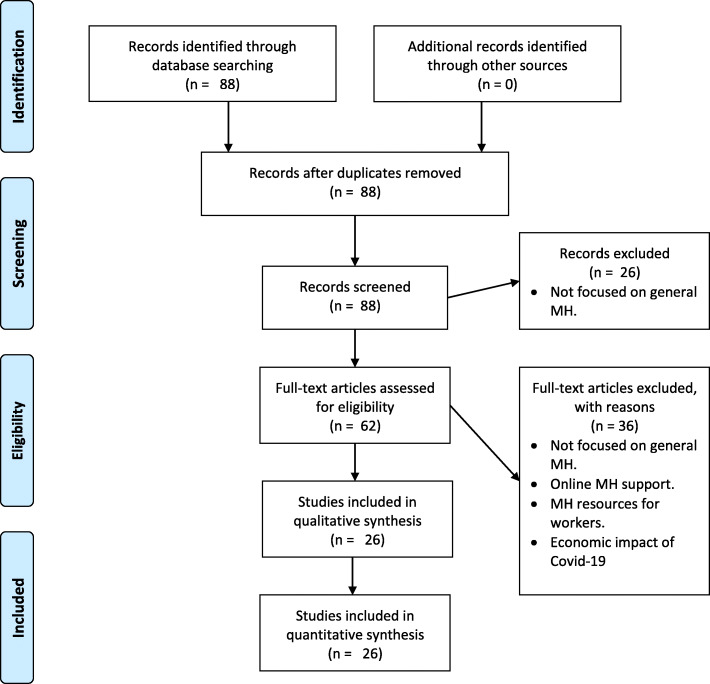
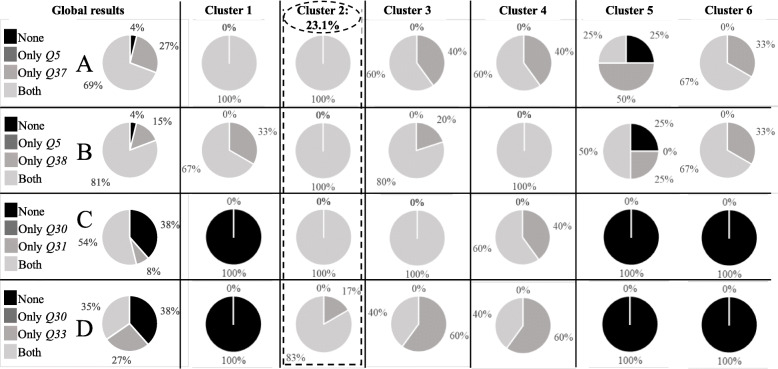
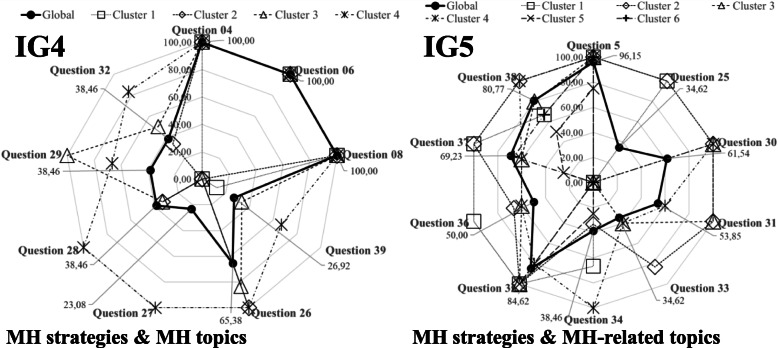
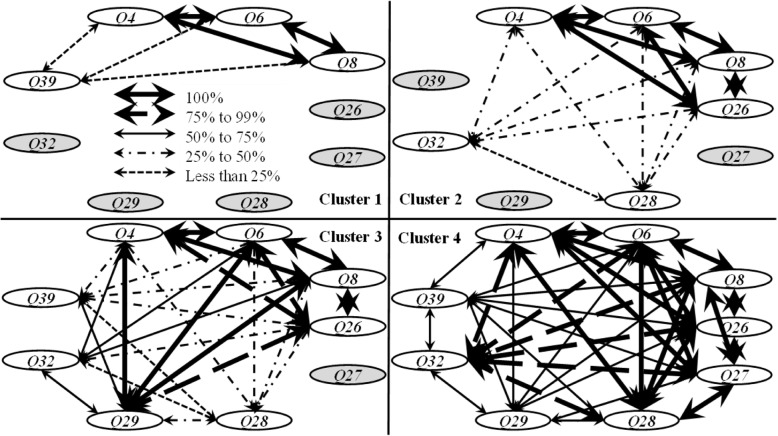
The PRISMA guidelines were adapted to review online documents. A new questionnaire was developed to identify the existence of common patterns in the selected documents. Questions were classified into three domains: COVID-19 information, mental health strategies and mental health recommendations. A two-step cluster analysis was carried out to highlight underlying behaviours in the data (patterns). The results are shown as spider graphs (pattern profiles) and conceptual maps (multidimensional links between questions).
Twenty-six documents were included in the review. The questionnaire analysed document complexity and identified their common key mental health characteristics (i.e., does the respondent have the tools for dealing with stress, depression and anxiety?). Cluster analysis highlighted patterns from the questionnaire domains. Strong relationships between questions were identified, such as psychological tips for maintaining good mental health and coping with COVID-19 (question n° 4), describing some psychological skills to help people cope with anxiety and worry about COVID-19 (question n° 6) and promoting social connection at home (question n° 8).
When fast results are needed to develop health strategies and policies, rapid reviews associated with statistical and graphical methods are essential. The results obtained from the proposed analytical procedure can be relevant to a) classify documents according to their complexity in structuring the information provided on how to cope with the psychological impact of COVID-19, b) develop new documents according to specific objectives matching population needs, c) improve document design to face unforeseen events, and d) adapt new documents to local situations. In this framework, the relevance of adapting e-mental health procedures to community mental health care model principles was highlighted, although some problems related to the digital gap must be considered.
心理健康保健系统受到了 COVID-19 的极大影响。已采取遏制措施,对民众心理健康造成了负面影响。因此,预计症状和精神障碍发生率都会增加。本研究旨在识别、描述和评估国际组织和政府在大流行初期为应对 COVID-19 的心理影响而制定的在线策略和建议的实证背景。
适应 PRISMA 指南以审查在线文件。制定了一个新的问卷来确定所选文件中存在的常见模式。问题分为三个领域:COVID-19 信息、心理健康策略和心理健康建议。进行了两步聚类分析,以突出数据中的潜在行为(模式)。结果显示为蜘蛛图(模式图)和概念图(问题之间的多维联系)。
综述包括 26 份文件。问卷分析了文件的复杂性,并确定了它们常见的关键心理健康特征(即,受访者是否有应对压力、抑郁和焦虑的工具?)。聚类分析突出了问卷领域的模式。确定了问题之间的强关系,例如保持良好心理健康和应对 COVID-19 的心理提示(问题 4)、描述帮助人们应对对 COVID-19 的焦虑和担忧的一些心理技巧(问题 6)和促进家庭内的社会联系(问题 8)。
当需要快速制定卫生策略和政策时,快速审查与统计和图形方法相关是必要的。所提出分析程序的结果可用于:a)根据提供有关如何应对 COVID-19 心理影响的信息的结构,对文件进行分类,b)根据特定目标开发新文件,以匹配人口需求,c)改进文件设计以应对意外事件,以及 d)根据当地情况调整新文件。在此框架内,强调了使电子心理健康程序适应社区心理健康保健模式原则的相关性,尽管必须考虑与数字鸿沟相关的一些问题。