German Center for Neurodegenerative Diseases (DZNE), Göttingen, Germany.
Department for NMR-based Structural Biology, Max Planck Institute for Biophysical Chemistry, Göttingen, Germany.
Protein Sci. 2021 Jul;30(7):1326-1336. doi: 10.1002/pro.4025. Epub 2021 Jan 28.
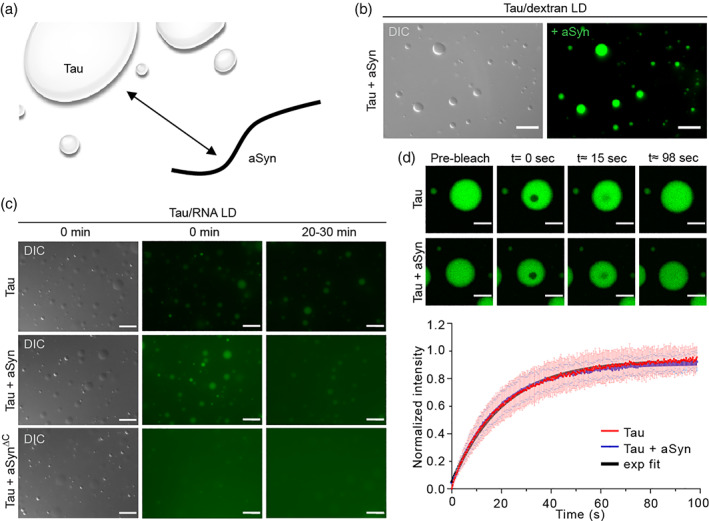
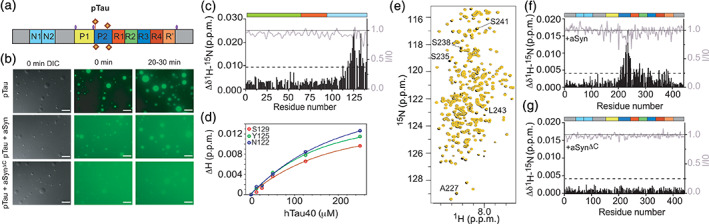
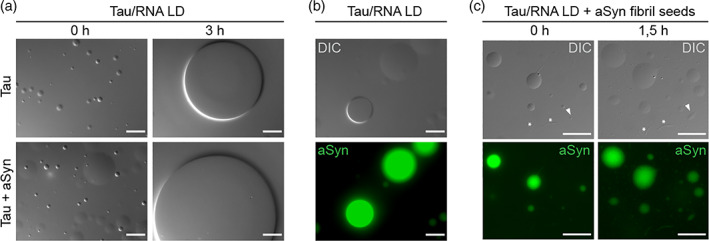
In Parkinson's disease with dementia, up to 50% of patients develop a high number of tau-containing neurofibrillary tangles. Tau-based pathologies may thus act synergistically with the α-synuclein pathology to confer a worse prognosis. A better understanding of the relationship between the two distinct pathologies is therefore required. Liquid-liquid phase separation (LLPS) of proteins has recently been shown to be important for protein aggregation involved in amyotrophic lateral sclerosis, whereas tau phase separation has been linked to Alzheimer's disease. We therefore investigated the interaction of α-synuclein with tau and its consequences on tau LLPS. We find α-synuclein to have a low propensity for both, self-coacervation and RNA-mediated LLPS at pH 7.4. However, full-length but not carboxy-terminally truncated α-synuclein efficiently partitions into tau/RNA droplets. We further demonstrate that Cdk2-phosphorylation promotes the concentration of tau into RNA-induced droplets, but at the same time decreases the amount of α-synuclein inside the droplets. NMR spectroscopy reveals that the interaction of the carboxy-terminal domain of α-synuclein with the proline-rich region P2 of tau is required for the recruitment of α-synuclein into tau droplets. The combined data suggest that the concentration of α-synuclein into tau-associated condensates can contribute to synergistic aSyn/tau pathologies.
在伴有痴呆的帕金森病中,多达 50%的患者出现大量含有 tau 的神经纤维缠结。因此,tau 病理学可能与α-突触核蛋白病理学协同作用,导致预后更差。因此,需要更好地了解这两种不同病理学之间的关系。最近的研究表明,蛋白质的液-液相分离(LLPS)对于涉及肌萎缩侧索硬化症的蛋白质聚集非常重要,而 tau 的液-液相分离与阿尔茨海默病有关。因此,我们研究了α-突触核蛋白与 tau 的相互作用及其对 tau LLPS 的影响。我们发现α-突触核蛋白本身既不容易发生自我凝聚,也不容易在 pH 值为 7.4 时发生 RNA 介导的 LLPS。然而,全长但不是羧基端截断的α-突触核蛋白有效地分配到 tau/RNA 液滴中。我们进一步证明,Cdk2 磷酸化促进 tau 聚集到 RNA 诱导的液滴中,但同时减少了液滴内的α-突触核蛋白的量。NMR 光谱学揭示,α-突触核蛋白的羧基末端结构域与 tau 的脯氨酸丰富区 P2 的相互作用是将α-突触核蛋白募集到 tau 液滴中的必要条件。综合数据表明,将α-突触核蛋白浓缩到与 tau 相关的凝聚物中可能有助于协同的 aSyn/tau 病理学。