Respiratory Diseases and Lung Transplantation, Department of Medical and Surgical Sciences & Neurosciences, Siena University Hospital, Siena, Italy.
Diagnostic Imaging Section, Department of Medical and Surgical Sciences & Neurosciences, Siena University Hospital, Siena, Italy.
Intern Emerg Med. 2021 Sep;16(6):1541-1545. doi: 10.1007/s11739-020-02614-7. Epub 2021 Jan 16.
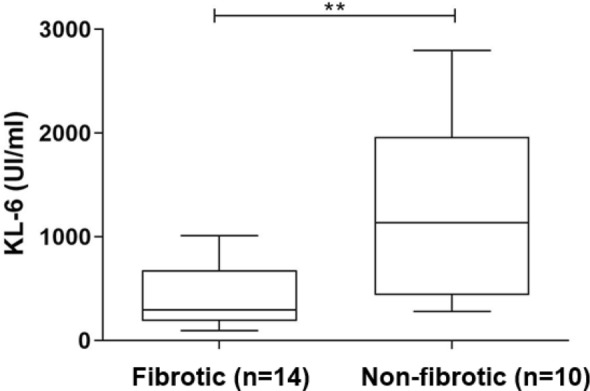
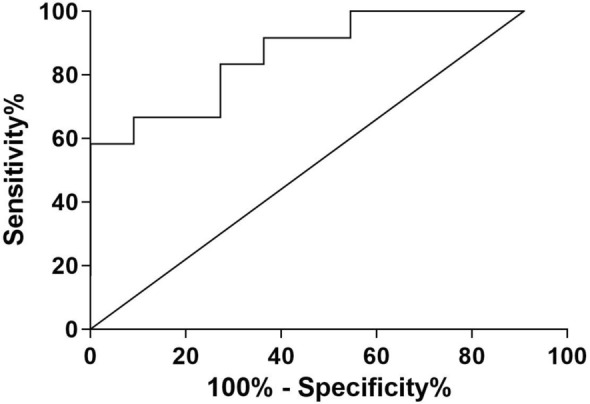
SARS-CoV2-induced direct cytopathic effects against type II pneumocytes are suspected to play a role in mediating and perpetuating lung damage. The aim of this study was to evaluate serum KL-6 behavior in COVID-19 patients to investigate its potential role in predicting clinical course. Sixty patients (median age IQR, 65 (52-69), 43 males), hospitalized for COVID-19 at Siena COVID Unit University Hospital, were prospectively enrolled. Twenty-six patients were selected (median age IQR, 63 (55-71), 16 males); all of them underwent follow-up evaluations, including clinical, radiological, functional, and serum KL-6 assessments, after 6 (t1) and 9 (t2) months from hospital discharge. At t0, KL-6 concentrations were significantly higher than those at t1 (760 (311-1218) vs. 309 (210-408) p = 0.0208) and t2 (760 (311-1218) vs 324 (279-458), p = 0.0365). At t0, KL-6 concentrations were increased in patients with fibrotic lung alterations than in non-fibrotic group (755 (370-1023) vs. 305 (225-608), p = 0.0225). Area under the receiver operating curve (AUROC) analysis showed that basal KL-6 levels showed good accuracy in discriminating patients with fibrotic sequelae radiologically documented (AUC 85%, p = 0.0404). KL-6 concentrations in patients with fibrotic involvement were significantly reduced at t1 (755 (370-1023) vs. 290 (197-521), p = 0.0366) and t2 (755 (370-1023) vs. 318 (173-435), p = 0.0490). Serum concentrations of KL-6 in hospitalized COVID-19 patients may contribute to identify severe patients requiring mechanical ventilation and to predict those who will develop pulmonary fibrotic sequelae in the follow-up.
SARS-CoV2 诱导的 II 型肺泡细胞直接细胞病变作用被怀疑在介导和持续肺损伤中起作用。本研究旨在评估 COVID-19 患者血清 KL-6 的行为,以研究其在预测临床病程中的潜在作用。
在锡耶纳 COVID 大学医院 COVID 病房住院的 60 名 COVID-19 患者(中位数年龄 IQR,65(52-69),43 名男性)前瞻性入组。选择了 26 名患者(中位数年龄 IQR,63(55-71),16 名男性);所有患者在出院后 6(t1)和 9(t2)个月进行临床、放射学、功能和血清 KL-6 评估的随访评估。
在 t0,KL-6 浓度明显高于 t1(760(311-1218)比 309(210-408),p=0.0208)和 t2(760(311-1218)比 324(279-458),p=0.0365)。在 t0,纤维化肺改变的患者的 KL-6 浓度高于非纤维化组(755(370-1023)比 305(225-608),p=0.0225)。
受试者工作特征曲线(AUROC)分析显示,基础 KL-6 水平在区分有影像学记录的纤维化后遗症患者方面具有良好的准确性(AUC 85%,p=0.0404)。纤维化受累患者的 KL-6 浓度在 t1 时明显降低(755(370-1023)比 290(197-521),p=0.0366)和 t2(755(370-1023)比 318(173-435),p=0.0490)。
住院 COVID-19 患者血清 KL-6 浓度有助于识别需要机械通气的重症患者,并预测在随访中发生肺纤维化后遗症的患者。