Department of Gynecology and Obstetrics, Maxima Medisch Centrum, Veldhoven, The Netherlands.
Department of Obstetrics and Gynecology, GROW-School for Oncology and Developmental Biology, Maastricht University Medical Center, Maastricht, The Netherlands.
Acta Obstet Gynecol Scand. 2021 Jul;100(7):1258-1264. doi: 10.1111/aogs.14086. Epub 2021 Feb 7.
The aim of this study is to evaluate the quality of the endometrial sample obtained by office endometrial aspiration when performed before or after saline contrast sonohysterography (SCSH) in women with postmenopausal bleeding and a thickened endometrium. To conduct a complete, minimally invasive and cost-effective diagnostic workup in women with postmenopausal bleeding and a thickened endometrium, ideally both the office endometrial sampling and SCSH are performed. However, it is not known whether both tests affect each other when performed one after another.
Women with postmenopausal bleeding and an endometrial thickness >4 mm were eligible. Women were randomized into two groups: one group received endometrial aspiration before SCSH, the other group received SCSH before endometrial aspiration. The primary outcome was the proportion of sufficient endometrial samples. Reliability of the SCSH images and pain during procedures were secondary outcomes.
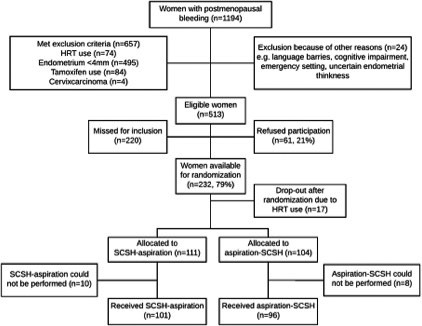
During the inclusion period, 513 eligible women with postmenopausal bleeding visited the participating hospitals, 293 of whom received information about the study. Of these women, 232 (79%) agreed to participate. In the SCSH-aspiration group, 65 women (59%) had a sufficient endometrial sample compared with 70 (67%) in the aspiration-SCSH group (odds ratio 1.46, 95% CI 0.83-2.54, P = .19). The proportion of reliable sonographic images was significantly higher in the SCSH-aspiration group (n = 88, 87%) compared with the aspiration-SCSH group (n = 71, 74%) (OR 2.38, 95% CI 1.38-4.99, P = .02) in the per protocol analysis.
This study shows that the quality of an endometrial sample in women with postmenopausal bleeding is not affected by SCSH. Both procedures can be performed in one outpatient visit to perform an optimal diagnostic workup.
本研究旨在评估在绝经后出血且子宫内膜增厚的女性中,经阴道超声引导下子宫内膜吸取术(TA)与生理盐水宫腔声学造影(SCSH)先后施行时,获取的子宫内膜标本的质量。为绝经后出血且子宫内膜增厚的女性进行全面、微创且具有成本效益的诊断性检查,理想情况下,TA 和 SCSH 都应施行。然而,目前尚不清楚这两种检查在先后施行时是否会相互影响。
符合条件的绝经后出血且子宫内膜厚度>4mm 的女性被纳入研究。将这些女性随机分为两组:一组在 SCSH 前接受 TA,另一组在 TA 前接受 SCSH。主要结局为获得足够子宫内膜标本的比例。SCSH 图像的可靠性和操作过程中的疼痛为次要结局。
在纳入期内,513 名绝经后出血的符合条件的女性就诊于参与医院,其中 293 名女性被告知有关研究的信息。在这些女性中,有 232 名(79%)同意参与研究。在 SCSH-TA 组中,65 名女性(59%)获得了足够的子宫内膜标本,而在 TA-SCSH 组中,有 70 名女性(67%)获得了足够的标本(优势比 1.46,95%CI 0.83-2.54,P=0.19)。在 SCSH-TA 组中,可靠的超声图像比例明显高于 TA-SCSH 组(分别为 88 名[87%]和 71 名[74%])(比值比 2.38,95%CI 1.38-4.99,P=0.02)。
本研究表明,SCSH 并不影响绝经后出血女性的子宫内膜标本质量。这两种操作可以在一次门诊就诊中进行,以进行最佳的诊断性检查。