Departments of Gastroenterology, The Second Affiliated Hospital, Zhejiang University School of Medicine, Hangzhou, Zhejiang 310009, P.R. China.
Cancer Institute (Key Laboratory of Cancer Prevention and Intervention, China National Ministry of Education), The Second Affiliated Hospital, Zhejiang University School of Medicine, Hangzhou, Zhejiang 310009, P.R. China.
Int J Med Sci. 2021 Jan 1;18(4):911-920. doi: 10.7150/ijms.51186. eCollection 2021.
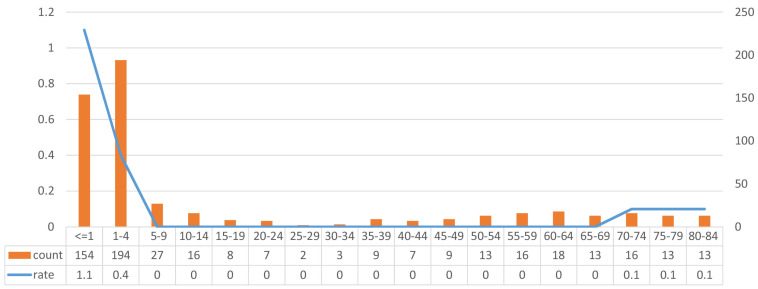
Malignant rhabdoid tumor (MRT) is a rare but aggressive malignancy. It has been a long time since data on this tumor have been updated. We retrospectively reviewed patients from the SEER database who were pathologically diagnosed with MRT and analyzed incidence rates, clinical features and survival using Stata 12.0. In total, 544 patients were included in the epidemiological analysis. There were two peak periods of MRT incidence: patients younger than 4 years and those older than 70 years. Further survival analysis showed that the survival of children (especially younger than 1 year) was markedly worse than that of adults (<0.01), and different primary sites were associated with different age groups and survival outcomes. The central nervous system (CNS) was the most common primary site (50.00%), followed by the kidney (15.66%). Patients with MRTs that originated from the digestive system experienced worse survival outcomes than those with MRTs originating from other locations. Primary site surgery conferred survival benefits to patients with renal and digestive system MRTs (HR = 0.06, CI: 0.02-0.23, <0.01; HR=0.10, CI: 0.02-0.48, <0.01), whereas radiotherapy conferred benefits to patients with CNS, bone and soft tissue MRTs (HR=0.22, CI: 0.15-0.34, <0.01; HR=0.44, CI: 0.21-0.90 =0.03). Our results indicate that age and the primary site of MRT are critical clinical factors that affect patient survival and treatment choices. Primary site tumor resection should be considered for renal and digestive system MRTs, and systematic therapy, including surgery and radiotherapy, should be recommended for the treatment of CNS, bone and soft tissue MRTs.
横纹肌样瘤(Malignant rhabdoid tumor,MRT)是一种罕见但具有侵袭性的恶性肿瘤。关于这种肿瘤的最新数据已经有很长一段时间没有更新了。我们回顾性分析了来自 SEER 数据库中经病理诊断为 MRT 的患者,使用 Stata 12.0 分析发病率、临床特征和生存率。共纳入 544 例患者进行流行病学分析。MRT 的发病有两个高峰期:年龄小于 4 岁和年龄大于 70 岁。进一步的生存分析表明,儿童(尤其是 1 岁以下)的生存率明显差于成年人(<0.01),不同的原发部位与不同的年龄组和生存结局相关。中枢神经系统(Central nervous system,CNS)是最常见的原发部位(50.00%),其次是肾脏(15.66%)。起源于消化系统的 MRT 患者的生存结果较其他部位起源的 MRT 患者差。原发部位手术为肾和消化系统 MRT 患者带来生存获益(HR=0.06,CI:0.02-0.23,<0.01;HR=0.10,CI:0.02-0.48,<0.01),而放疗为 CNS、骨和软组织 MRT 患者带来获益(HR=0.22,CI:0.15-0.34,<0.01;HR=0.44,CI:0.21-0.90,=0.03)。我们的研究结果表明,年龄和 MRT 的原发部位是影响患者生存和治疗选择的关键临床因素。肾和消化系统 MRT 应考虑行原发部位肿瘤切除术,CNS、骨和软组织 MRT 应推荐采用系统治疗,包括手术和放疗。