Fan Junjie, Gao Li, Chen Jing, Hu Shaoyan
Department of Hematology and Oncology, Children's Hospital of Soochow University, Suzhou, China.
Department of Neonatology, Children's Hospital of Soochow University, Suzhou, China.
Transl Pediatr. 2020 Dec;9(6):726-733. doi: 10.21037/tp-20-102.
KIT mutations are common in children with core-binding factor (CBF) acute myeloid leukemia (AML). The relationship between KIT mutations and their prognostic value has generated intense attention during the past years. Although studies have evaluated the role of KIT mutations, their prognostic implications remain unclear. To clarify this issue, we conducted this meta-analysis.
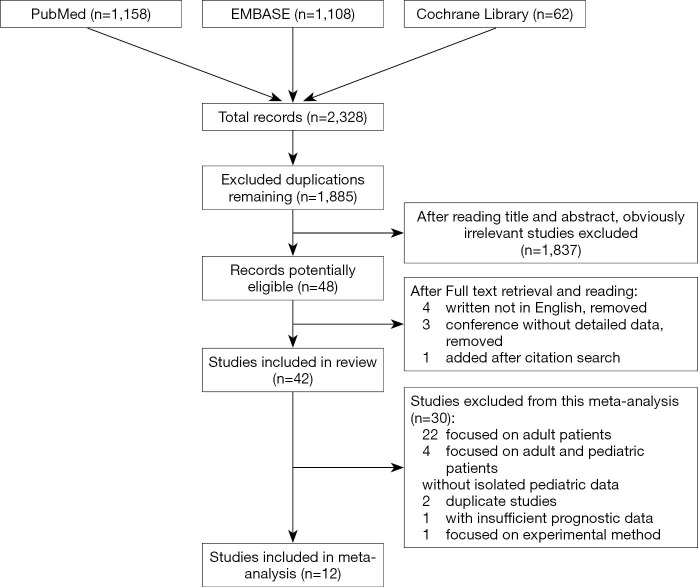
We electronically searched the PubMed, Embase and Cochrane Library databases. Twelve studies met our selection criteria. These studies involved 1,123 children with CBF-AML including 256 children with KIT mutations. We investigated the effects of KIT mutations on the complete remission (CR), relapse, event-free survival (EFS), disease-free survival (DFS), and overall survival (OS) rates of pediatric CBF-AML patients.
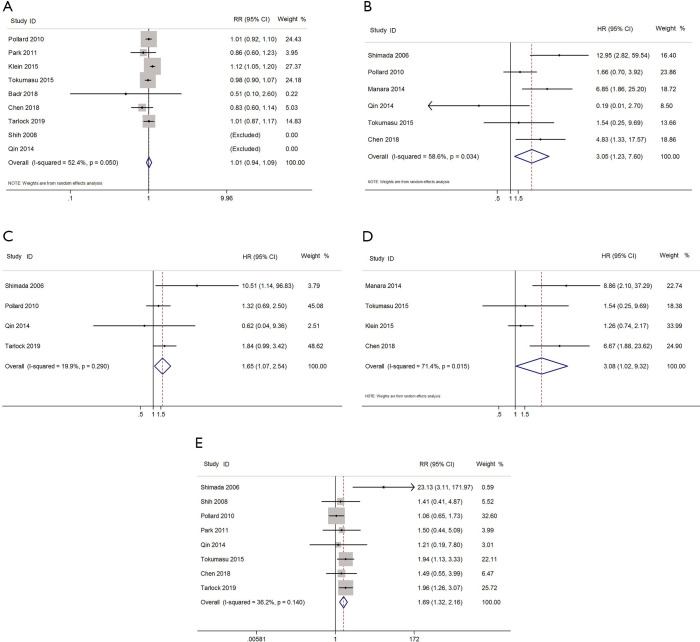
KIT mutations were not associated with CR [relative risk: 1.01, 95% confidence interval (CI): 0.94-1.09, P=0.761], but were associated with higher relapse risk [hazard ratio (HR): 1.69, 95% CI: 1.32-2.16, P=0.000], lower OS (HR: 3.05, 95% CI: 1.23-7.60, P=0.016), lower DFS (HR: 1.65, 95% CI: 1.07-2.54, P=0.024), and lower EFS (HR: 3.08, 95% CI: 1.02-9.32, P=0.046).
Our analysis suggested that KIT mutations had an adverse prognostic effect in pediatric CBF-AML patients. The initial diagnostic workup for these patients should include tests for the detection of KIT mutations, and the treatment may need to be adjusted when these mutations are found to be present.
KIT突变在核心结合因子(CBF)急性髓系白血病(AML)患儿中很常见。在过去几年中,KIT突变与其预后价值之间的关系引起了广泛关注。尽管已有研究评估了KIT突变的作用,但其预后意义仍不明确。为阐明这一问题,我们进行了这项荟萃分析。
我们通过电子检索PubMed、Embase和Cochrane图书馆数据库。12项研究符合我们的纳入标准。这些研究共纳入1123例CBF-AML患儿,其中256例有KIT突变。我们研究了KIT突变对小儿CBF-AML患者完全缓解(CR)、复发、无事件生存(EFS)、无病生存(DFS)和总生存(OS)率的影响。
KIT突变与CR无关[相对危险度:1.01,95%置信区间(CI):0.94 - 1.09,P = 0.761],但与较高的复发风险相关[风险比(HR):1.69,95%CI:1.32 - 2.16,P = 0.000],较低的OS(HR:3.05,95%CI:1.23 - 7.60,P = 0.016),较低的DFS(HR:1.65,95%CI:1.07 - 2.54,P = 0.024),以及较低的EFS(HR:3.08,95%CI:1.02 - 9.32,P = 0.046)。
我们的分析表明,KIT突变对小儿CBF-AML患者具有不良预后影响。这些患者的初始诊断检查应包括KIT突变检测,当发现存在这些突变时,治疗可能需要调整。