Schakel Tim, Peltenburg Boris, Dankbaar Jan-Willem, Cardenas Carlos E, Aristophanous Michalis, Terhaard Chris H J, Hoogduin Johannes M, Philippens Marielle E P
Department of Radiotherapy, University Medical Center, Utrecht, The Netherlands.
Department of Radiology, University Medical Center, Utrecht, The Netherlands.
Phys Imaging Radiat Oncol. 2018 Jan 30;5:13-18. doi: 10.1016/j.phro.2017.12.004. eCollection 2018 Jan.
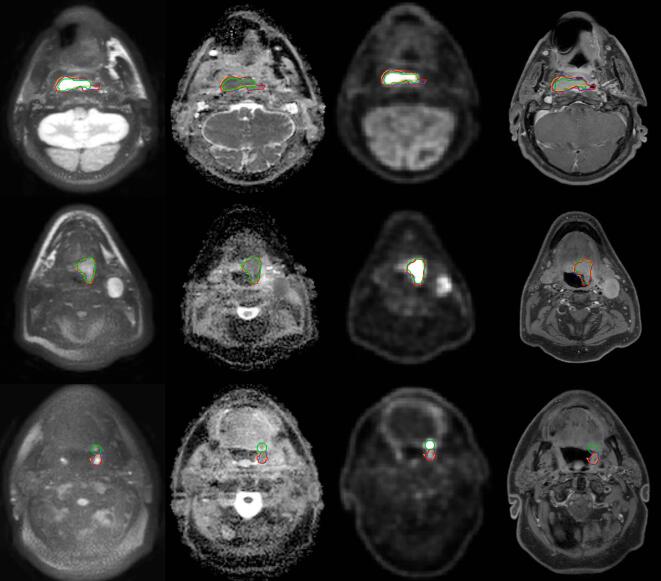
Diffusion weighted (DW) MRI may facilitate target volume delineation for head-and-neck (HN) radiation treatment planning. In this study we assessed the use of a dedicated, geometrically accurate, DW-MRI sequence for target volume delineation. The delineations were compared with semi-automatic segmentations on F-fluorodeoxyglucose (FDG) positron emission tomography (PET) images and evaluated for interobserver variation.
Fifteen HN cancer patients underwent both DW-MRI and FDG-PET for RT treatment planning. Target delineation on DW-MRI was performed by three observers, while for PET a semi-automatic segmentation was performed using a Gaussian mixture model. For interobserver variation and intermodality variation, volumes, overlap metrics and Hausdorff distances were calculated from the delineations.
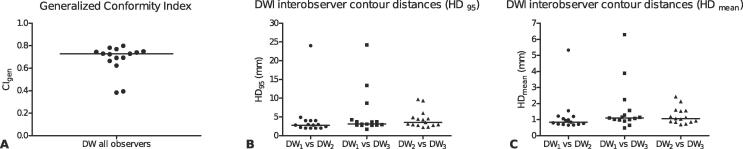
The median volumes delineated by the three observers on DW-MRI were 10.8, 10.5 and 9.0 cm respectively, and was larger than the median PET volume (8.0 cm). The median conformity index of DW-MRI for interobserver variation was 0.73 (range 0.38-0.80). Compared to PET, the delineations on DW-MRI by the three observers showed a median dice similarity coefficient of 0.71, 0.69 and 0.72 respectively. The mean Hausdorff distance was small with median (range) distances between PET and DW-MRI of 2.3 (1.5-6.8), 2.5 (1.6-6.9) and 2.0 (1.35-7.6) mm respectively. Over all patients, the median 95th percentile distances were 6.0 (3.0-13.4), 6.6 (4.0-24.0) and 5.3 (3.4-26.0) mm.
Using a dedicated DW-MRI sequence, target volumes could be defined with good interobserver agreement and a good overlap with PET. Target volume delineation using DW-MRI is promising in head-and-neck radiotherapy, combined with other modalities, it can lead to more precise target volume delineation.
扩散加权磁共振成像(DW-MRI)有助于对头颈部(HN)放射治疗计划中的靶区进行勾画。在本研究中,我们评估了一种专门的、几何精度高的DW-MRI序列用于靶区勾画的情况。将这些勾画结果与基于氟脱氧葡萄糖(FDG)正电子发射断层扫描(PET)图像的半自动分割结果进行比较,并评估观察者间的差异。
15例HN癌症患者同时接受了DW-MRI和FDG-PET检查以进行放疗计划。三位观察者对DW-MRI图像进行靶区勾画,而对于PET图像,则使用高斯混合模型进行半自动分割。从勾画结果中计算观察者间差异和模态间差异的体积、重叠指标和豪斯多夫距离。
三位观察者在DW-MRI上勾画的中位体积分别为10.8、10.5和9.0 cm³,大于PET的中位体积(8.0 cm³)。观察者间差异的DW-MRI中位符合指数为0.73(范围0.38 - 0.80)。与PET相比,三位观察者在DW-MRI上的勾画结果的中位骰子相似系数分别为0.71、0.69和0.72。平均豪斯多夫距离较小,PET与DW-MRI之间距离的中位数(范围)分别为2.3(1.5 - 6.8)、2.5(1.6 - 6.9)和2.0(1.35 - 7.6)mm。在所有患者中,第95百分位数距离的中位数分别为6.0(3.0 - 13.4)、6.6(4.0 - 24.0)和5.3(3.4 - 26.0)mm。
使用专门的DW-MRI序列,可以在观察者间达成良好的一致性且与PET有良好的重叠来定义靶区体积。在头颈部放疗中,使用DW-MRI进行靶区勾画很有前景,与其他模态相结合,可实现更精确的靶区勾画。