
一项病例对照研究,使用包含运动的空间剂量体积指标来评估前列腺癌高精度放疗后的泌尿生殖系统毒性。
A case-control study using motion-inclusive spatial dose-volume metrics to account for genito-urinary toxicity following high-precision radiotherapy for prostate cancer.
作者信息
Casares-Magaz Oscar, Muren Ludvig P, Pettersson Niclas, Thor Maria, Hopper Austin, Knopp Rick, Deasy Joseph O, Væth Michael, Einck John, Moiseenko Vitali
机构信息
Dept of Medical Physics, Aarhus University Hospital, Aarhus, Denmark.
Dept of Medical Physics, Sahlgrenska University Hospital, Gothenburg, Sweden.
出版信息
Phys Imaging Radiat Oncol. 2018 Oct 5;7:65-69. doi: 10.1016/j.phro.2018.09.005. eCollection 2018 Jul.
BACKGROUND AND PURPOSE
The risk of genitourinary (GU) toxicity is dose-limiting in radiotherapy (RT) for prostate cancer. This study investigated whether motion-inclusive spatial dose/volume metrics explain the GU toxicity manifesting after high-precision RT for prostate cancer.
MATERIAL AND METHODS
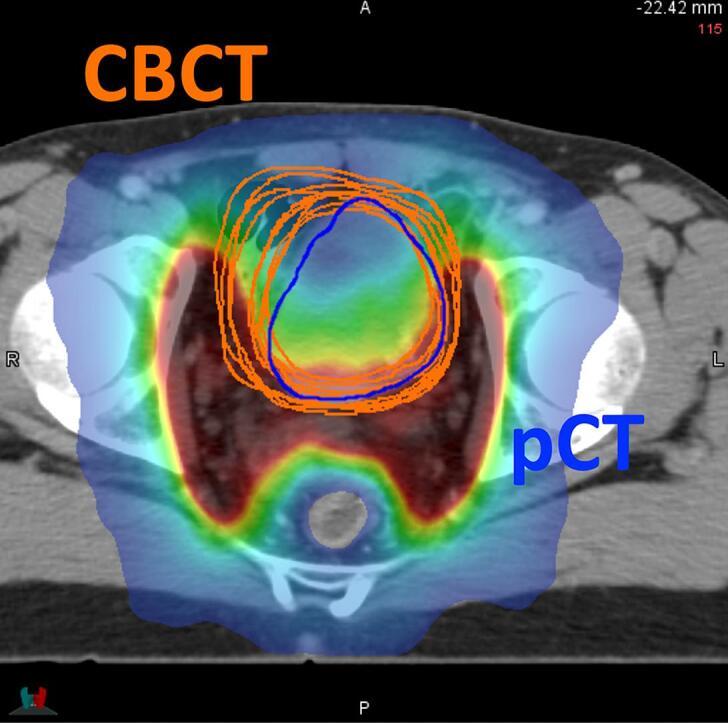
A matched case-control was performed within a cohort of 258 prostate cancer patients treated with daily cone-beam CT (CBCT)-guided RT (prescription doses of 77.4-81.0 Gy). Twenty-seven patients (10.5%) presented late RTOG GU ≥ Grade 2 toxicity and those without symptoms of toxicity prior treatment (N = 7) were selected as cases. Each case was matched with three controls based on pre-treatment GU symptoms, age, Gleason score, follow-up time, and hormone therapy. Thirteen CBCTs per patient were rigidly registered to the planning CT using the recorded treatment shifts, and the bladder was manually contoured on each CBCT. Planned and actually delivered dose/volume metrics (the latter averaged across the CBCTs) were extracted from the bladder and its subsectors, and compared between cases and controls (two-way ANOVA test).
RESULTS
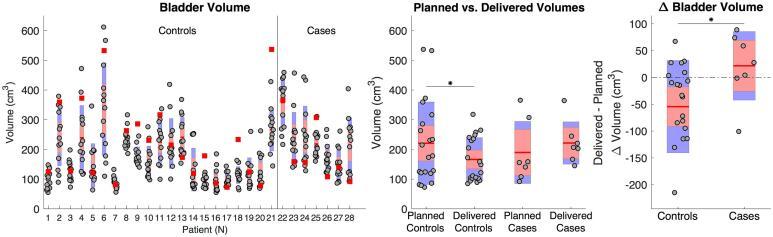
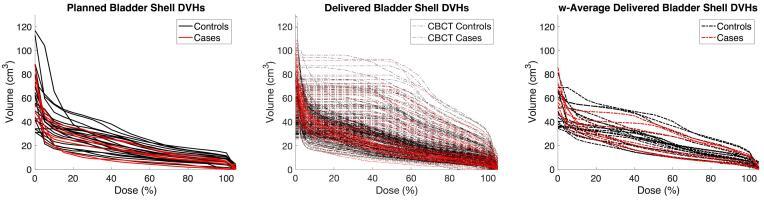
There were no significant differences between planned and delivered dose/volume metrics; also, there were no significant differences between cases and controls at any dose level, neither for planned nor delivered doses. The cases tended to have larger bladder volumes during treatment than controls (221 ± 71 cm vs 166 ± 73 cm; p = 0.09).
CONCLUSIONS
High-precision RT for prostate cancer eliminates differences between planned and delivered dose distributions. Neither planned nor delivered bladder dose/volume metrics were associated to the remaining low risk of developing GU toxicity after high-precision radiotherapy for prostate cancer.
背景与目的
在前列腺癌放射治疗(RT)中,泌尿生殖系统(GU)毒性风险是剂量限制因素。本研究调查了包含运动因素的空间剂量/体积指标是否能解释前列腺癌高精度放疗后出现的GU毒性。
材料与方法
在258例接受每日锥形束CT(CBCT)引导下放疗(处方剂量为77.4 - 81.0 Gy)的前列腺癌患者队列中进行了配对病例对照研究。27例患者(10.5%)出现晚期放射肿瘤学组(RTOG)GU≥2级毒性,将治疗前无症状毒性的患者(N = 7)选为病例组。根据治疗前GU症状、年龄、 Gleason评分、随访时间和激素治疗情况,为每个病例匹配三个对照组。利用记录的治疗移位将每位患者的13次CBCT与计划CT进行刚性配准,并在每次CBCT上手动勾勒膀胱轮廓。从膀胱及其子区域提取计划和实际 delivered 剂量/体积指标(后者在CBCT上进行平均),并在病例组和对照组之间进行比较(双向方差分析)。
结果
计划和 delivered 剂量/体积指标之间无显著差异;同样,在任何剂量水平下,病例组和对照组之间无论是计划剂量还是 delivered 剂量均无显著差异。病例组在治疗期间的膀胱体积往往比对照组大(221±71 cm³ 对 166±73 cm³;p = 0.09)。
结论
前列腺癌的高精度放疗消除了计划和 delivered 剂量分布之间的差异。在前列腺癌高精度放疗后,计划和 delivered 的膀胱剂量/体积指标均与发生GU毒性的剩余低风险无关。

 Zotero 插件