Lowther Nicholas J, Hamilton David A, Kim Han, Evans Jamie M, Marsh Steven H, Louwe Robert J W
Wellington Blood and Cancer Centre, Department of Radiation Oncology, Wellington, New Zealand.
University of Canterbury, School of Physical and Chemical Sciences, Christchurch, New Zealand.
Phys Imaging Radiat Oncol. 2018 Dec 20;9:21-27. doi: 10.1016/j.phro.2018.12.004. eCollection 2019 Jan.
Reduced toxicity while maintaining loco-regional control rates have been reported after reducing planning target volume (PTV) margins for head-and-neck radiotherapy (HNRT). In this context, quantifying anatomical changes to monitor patient treatment is preferred. This retrospective feasibility study investigated the application of deformable image registration (DIR) and Exponentially Weighted Moving Average (EWMA) Statistical Process Control (SPC) charts for this purpose.
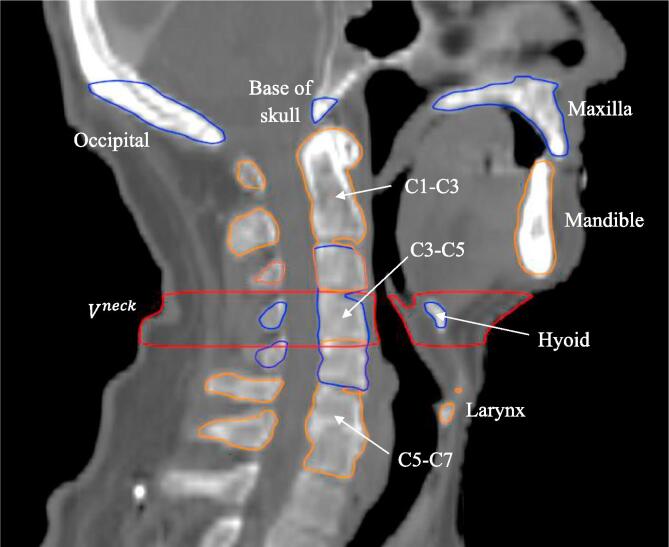
DIR between the computed tomography for treatment planning (pCT) images of twelve patients and their daily on-treatment cone beam computed tomography (CBCT) images quantified anatomical changes during treatment. EWMA charts investigated corresponding trends. Uncertainty analysis provided 90% confidence limits which were used to confirm whether a trend previously breached a threshold.
Trends in patient positioning reproducibility occurred before the end of treatment week four in 54% of cases. Using SPC process limits, only 24% of these were confirmed at a 90% confidence level before the end of treatment. Using an clinical limit of 2 mm, absolute changes in patient pose were detected in 39% of cases, of which 82% were confirmed. Soft tissue trends outside SPC process limits occurring before the end of treatment week four were confirmed in 90% of cases.
Structure specific action thresholds enabled detection of systematic anatomical changes during the first four weeks of treatment. Investigation of the dosimetric impact of the observed deviations is needed to show the efficacy of SPC to timely indicate required treatment adaptation and provide a safety net for PTV margin reduction.
据报道,在对头颈部放疗(HNRT)的计划靶体积(PTV)边界进行缩减后,毒性降低的同时局部区域控制率得以维持。在此背景下,对解剖结构变化进行量化以监测患者治疗情况更为可取。本回顾性可行性研究旨在探讨可变形图像配准(DIR)和指数加权移动平均(EWMA)统计过程控制(SPC)图在此方面的应用。
对12例患者治疗计划的计算机断层扫描(pCT)图像与其每日治疗时的锥形束计算机断层扫描(CBCT)图像进行DIR,以量化治疗期间的解剖结构变化。EWMA图用于研究相应趋势。不确定性分析提供了90%的置信区间,用于确认先前的趋势是否突破阈值。
54%的病例在治疗第4周结束前出现患者体位重复性趋势。使用SPC过程界限,在治疗结束前,其中只有24%在90%置信水平下得到确认。使用2毫米的临床界限,在39%的病例中检测到患者体位的绝对变化,其中82%得到确认。在90%的病例中,在治疗第4周结束前出现的超出SPC过程界限的软组织趋势得到确认。
特定结构的行动阈值能够在治疗的前四周检测到系统性解剖结构变化。需要对观察到的偏差的剂量学影响进行研究,以证明SPC及时指示所需治疗调整并为PTV边界缩减提供安全保障的有效性。