Şahİn Mehtap, Aydin Hüseyin, Altun Ahmet, Derİn Mehmet Emin, Şahİn Ali
Department of Medical Biochemistry, Sivas Cumhuriyet University Medical Faculty, Sivas, Turkey.
Department of Pharmacology, Sivas Cumhuriyet University Medical Faculty, Sivas, Turkey.
Arch Rheumatol. 2020 Feb 7;35(3):343-350. doi: 10.46497/ArchRheumatol.2020.7568. eCollection 2020 Sep.
This study aims to investigate the effects of Janus kinase/signal transducers and activators of the transcription (JAK/STAT) pathway inhibition on collagen biosynthesis in fibroblast cell culture by tofacitinib.
BJ-CRL-1474® (skin) and BRL3A® (hepatic) fibroblast cell cultures were proliferated in a suitable medium. Tofacitinib was administered to fibroblast cells proliferating in 96-well flasks at concentrations of 25, 50, 100, 200, 400, and 800 nM. Tissue inhibitor of metalloproteinase-1 (TIMP-1), matrix metalloproteinase-3 (MMP-3), transforming growth factor beta 1 (TGF-β1), and hydroxyproline levels were measured using the enzyme-linked immunosorbent assay method.
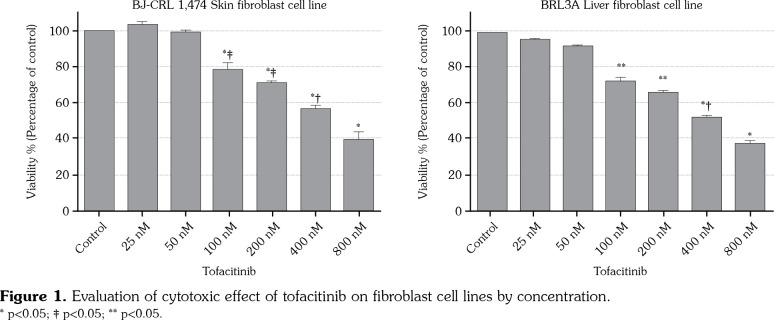
Tofacitinib showed cytotoxic effect on skin and liver cell culture. The cytotoxic effect of tofacitinib started at 100 nM (p<0.05). The highest effect was obtained at 800 nM. The time-dependent cytotoxic effect of tofacitinib was significantly higher at all concentrations after 72 hours than at 24 and 48 hours (p<0.05). The level of TGF-β1 was significantly lower even at a tofacitinib concentration of 25 nM (p<0.05). There were significant decreases in MMP-3, TIMP-1, and hydroxyproline levels after tofacitinib administration (p<0.05).
Tofacitinib inhibited fibroblast cell proliferation in a concentration-dependent manner in a fibroblast cell culture. However, further extensive animal and human studies are necessary to determine the clinical significance of this effect.
本研究旨在探讨托法替布抑制Janus激酶/信号转导子和转录激活子(JAK/STAT)通路对成纤维细胞培养中胶原蛋白生物合成的影响。
BJ-CRL-1474®(皮肤)和BRL3A®(肝脏)成纤维细胞培养物在合适的培养基中增殖。将托法替布以25、50、100、200、400和800 nM的浓度施用于在96孔培养板中增殖的成纤维细胞。使用酶联免疫吸附测定法测量金属蛋白酶组织抑制剂-1(TIMP-1)、基质金属蛋白酶-3(MMP-3)、转化生长因子β1(TGF-β1)和羟脯氨酸水平。
托法替布对皮肤和肝细胞培养物显示出细胞毒性作用。托法替布的细胞毒性作用在100 nM时开始(p<0.05)。在800 nM时获得最高效应。托法替布的时间依赖性细胞毒性作用在72小时后所有浓度下均显著高于24小时和48小时(p<0.05)。即使在托法替布浓度为25 nM时,TGF-β1水平也显著降低(p<0.05)。托法替布给药后,MMP-3、TIMP-1和羟脯氨酸水平显著降低(p<0.05)。
在成纤维细胞培养中,托法替布以浓度依赖性方式抑制成纤维细胞增殖。然而,需要进一步广泛的动物和人体研究来确定这种作用的临床意义。