• 文献检索
  • 文档翻译
  • 深度研究
  • 学术资讯
  • Suppr Zotero 插件Zotero 插件
  • 邀请有礼
  • 套餐&价格
  • 历史记录
应用&插件
Suppr Zotero 插件Zotero 插件浏览器插件Mac 客户端Windows 客户端微信小程序
定价
高级版会员购买积分包购买API积分包
服务
文献检索文档翻译深度研究API 文档MCP 服务
关于我们
关于 Suppr公司介绍联系我们用户协议隐私条款
关注我们

Suppr 超能文献

核心技术专利:CN118964589B侵权必究
粤ICP备2023148730 号-1Suppr @ 2026

文献检索

告别复杂PubMed语法,用中文像聊天一样搜索,搜遍4000万医学文献。AI智能推荐,让科研检索更轻松。

立即免费搜索

文件翻译

保留排版,准确专业,支持PDF/Word/PPT等文件格式,支持 12+语言互译。

免费翻译文档

深度研究

AI帮你快速写综述,25分钟生成高质量综述,智能提取关键信息,辅助科研写作。

立即免费体验

1999 年以来的帕金森病药物研发:再利用与相对成功的故事。

Parkinson's Disease Drug Development Since 1999: A Story of Repurposing and Relative Success.

机构信息

Swammerdam Institute for Life Sciences, Center for Neuroscience, University of Amsterdam, Amsterdam, The Netherlands.

Laboratory of Clinical Pharmacology and Therapeutics, Faculdade de Medicina, Universidade de Lisboa, Lisboa, Portugal.

出版信息

J Parkinsons Dis. 2021;11(2):421-429. doi: 10.3233/JPD-202184.

DOI:10.3233/JPD-202184
PMID:33459662
原文链接:https://pmc.ncbi.nlm.nih.gov/articles/PMC8150606/
Abstract

BACKGROUND

A global overview of drug development programs in Parkinson's disease over the last few decades is lacking, while such programs are challenging given the multifaceted and heterogeneous nature of the disease.

OBJECTIVE

To indirectly assess drug development programs in Parkinson's disease, exploring some factors associated with compound attrition at different trial phases.

METHODS

We assessed all Parkinson's disease trials in the WHO trials portal, from inception (1999) to September 2019. Independent authors selected trials and extracted data. The success rate was the number of compounds that progressed to the next drug development phase divided by the number of compounds in that phase.

RESULTS

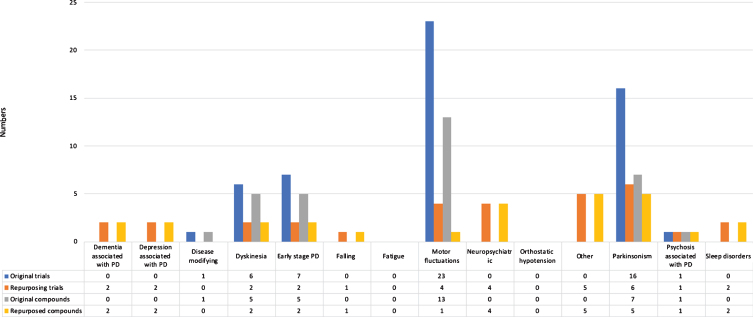
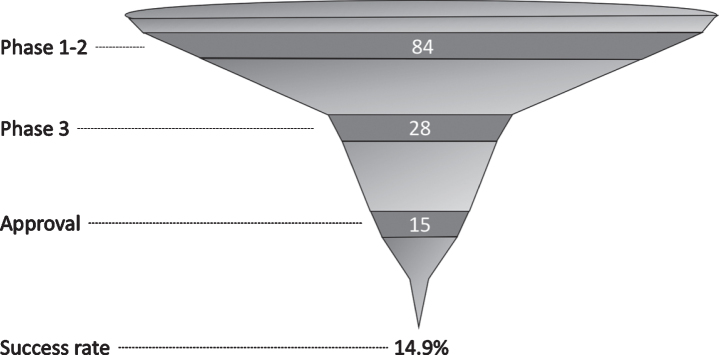
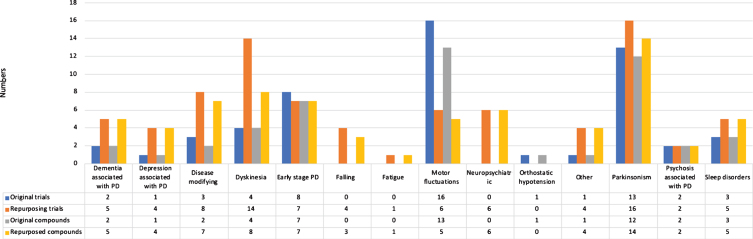
Overall, 357 trials (studying 152 compounds) fulfilled our inclusion criteria, with 62 (17.3%) phase 1 trials, 135 (37.8%) phase 2 trials, 85 (23.8%) phase 3 trials, and 53 (14.8%) phase 4 trials. The success rate was 42.4% from phase 2 to 3. Original compounds received regulatory approval by the FDA in 21.4% of cases, compared with 6.7% of repurposed compounds, representing an overall success rate of 14.9%. We found 172 trials (48.2%) conducted for repurposing previously licensed compounds. These figures were approximately the same regarding approval by the EMA. Most compounds were approved to treat parkinsonism and motor fluctuations.

CONCLUSION

We found a moderate-to-high success rate in all phases of drug development. This was largely based on the success of original compounds, despite almost half of the identified trials attempting compound repurposing.

摘要

背景

过去几十年,全球范围内缺乏帕金森病药物研发项目的综述,鉴于该疾病具有多方面和异质性的特点,此类项目极具挑战性。

目的

旨在间接评估帕金森病的药物研发项目,探索不同试验阶段与化合物淘汰相关的一些因素。

方法

我们评估了世界卫生组织试验门户中自 1999 年成立至 2019 年 9 月期间所有的帕金森病试验。独立作者选择试验并提取数据。成功率是指进入下一药物研发阶段的化合物数量与该阶段化合物数量的比值。

结果

总体而言,有 357 项试验(研究了 152 种化合物)符合我们的纳入标准,其中 62 项(17.3%)为 1 期试验,135 项(37.8%)为 2 期试验,85 项(23.8%)为 3 期试验,53 项(14.8%)为 4 期试验。从 2 期到 3 期的成功率为 42.4%。原始化合物获得 FDA 监管批准的比例为 21.4%,而重新定位化合物的批准比例为 6.7%,总成功率为 14.9%。我们发现有 172 项(48.2%)试验是为重新定位以前批准的化合物而进行的。在 EMA 批准方面,这些数据大致相同。大多数化合物被批准用于治疗帕金森病和运动波动。

结论

我们发现药物研发的所有阶段都有中高成功率。这主要基于原始化合物的成功,尽管近一半的已识别试验都试图重新定位化合物。

https://cdn.ncbi.nlm.nih.gov/pmc/blobs/19c5/8150606/e09043b5b099/jpd-11-jpd202184-g004.jpg
https://cdn.ncbi.nlm.nih.gov/pmc/blobs/19c5/8150606/1854a9bbc048/jpd-11-jpd202184-g001.jpg
https://cdn.ncbi.nlm.nih.gov/pmc/blobs/19c5/8150606/296ddcb9c242/jpd-11-jpd202184-g002.jpg
https://cdn.ncbi.nlm.nih.gov/pmc/blobs/19c5/8150606/a26bfccb8d59/jpd-11-jpd202184-g003.jpg
https://cdn.ncbi.nlm.nih.gov/pmc/blobs/19c5/8150606/e09043b5b099/jpd-11-jpd202184-g004.jpg
https://cdn.ncbi.nlm.nih.gov/pmc/blobs/19c5/8150606/1854a9bbc048/jpd-11-jpd202184-g001.jpg
https://cdn.ncbi.nlm.nih.gov/pmc/blobs/19c5/8150606/296ddcb9c242/jpd-11-jpd202184-g002.jpg
https://cdn.ncbi.nlm.nih.gov/pmc/blobs/19c5/8150606/a26bfccb8d59/jpd-11-jpd202184-g003.jpg
https://cdn.ncbi.nlm.nih.gov/pmc/blobs/19c5/8150606/e09043b5b099/jpd-11-jpd202184-g004.jpg

相似文献

1
Parkinson's Disease Drug Development Since 1999: A Story of Repurposing and Relative Success.1999 年以来的帕金森病药物研发:再利用与相对成功的故事。
J Parkinsons Dis. 2021;11(2):421-429. doi: 10.3233/JPD-202184.
2
Fifteen Years of Clinical Trials in Huntington's Disease: A Very Low Clinical Drug Development Success Rate.亨廷顿舞蹈症十五年临床试验:极低的临床药物研发成功率
J Huntingtons Dis. 2017;6(2):157-163. doi: 10.3233/JHD-170245.
3
Drug Repurposing in Parkinson's Disease.药物重用于帕金森病。
CNS Drugs. 2018 Aug;32(8):747-761. doi: 10.1007/s40263-018-0548-y.
4
Recent Advances in Drug Repurposing for Parkinson's Disease.药物重用于帕金森病的最新进展。
Curr Med Chem. 2019;26(28):5340-5362. doi: 10.2174/0929867325666180719144850.
5
Drug repurposing strategies of relevance for Parkinson's disease.与帕金森病相关的药物再利用策略。
Pharmacol Res Perspect. 2021 Aug;9(4):e00841. doi: 10.1002/prp2.841.
6
Repositioning of drugs for Parkinson's disease and pharmaceutical nanotechnology tools for their optimization.帕金森病药物的再定位和药物纳米技术工具及其优化。
J Nanobiotechnology. 2022 Sep 15;20(1):413. doi: 10.1186/s12951-022-01612-5.
7
Repurposing drugs to treat l-DOPA-induced dyskinesia in Parkinson's disease.重新利用药物治疗帕金森病中 l-DOPA 诱导的运动障碍。
Neuropharmacology. 2019 Mar 15;147:11-27. doi: 10.1016/j.neuropharm.2018.05.035. Epub 2018 Jun 1.
8
Helicobacter pylori eradication for Parkinson's disease.根除幽门螺杆菌治疗帕金森病。
Cochrane Database Syst Rev. 2011 Nov 9(11):CD008453. doi: 10.1002/14651858.CD008453.pub2.
9
Tetracycline repurposing in neurodegeneration: focus on Parkinson's disease.四环素在神经退行性疾病中的再利用:聚焦帕金森病。
J Neural Transm (Vienna). 2018 Oct;125(10):1403-1415. doi: 10.1007/s00702-018-1913-1. Epub 2018 Aug 14.
10
Parkinson's Disease Drug Therapies in the Clinical Trial Pipeline: 2021 Update.帕金森病临床试验药物治疗:2021 年更新。
J Parkinsons Dis. 2021;11(3):891-903. doi: 10.3233/JPD-219006.

引用本文的文献

1
Driving Therapeutic Innovation in Neurodegenerative Disease With Hydrogen Deuterium eXchange Mass Spectrometry.利用氢氘交换质谱法推动神经退行性疾病的治疗创新
Mol Cell Proteomics. 2025 Jun 20;24(8):101017. doi: 10.1016/j.mcpro.2025.101017.
2
An Open-Label, Non-randomized, Drug-Repurposing Study to Explore the Clinical Effects of Angiotensin II Type 1 (AT1) Receptor Antagonists on Anxiety and Depression in Parkinson's Disease.一项开放标签、非随机、药物再利用研究,以探索1型血管紧张素II(AT1)受体拮抗剂对帕金森病焦虑和抑郁的临床疗效。
Mov Disord Clin Pract. 2025 May;12(5):653-658. doi: 10.1002/mdc3.14326. Epub 2025 Jan 18.
3

本文引用的文献

1
The Challenge of Disease-Modifying Therapies in Parkinson's Disease: Role of CSF Biomarkers.帕金森病中疾病修饰治疗的挑战:脑脊液生物标志物的作用。
Biomolecules. 2020 Feb 19;10(2):335. doi: 10.3390/biom10020335.
2
Promising disease-modifying therapies for Parkinson's disease.有前途的帕金森病治疗方法。
Sci Transl Med. 2019 Nov 27;11(520). doi: 10.1126/scitranslmed.aba1659.
3
Nocebo response in Parkinson's disease: A systematic review and meta-analysis.帕金森病中的反安慰剂效应:系统评价和荟萃分析。
Some Novel Therapies in Parkinson's Disease: A Promising Path Forward or Not Yet? A Systematic Review of the Literature.
帕金森病的一些新型疗法:是充满希望的前进道路还是并非如此?文献系统综述
Biomedicines. 2024 Feb 29;12(3):549. doi: 10.3390/biomedicines12030549.
4
Role of Nrf2 in Parkinson's Disease: Toward New Perspectives.Nrf2在帕金森病中的作用:新视角探索
Front Pharmacol. 2022 Jun 24;13:919233. doi: 10.3389/fphar.2022.919233. eCollection 2022.
5
Induced pluripotent stem cell-based organ-on-a-chip as personalized drug screening tools: A focus on neurodegenerative disorders.基于诱导多能干细胞的芯片器官作为个性化药物筛选工具:聚焦神经退行性疾病
J Tissue Eng. 2022 May 9;13:20417314221095339. doi: 10.1177/20417314221095339. eCollection 2022 Jan-Dec.
6
Human IPSC 3D brain model as a tool to study chemical-induced dopaminergic neuronal toxicity.人诱导多能干细胞 3D 脑模型作为研究化学诱导多巴胺能神经元毒性的工具。
Neurobiol Dis. 2022 Jul;169:105719. doi: 10.1016/j.nbd.2022.105719. Epub 2022 Apr 7.
7
(Dys)Prosody in Parkinson's Disease: Effects of Medication and Disease Duration on Intonation and Prosodic Phrasing.帕金森病中的(失)韵律:药物治疗和病程对语调及韵律短语的影响
Brain Sci. 2021 Aug 20;11(8):1100. doi: 10.3390/brainsci11081100.
8
Recent advances in drug repurposing using machine learning.基于机器学习的药物重定位的最新进展。
Curr Opin Chem Biol. 2021 Dec;65:74-84. doi: 10.1016/j.cbpa.2021.06.001. Epub 2021 Jul 16.
9
Integrated network analysis identifying potential novel drug candidates and targets for Parkinson's disease.整合网络分析鉴定帕金森病潜在的新型药物靶点。
Sci Rep. 2021 Jun 23;11(1):13154. doi: 10.1038/s41598-021-92701-2.
Parkinsonism Relat Disord. 2019 Aug;65:13-19. doi: 10.1016/j.parkreldis.2019.04.015. Epub 2019 Apr 20.
4
Update on treatments for nonmotor symptoms of Parkinson's disease-an evidence-based medicine review.帕金森病非运动症状治疗的研究进展——基于循证医学的评价
Mov Disord. 2019 Feb;34(2):180-198. doi: 10.1002/mds.27602. Epub 2019 Jan 17.
5
Deep brain stimulation for dystonia.用于治疗肌张力障碍的深部脑刺激术。
Cochrane Database Syst Rev. 2019 Jan 10;1(1):CD012405. doi: 10.1002/14651858.CD012405.pub2.
6
Finding useful biomarkers for Parkinson's disease.寻找帕金森病的有用生物标志物。
Sci Transl Med. 2018 Aug 15;10(454). doi: 10.1126/scitranslmed.aam6003.
7
Alzheimer's disease drug development pipeline: 2018.2018年阿尔茨海默病药物研发进展
Alzheimers Dement (N Y). 2018 May 3;4:195-214. doi: 10.1016/j.trci.2018.03.009. eCollection 2018.
8
International Parkinson and movement disorder society evidence-based medicine review: Update on treatments for the motor symptoms of Parkinson's disease.国际帕金森病和运动障碍学会循证医学综述:帕金森病运动症状治疗的最新进展。
Mov Disord. 2018 Aug;33(8):1248-1266. doi: 10.1002/mds.27372. Epub 2018 Mar 23.
9
Fifteen Years of Clinical Trials in Huntington's Disease: A Very Low Clinical Drug Development Success Rate.亨廷顿舞蹈症十五年临床试验:极低的临床药物研发成功率
J Huntingtons Dis. 2017;6(2):157-163. doi: 10.3233/JHD-170245.
10
When are clinical trials registered? An analysis of prospective versus retrospective registration.临床试验何时注册?前瞻性注册与回顾性注册的分析。
Trials. 2016 Apr 15;17:187. doi: 10.1186/s13063-016-1310-8.