Imaging and Phenotyping Laboratory, Charles Perkins Centre, Faculty of Medicine and Health, University of Sydney, NSW, 2006, Australia.
Department of Genetic Medicine, Westmead Hospital, Westmead, NSW, 2145, Australia.
Neuroimage Clin. 2021;29:102555. doi: 10.1016/j.nicl.2020.102555. Epub 2021 Jan 9.
Phenylketonuria (PKU) is an autosomal recessive disorder whereby deficiencies in phenylalanine metabolism cause progressive neurological dysfunction. Managing PKU is challenging, with disease monitoring focussed on short-term phenylalanine control rather than measures of neuronal damage. Conventional imaging lacks sensitivity, however diffusion kurtosis imaging (DKI), a new MRI method may reveal subclinical white matter structural changes in PKU.
This cohort study involved adults with PKU recruited during routine clinical care. MRI, neurocognitive assessment and historical phenylalanine (Phe) levels were collected. A hypothesis-generating case study comparing diet-compliant and non-compliant siblings confirmed that DKI metrics are sensitive to dietary adherence and prompted a candidate metric (K/K ratio). We then tested this metric in a Replication cohort (PKU = 20; controls = 43).
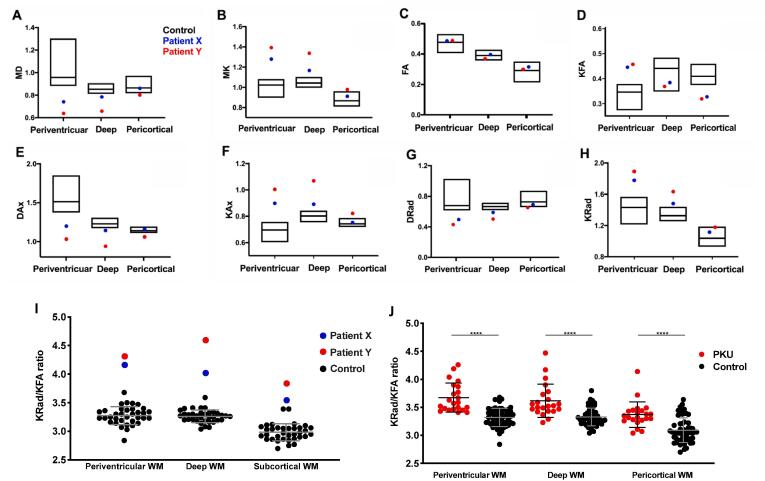
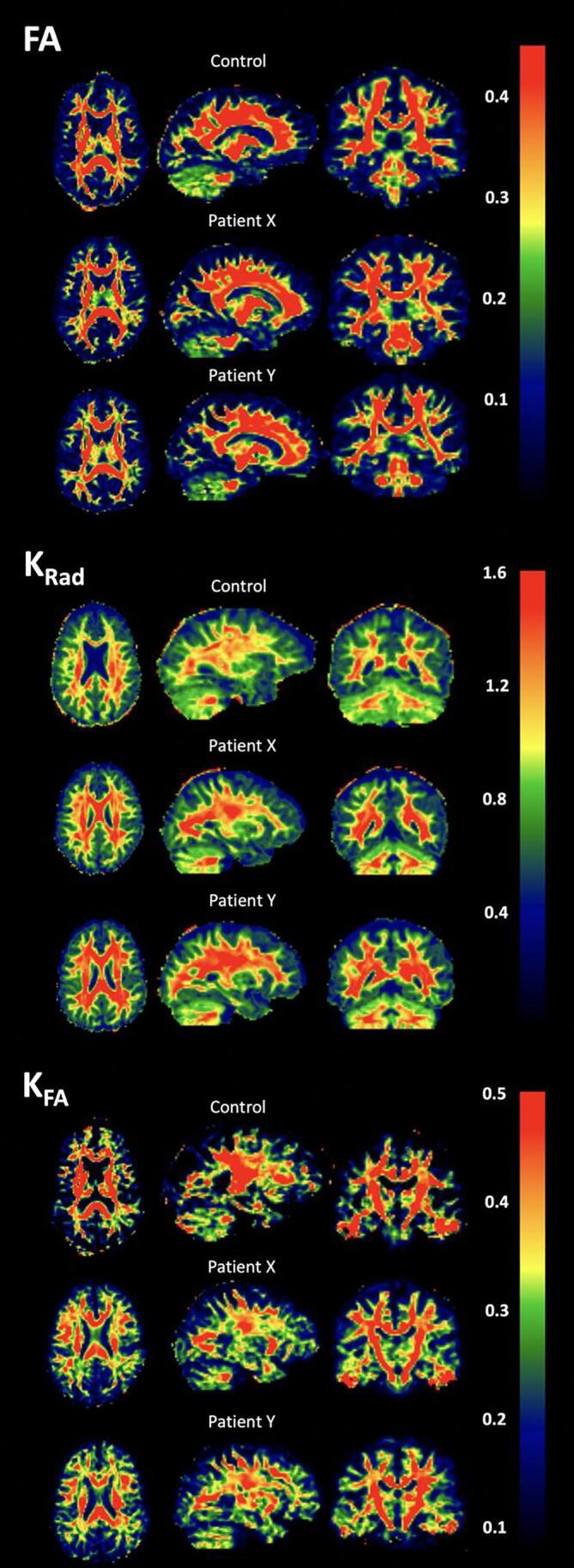
Both siblings scored outside the range of controls for all DKI-based metrics, with severe changes in the periventricular white matter and a gradient of severity toward the cortex. K/K provided clear separation by diagnosis in the Replication cohort (p < 0.001 in periventricular, deep and pericortical compartments). The ratio also correlated negatively with attention (r = -0.51 & -0.50, p < 0.05) and positively with 3-year mean Phe (r = 0.45 & 0.58, p < 0.01).
DKI reveals regionally-specific, progressive abnormalities of brain diffusion characteristics in PKU, even in the absence of conspicuous clinical signs or abnormalities on conventional MRI. A DKI-based marker derived from these scores (K/K ratio) was sensitive to cognitive impairment and PKU control over the medium term and may provide a meaningful subclinical biomarker of end-organ damage.
苯丙酮尿症(PKU)是一种常染色体隐性遗传病,由于苯丙氨酸代谢缺陷导致进行性神经功能障碍。PKU 的管理具有挑战性,疾病监测侧重于短期苯丙氨酸控制,而不是神经元损伤的测量。然而,常规成像缺乏敏感性,而扩散峰度成像(DKI)是一种新的 MRI 方法,可能会揭示 PKU 亚临床的白质结构变化。
这项队列研究纳入了在常规临床护理中招募的成年 PKU 患者。收集了 MRI、神经认知评估和历史苯丙氨酸(Phe)水平。一项比较饮食依从性和不依从性兄弟姐妹的假设生成病例研究证实,DKI 指标对饮食依从性敏感,并提示了一个候选指标(K/K 比值)。然后,我们在一个复制队列(PKU=20;对照组=43)中测试了该指标。
两个兄弟姐妹的所有基于 DKI 的指标都超出了对照组的范围,脑室周围白质有严重变化,向皮质的严重程度呈梯度变化。K/K 在复制队列中通过诊断得到了清晰的区分(脑室周围、深部和皮质旁隔室的 p<0.001)。该比值还与注意力呈负相关(r=-0.51 和-0.50,p<0.05),与 3 年平均 Phe 呈正相关(r=0.45 和 0.58,p<0.01)。
即使在没有明显的临床症状或常规 MRI 异常的情况下,DKI 也揭示了 PKU 大脑扩散特征的区域特异性、进行性异常。从这些评分中得出的基于 DKI 的标志物(K/K 比值)对认知障碍和 PKU 控制具有中度敏感性,并且可能为终末器官损伤提供有意义的亚临床生物标志物。