Division of Biological and Environmental Science and Engineering, Water Desalination and Reuse Center, King Abdullah University of Science and Technology (KAUST), Thuwal, 23955-6900, Saudi Arabia.
Division of Biological and Environmental Science and Engineering, Water Desalination and Reuse Center, King Abdullah University of Science and Technology (KAUST), Thuwal, 23955-6900, Saudi Arabia.
Environ Res. 2021 Apr;195:110748. doi: 10.1016/j.envres.2021.110748. Epub 2021 Jan 17.
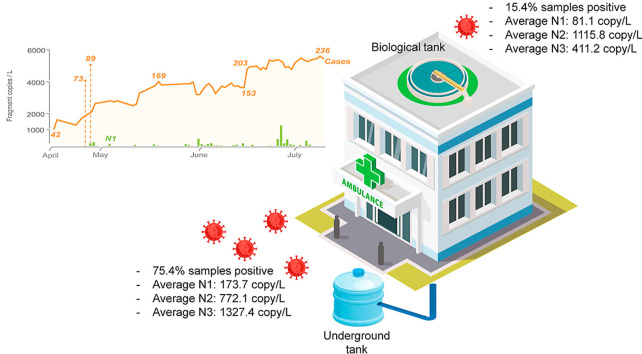
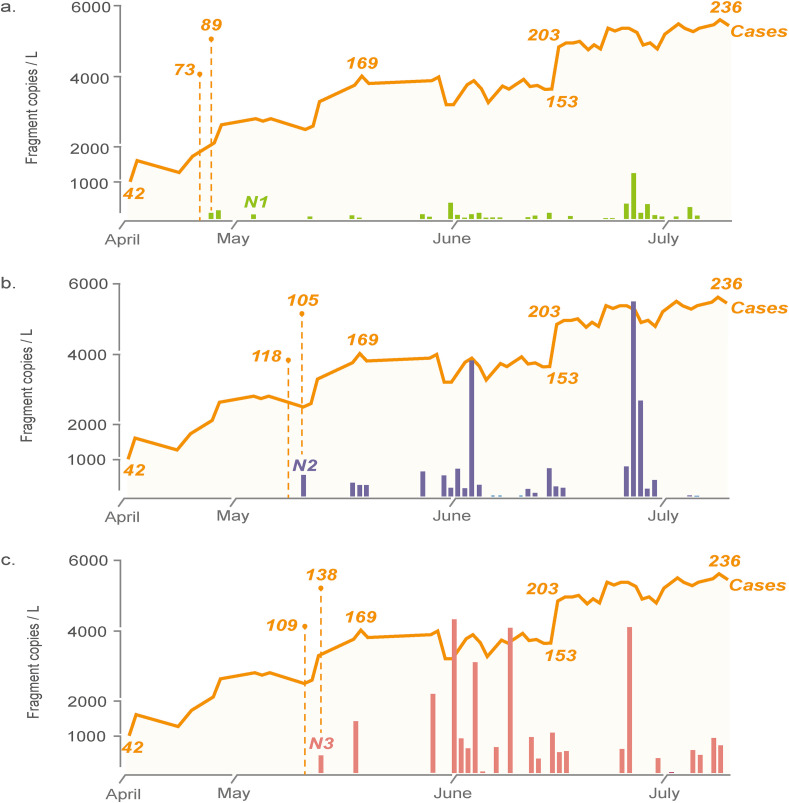
There is increasing interest in wastewater-based epidemiology (WBE) of SARS-CoV-2 RNA to serve as an early warning system for a community. Despite successful detection of SARS-CoV-2 RNA in wastewaters sampled from multiple locations, there is still no clear idea on the minimal number of cases in a community that are associated with a positive detection of the virus in wastewater. To address this knowledge gap, we sampled wastewaters from a septic tank (n = 57) and biological activated sludge tank (n = 52) located on-site of a hospital. The hospital is providing treatment for SARS-CoV-2 infected patients, with the number of hospitalized patients per day known. It was observed that depending on which nucleocapsid gene is targeted by means of RT-qPCR, a range of 253-409 positive cases out of 10,000 persons are required prior to detecting RNA SARS-CoV-2 in wastewater. There was a weak correlation between N1 and N2 gene abundances in wastewater with the number of hospitalized cases. This correlation was however not observed for N3 gene. The frequency of detecting N1 and N2 gene in wastewater was also higher than that for N3 gene. Furthermore, nucleocapsid genes of SARS-CoV-2 were detected at lower frequency in the partially treated wastewater than in the septic tank. In particular, N1 gene abundance was associated with water quality parameters such as total organic carbon and pH. In instances of positive detection, the average abundance of N1 and N3 genes in the activated sludge tank were reduced by 50 and 70% of the levels detected in septic tank, suggesting degradation of the SARS-CoV-2 gene fragments already occurring in the early stages of the wastewater treatment process.
人们越来越关注基于污水的 SARS-CoV-2 RNA 流行病学(WBE),以作为社区的早期预警系统。尽管已经成功地从多个地点采集的污水中检测到 SARS-CoV-2 RNA,但对于与污水中病毒阳性检测相关的社区中最低病例数,仍没有明确的认识。为了解决这一知识空白,我们对医院现场的一个化粪池(n=57)和生物活性污泥池(n=52)中的污水进行了采样。该医院正在为 SARS-CoV-2 感染患者提供治疗,每天住院患者的人数是已知的。结果表明,根据 RT-qPCR 靶向的核衣壳基因,在污水中检测到 SARS-CoV-2 RNA 之前,需要 10000 人中 253-409 例阳性病例,这取决于哪种核衣壳基因。污水中 N1 和 N2 基因丰度与住院病例数之间存在弱相关性。然而,在 N3 基因中未观察到这种相关性。污水中 N1 和 N2 基因的检测频率也高于 N3 基因。此外,污水中核衣壳基因的 SARS-CoV-2 的检测频率低于化粪池。特别是,N1 基因丰度与总有机碳和 pH 等水质参数有关。在阳性检测的情况下,活性污泥池中的 N1 和 N3 基因的平均丰度分别比化粪池中的检测水平降低了 50%和 70%,这表明 SARS-CoV-2 基因片段已经在废水处理过程的早期阶段发生降解。