Department of Clinical Genetics and Amsterdam Reproduction & Development Research Institute, Amsterdam UMC, Vrije Universiteit Amsterdam, Amsterdam, the Netherlands.
Department of Pediatrics and Amsterdam Reproduction & Development Research Institute, Amsterdam UMC, Vrije Universiteit Amsterdam, Amsterdam, the Netherlands.
Acta Obstet Gynecol Scand. 2021 Jul;100(7):1265-1272. doi: 10.1111/aogs.14091. Epub 2021 Feb 9.
The introduction of the non-invasive prenatal test (NIPT) has shifted the prenatal screening landscape. Countries are exploring ways to integrate NIPT in their national prenatal screening programs, either as a first- or second-tier test. This study aimed to describe how the uptake of fetal aneuploidy screening changed after the introduction of NIPT as a second-tier and as a first-tier test within the national prenatal screening program of the Netherlands.
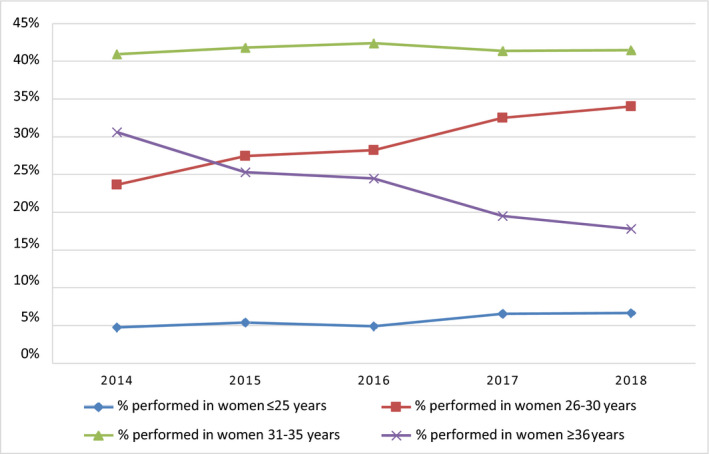
A population-based register study in the Netherlands, recording uptake of fetal aneuploidy screening. Data from all pregnant women choosing to have the first-trimester combined test (FCT) or first-tier NIPT between January 2007 and March 2019 were retrospectively collected using national registration systems. Uptake percentages for fetal aneuploidy screening (FCT and NIPT) were calculated and stratified by region and maternal age. Statistical significance was determined using trend analysis and chi-squared tests.
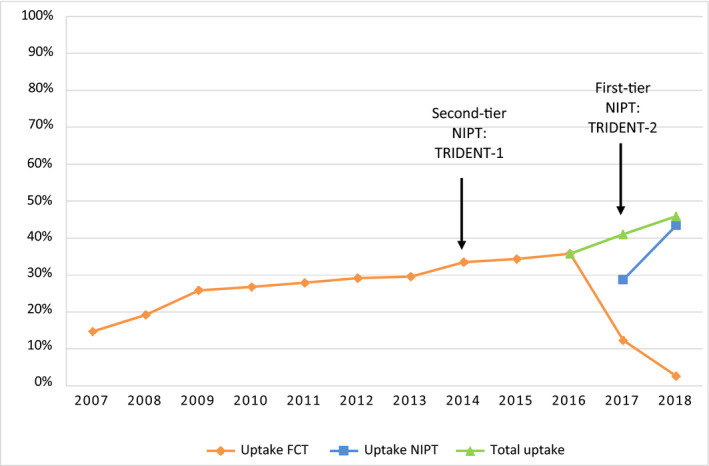
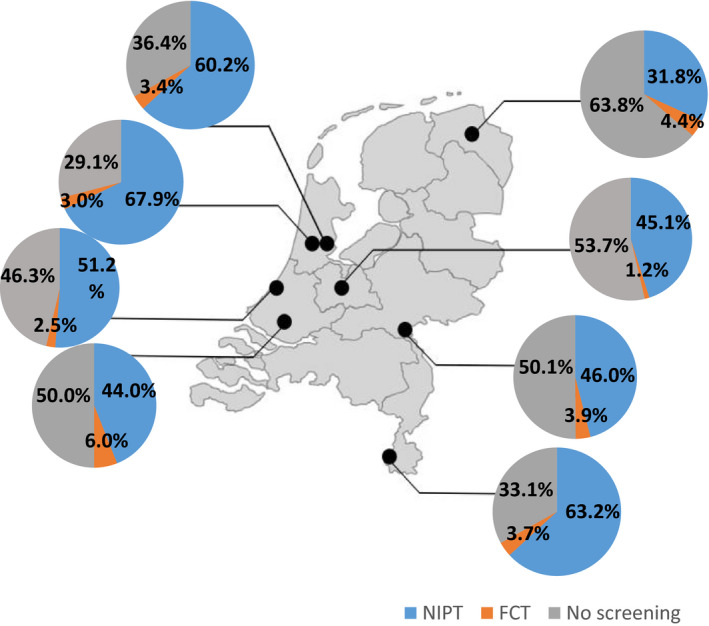
Between 2007 and 2013 FCT uptake increased from 14.8% to 29.5% (P = .004). In April 2014 NIPT was introduced as a second-tier test for high-risk women after FCT (TRIDENT-1 study). FCT uptake rose from 29.5% in 2013 to 34.2% in 2015 (P < .0001). After the introduction of NIPT as a first-tier test for all women in April 2017 (TRIDENT-2 study), FCT uptake declined significantly from 35.8% in 2016 to 2.6% in 2018 (P < .0001). NIPT uptake increased to 43.4% in 2018. Regionally, NIPT uptake ranged from 31.8% to 67.9%. Total uptake (FCT and NIPT) between 2007 and 2018 increased significantly from 14.8% to 45.9% (P < .0001). However, total uptake stabilized at 46% for both years of TRIDENT-2 (April 2017-March 2019).
An increase in total fetal aneuploidy screening uptake up to 45.9% was observed after the introduction of NIPT. Uptake appears to have stabilized within a year after introducing first-tier NIPT.
非侵入性产前检测(NIPT)的引入改变了产前筛查的格局。各国正在探索将 NIPT 纳入其国家产前筛查计划的方法,无论是作为一级或二级检测。本研究旨在描述在荷兰国家产前筛查计划中,NIPT 作为二级和一级检测引入后,胎儿非整倍体筛查的采用率如何变化。
这是一项基于人群的荷兰注册研究,记录了胎儿非整倍体筛查的采用率。使用国家登记系统回顾性收集了 2007 年 1 月至 2019 年 3 月期间所有选择进行第一 trimester 联合检测(FCT)或一级 NIPT 的孕妇的数据。计算了胎儿非整倍体筛查(FCT 和 NIPT)的采用率,并按地区和产妇年龄进行分层。使用趋势分析和卡方检验确定统计学意义。
2007 年至 2013 年期间,FCT 的采用率从 14.8%上升至 29.5%(P=0.004)。2014 年 4 月,NIPT 作为 FCT 后的高危女性的二级检测(TRIDENT-1 研究)引入。2013 年 FCT 的采用率从 29.5%上升至 2015 年的 34.2%(P<0.0001)。2017 年 4 月 NIPT 作为所有女性的一级检测引入后(TRIDENT-2 研究),FCT 的采用率从 2016 年的 35.8%显著下降至 2018 年的 2.6%(P<0.0001)。2018 年 NIPT 的采用率上升至 43.4%。区域上,NIPT 的采用率在 31.8%至 67.9%之间。2007 年至 2018 年期间,FCT 和 NIPT 的总采用率从 14.8%显著增加至 45.9%(P<0.0001)。然而,在 TRIDENT-2 研究的两年内(2017 年 4 月至 2019 年 3 月),总采用率稳定在 46%。
NIPT 引入后,胎儿非整倍体筛查的总采用率增加到 45.9%。一级 NIPT 引入后一年内,采用率似乎趋于稳定。