Rojas-Valverde Daniel, Timón Rafael, Sánchez-Ureña Braulio, Pino-Ortega José, Martínez-Guardado Ismael, Olcina Guillermo
Centro de Investigación y Diagnóstico en Salud y Deporte (CIDISAD), Escuela Ciencias del Movimiento Humano y Calidad de Vida (CIEMHCAVI), Universidad Nacional, Heredia 86-3000, Costa Rica.
Grupo en Avances en el Entrenamiento Deportivo y Acondicionamiento Físico (GAEDAF), Facultad Ciencias del Deporte, Universidad de Extremadura, 10005 Cáceres, Spain.
J Funct Morphol Kinesiol. 2020 Dec 14;5(4):93. doi: 10.3390/jfmk5040093.
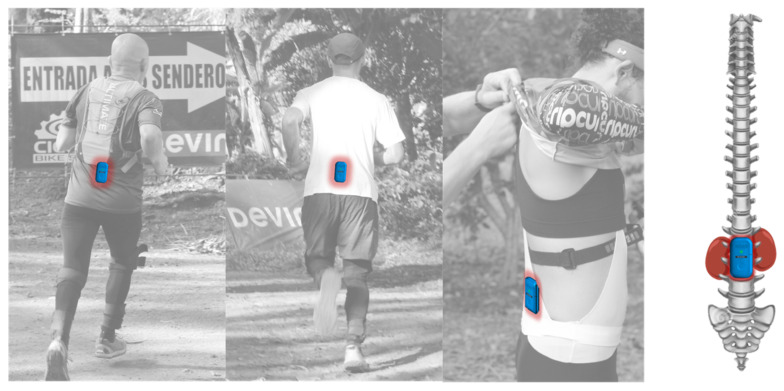
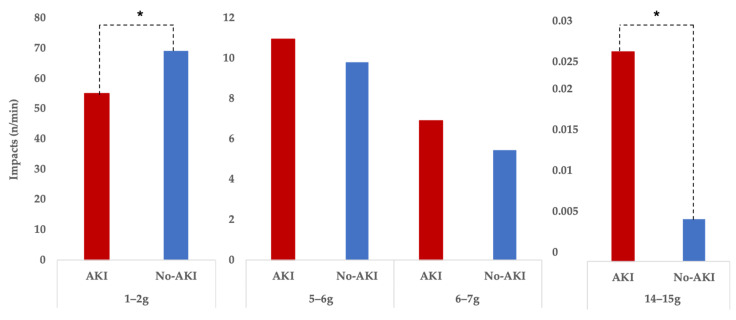
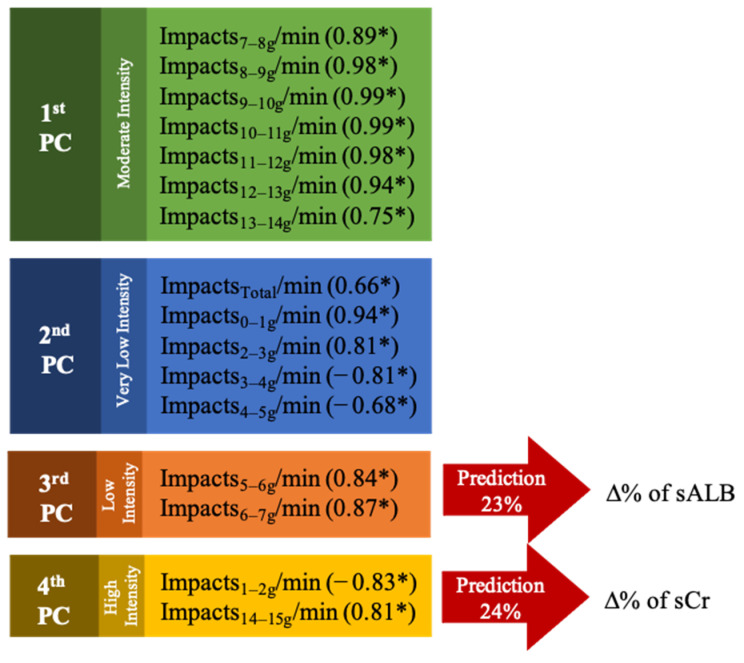
(1) Background: This study aimed to explore wearable sensors' potential use to assess cumulative mechanical kidney trauma during endurance off-road running. (2) Methods: 18 participants (38.78 ± 10.38 years, 73.24 ± 12.6 kg, 172.17 ± 9.48 cm) ran 36 k off-road race wearing a Magnetic, Angular Rate and Gravity (MARG) sensor attached to their lower back. Impacts in g forces were recorded throughout the race using the MARG sensor. Two blood samples were collected immediately pre- and post-race: serum creatinine (sCr) and albumin (sALB). (3) Results: Sixteen impact variables were grouped using principal component analysis in four different principal components (PC) that explained 90% of the total variance. The 4th PC predicted 24% of the percentage of change (∆%) of sCr and the 3rd PC predicted the ∆% of sALB by 23%. There were pre- and post-race large changes in sCr and sALB ( ≤ 0.01) and 33% of participants met acute kidney injury diagnosis criteria. (4) Conclusions: The data related to impacts could better explain the cumulative mechanical kidney trauma during mountain running, opening a new range of possibilities using technology to better understand how the number and magnitude of the g-forces involved in off-road running could potentially affect kidney function.
(1) 背景:本研究旨在探索可穿戴传感器在评估耐力越野跑过程中累积机械性肾损伤方面的潜在用途。(2) 方法:18名参与者(年龄38.78 ± 10.38岁,体重73.24 ± 12.6千克,身高172.17 ± 9.48厘米)在进行36公里越野赛时,在其下背部佩戴了磁、角速率和重力(MARG)传感器。在比赛全程使用MARG传感器记录以重力加速度表示的撞击情况。在比赛前和比赛后立即采集两份血样:血清肌酐(sCr)和白蛋白(sALB)。(3) 结果:使用主成分分析将16个撞击变量分组为四个不同的主成分(PC),这四个主成分解释了总方差的90%。第四主成分预测了sCr变化百分比(∆%)的24%,第三主成分预测了sALB的∆%为23%。比赛前后sCr和sALB有显著变化(≤0.01),33%的参与者符合急性肾损伤诊断标准。(4) 结论:与撞击相关的数据能够更好地解释山地跑过程中的累积机械性肾损伤,开启了利用技术更好地理解越野跑中重力加速度的数量和大小如何潜在影响肾功能的新可能性。