Pharmaceutical Research & Development, Pfizer Inc., Andover, MA, USA.
Drug Product Science & Technology, Bristol-Myers Squibb, Co., New Brunswick, NJ, USA.
Drug Des Devel Ther. 2021 Jan 13;15:159-170. doi: 10.2147/DDDT.S287323. eCollection 2021.
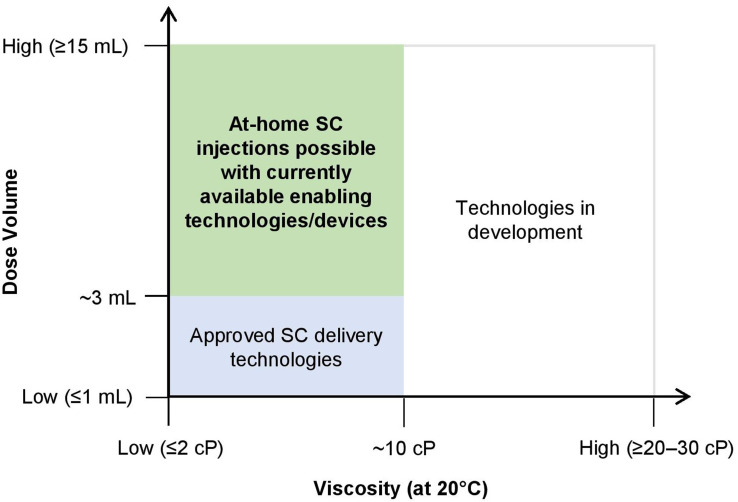
Subcutaneous (SC) delivery of biologics has traditionally been limited to fluid volumes of 1-2 mL, with recent increases to volumes of about 3 mL. This injection volume limitation poses challenges for high-dose biologics, as these formulations may also require increased solution concentration in many cases, resulting in high viscosities which can affect the stability, manufacturability, and delivery/administration of therapeutic drugs. Currently, there are technologies that can help to overcome these challenges and facilitate the delivery of larger amounts of drug through the SC route. This can be achieved either by enabling biologic molecules to be formulated or delivered as high-concentration injectables (>100 mg/mL for antibodies) or through facilitating the delivery of larger volumes of fluid (>3 mL). The SC Drug Delivery and Development Consortium, which was established in 2018, aims to identify and address critical gaps and issues in the SC delivery of high-dose/volume products to help expand this delivery landscape. Identified as a high priority out of the Consortium's eight problem statements, it highlights the need to shift perceptions of the capabilities of technologies that enable the SC delivery of large-volume (>3 mL) and/or high-dose biologics. The Consortium emphasizes a patient-focused approach towards the adoption of SC delivery of large-volume/high-concentration dosing products to facilitate the continued expansion of the capabilities of novel SC technologies. To raise awareness of the critical issues and gaps in high-dose/volume SC drug development, this review article provides a generalized overview of currently available and emerging technologies and devices that could facilitate SC delivery of high-dose/volume drug formulations. In addition, it discusses the challenges, gaps, and future outlook in high-dose/volume SC delivery as well as potential solutions to exploit the full value of the SC route of administration.
皮下(SC)给药的生物制剂传统上仅限于 1-2 毫升的体积,最近增加到约 3 毫升。这种注射体积限制对高剂量生物制剂构成了挑战,因为这些制剂在许多情况下还需要增加溶液浓度,导致高粘度,这可能会影响治疗药物的稳定性、可制造性和给药/管理。目前,有一些技术可以帮助克服这些挑战,并通过 SC 途径输送更多的药物。这可以通过使生物分子被配制成高浓度的注射剂(抗体>100mg/mL)或通过促进输送更大体积的流体(>3 毫升)来实现。SC 药物输送和开发联盟于 2018 年成立,旨在确定和解决高剂量/大容量产品 SC 输送中的关键差距和问题,以帮助扩大这一输送领域。该联盟被确定为八个问题陈述中的一个高优先级问题,它强调需要改变对能够实现大容量(>3 毫升)和/或高剂量生物制剂 SC 输送的技术的看法。该联盟强调了一种以患者为中心的方法,采用 SC 输送大容量/高浓度剂量产品,以促进新型 SC 技术能力的持续扩展。为了提高对高剂量/大容量 SC 药物开发中关键问题和差距的认识,本文综述了目前可用的和新兴的技术和设备,这些技术和设备可以促进高剂量/大容量药物制剂的 SC 输送。此外,还讨论了高剂量/大容量 SC 输送中的挑战、差距和未来展望,以及利用 SC 给药途径的全部价值的潜在解决方案。