Department of Gynecologic Oncology, National Hospital Organization Shikoku Cancer Center, Matsuyama, Japan.
Department of Obstetrics and Gynecology, Ehime University Graduate School of Medicine, Matsuyama, Japan.
J Gynecol Oncol. 2021 Mar;32(2):e21. doi: 10.3802/jgo.2021.32.e21. Epub 2021 Jan 6.
The primary objective of this study was to evaluate the safety of niraparib 300 mg/day in Japanese patients with platinum-sensitive, relapsed ovarian cancer in a maintenance setting.
Phase 2, multicenter, open-label, single-arm study enrolled Japanese patients with platinum-sensitive, relapsed ovarian cancer who had received ≥2 platinum-based regimens. The primary endpoint (incidence of grade 3 or 4 thrombocytopenia-related events within 30 days after initial niraparib administration) was justified by the incidences of a global pivotal phase 3 study and its post-hoc safety analysis on thrombocytopenia, the major hematological adverse event of niraparib. The overall safety analysis examined other treatment-emergent adverse events (TEAEs).
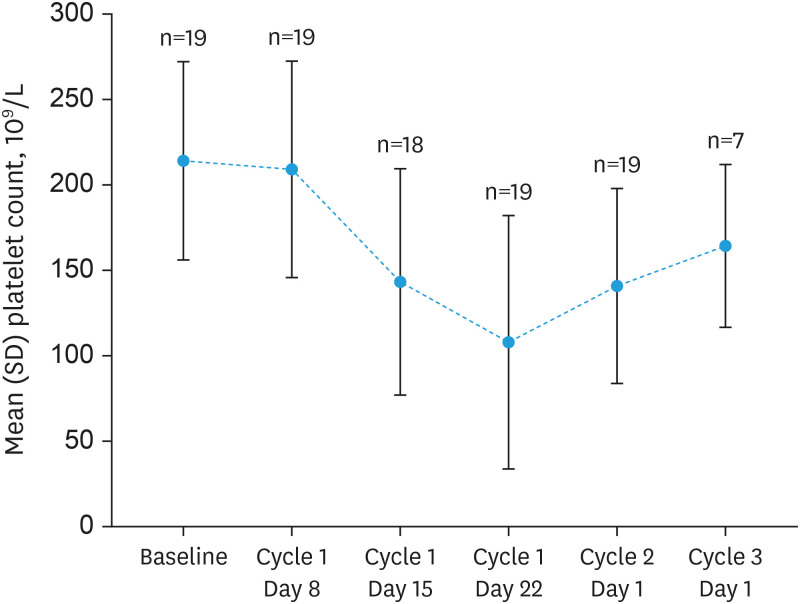
Enrolled patients (n=19) had a median (min, max) body weight of 53.9 (40.8-79.1) kg; all but one patient weighed <77 kg. Most (94.7%) patients initially received niraparib 300 mg/day but this decreased in subsequent cycles (mean±standard deviation dose intensity, 191.6±65.7 mg/day). In total, 6/19 (31.6%) patients experienced grade 3 or 4 thrombocytopenia-related events within 30 days of initial niraparib administration. Other common TEAEs included nausea, and decreased platelet or neutrophil counts. No progression-free or overall survival events occurred; only 1 of 4 response-evaluable patients had a post-baseline tumor assessment (stable disease).
The incidence of grade 3 or 4 thrombocytopenia-related events in Japanese ovarian cancer patients was similar to that in the corresponding non-Japanese study. Overall, the safety profile was acceptable and consistent with the known safety profile and previous experience with niraparib.
ClinicalTrials.gov Identifier: NCT03759587.
本研究的主要目的是评估尼拉帕利 300mg/天在日本铂类敏感复发性卵巢癌维持治疗中的安全性。
这项 2 期、多中心、开放标签、单臂研究纳入了铂类敏感、复发的卵巢癌患者,这些患者接受了≥2 种铂类为基础的治疗方案。主要终点(初始尼拉帕利给药后 30 天内发生 3 级或 4 级血小板减少相关事件的发生率)是基于全球关键性 3 期研究及其对尼拉帕利主要血液学不良事件血小板减少症的事后安全性分析的发生率得到验证。总体安全性分析检查了其他治疗后出现的不良事件(TEAEs)。
入组患者(n=19)的中位(最小,最大)体重为 53.9(40.8-79.1)kg;除 1 例患者外,所有患者体重均<77kg。大多数(94.7%)患者最初接受尼拉帕利 300mg/天,但在随后的周期中减少(平均±标准偏差剂量强度,191.6±65.7mg/天)。总共有 6/19(31.6%)名患者在初始尼拉帕利给药后 30 天内发生 3 级或 4 级血小板减少症相关事件。其他常见的 TEAEs 包括恶心和血小板或中性粒细胞计数减少。无无进展生存或总生存事件发生;仅 4 名可评估反应的患者中有 1 名在基线后肿瘤评估(疾病稳定)。
日本卵巢癌患者 3 级或 4 级血小板减少症相关事件的发生率与相应的非日本研究相似。总的来说,安全性特征是可以接受的,与已知的安全性特征和以前使用尼拉帕利的经验一致。
ClinicalTrials.gov 标识符:NCT03759587。