Department of Neuroscience Lewis Katz School of Medicine at Temple University Philadelphia, PA 19140, USA.
Department of Neurosurgery Temple University Hospital Philadelphia, PA 19140, USA.
Aging (Albany NY). 2021 Jan 5;13(1):1510-1527. doi: 10.18632/aging.202459.
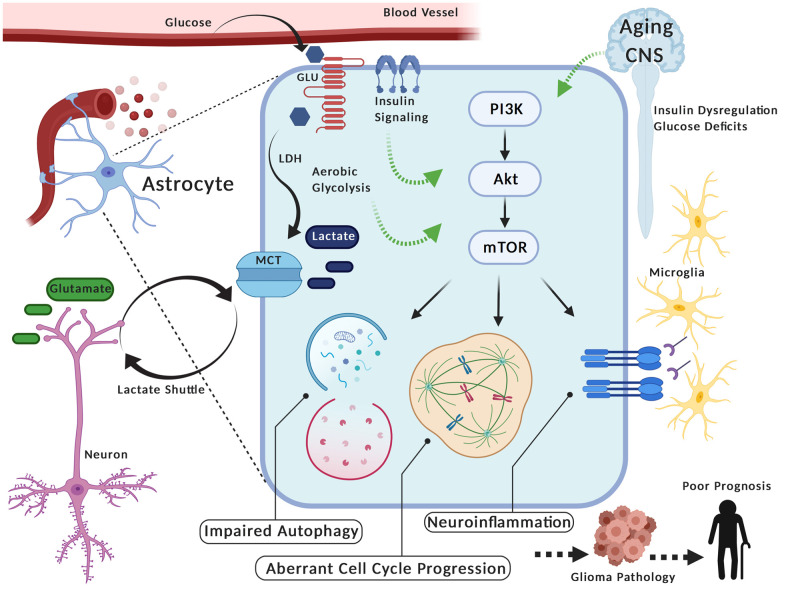
Despite a growing proportion of aged individuals at risk for developing cancer in the brain, the prognosis for these conditions remains abnormally poor due to limited knowledge of underlying mechanisms and minimal treatment options. While cancer metabolism in other organs is commonly associated with upregulated glycolysis (i.e. Warburg effect) and hyperactivation of PIK3/AKT/mTOR (PAM) pathways, the unique bioenergetic demands of the central nervous system may interact with these oncogenic processes to promote tumor progression in aging. Specifically, constitutive glycolysis and PIK3/AKT/mTOR signaling in glia may be dysregulated by age-dependent alterations in neurometabolic demands, ultimately contributing to pathological processes otherwise associated with PIK3/AKT/mTOR induction (e.g. cell cycle entry, impaired autophagy, dysregulated inflammation). Although several limitations to this theoretical model exist, the consideration of aberrant PIK3/AKT/mTOR signaling in glia during aging elucidates several therapeutic opportunities for brain tumors, including non-pharmacological interventions.
尽管越来越多的老年人面临患脑癌的风险,但由于对潜在机制的了解有限,治疗选择有限,这些疾病的预后仍然异常不佳。虽然其他器官的癌症代谢通常与糖酵解上调(即沃伯格效应)和 PI3K/AKT/mTOR(PAM)途径的过度激活有关,但中枢神经系统的独特能量需求可能与这些致癌过程相互作用,从而促进衰老过程中的肿瘤进展。具体而言,胶质细胞中的组成性糖酵解和 PI3K/AKT/mTOR 信号可能会受到神经代谢需求随年龄变化的失调,最终导致与 PI3K/AKT/mTOR 诱导相关的病理过程(例如细胞周期进入、自噬受损、炎症失调)。尽管该理论模型存在一些局限性,但在衰老过程中考虑胶质细胞中异常的 PI3K/AKT/mTOR 信号传递为脑肿瘤提供了几种治疗机会,包括非药物干预。