Rappl Peter, Brüne Bernhard, Schmid Tobias
Institute of Biochemistry I, Faculty of Medicine, Goethe-University Frankfurt, 60590 Frankfurt, Germany.
German Cancer Consortium (DKTK), Partner Site Frankfurt, 60590 Frankfurt, Germany.
Biology (Basel). 2021 Jan 19;10(1):66. doi: 10.3390/biology10010066.
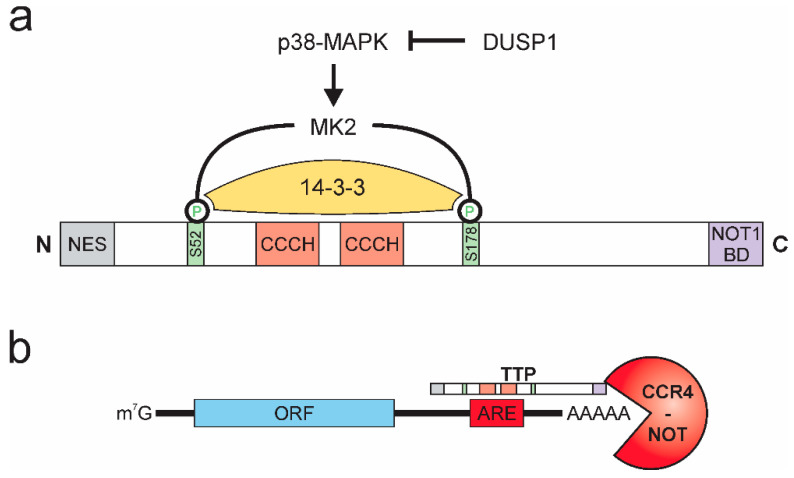
Inflammation is a crucial part of immune responses towards invading pathogens or tissue damage. While inflammatory reactions are aimed at removing the triggering stimulus, it is important that these processes are terminated in a coordinate manner to prevent excessive tissue damage due to the highly reactive inflammatory environment. Initiation of inflammatory responses was proposed to be regulated predominantly at a transcriptional level, whereas post-transcriptional modes of regulation appear to be crucial for resolution of inflammation. The RNA-binding protein tristetraprolin (TTP) interacts with AU-rich elements in the 3' untranslated region of mRNAs, recruits deadenylase complexes and thereby facilitates degradation of its targets. As TTP regulates the mRNA stability of numerous inflammatory mediators, it was put forward as a crucial post-transcriptional regulator of inflammation. Here, we summarize the current understanding of the function of TTP with a specific focus on its role in adding to resolution of inflammation.
炎症是针对入侵病原体或组织损伤的免疫反应的关键部分。虽然炎症反应旨在消除触发刺激,但重要的是这些过程要以协调的方式终止,以防止由于高反应性炎症环境导致的过度组织损伤。炎症反应的启动主要被认为是在转录水平上受到调节,而转录后调节模式似乎对炎症的消退至关重要。RNA结合蛋白锌指蛋白36(TTP)与mRNA的3'非翻译区富含AU的元件相互作用,募集去腺苷酸化酶复合物,从而促进其靶标的降解。由于TTP调节多种炎症介质的mRNA稳定性,它被认为是炎症关键的转录后调节因子。在此,我们总结了目前对TTP功能的理解,特别关注其在促进炎症消退中的作用。