Viozzi Ilaria, Guberinic Alis, Overduin Christiaan G, Rovers Maroeska M, Ter Laan Mark
Department of Neurosurgery, Radboud University Medical Center, Radboud Institute for Health Sciences, 6525 GA Nijmegen, The Netherlands.
Department of Radiology, Radboud University Medical Center, Radboud Institute for Health Sciences, 6525 GA Nijmegen, The Netherlands.
J Clin Med. 2021 Jan 19;10(2):355. doi: 10.3390/jcm10020355.
Laser interstitial thermal therapy (LITT) is a minimal invasive neurosurgical technique for the treatment of brain tumors. Results of LITT have been reported in a case series of patients with deep seated and/or recurrent glioblastoma or cerebral metastases. With this review we aim to summarize the currently available evidence regarding safety and effectiveness of LITT in patients with newly diagnosed glioblastoma (nGBM).
A literature search was performed using electronic databases (PubMed and Embase). Papers were assessed for the methodological quality using the Risk Of Bias In Non- randomised Studies - of Interventions (ROBINS-I) tool, and the Grading of Recommendations Assessment, Development and Evaluation (GRADE) was used to assess the quality of the evidence.
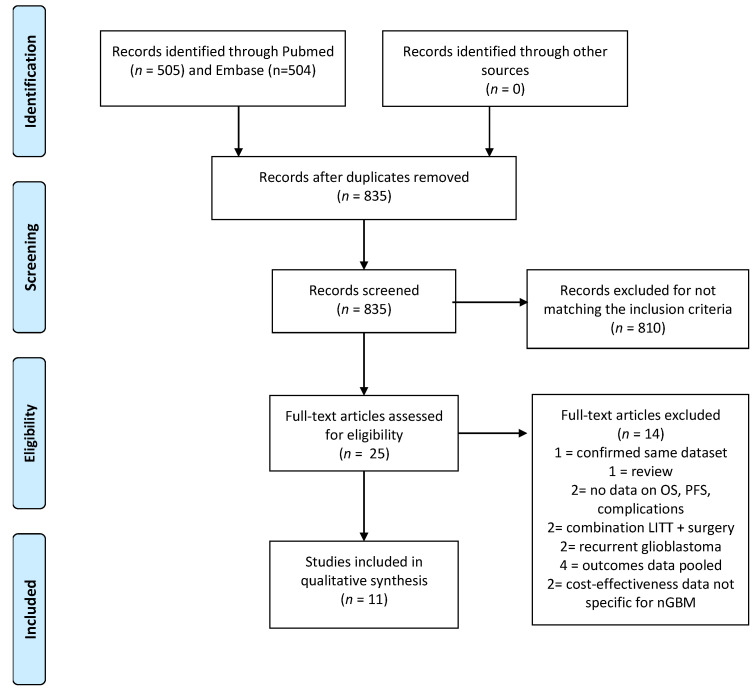
We identified 835 papers of which only 11 articles were eligible for our review. All papers suffered from serious or critical risk of bias, and the quality of evidence was graded as very low according to the GRADE criteria. None of the studies was randomized and reporting of confounders and other parameters was poor. Median overall survival (OS) ranged from 4.1 to 32 months and progression free survival (PFS) from 2 to 31 months. The mean complication rate was 33.7%. No quality of life or cost-effectiveness data were reported.
Due to the low quality of the studies, it is not possible to draw firm conclusions regarding the (cost) effectiveness of LITT in patients with newly diagnosed glioblastoma. The low quality of evidence shows the need for a well-designed prospective multicenter randomized controlled trial.
激光间质热疗(LITT)是一种用于治疗脑肿瘤的微创神经外科技术。已有关于深部和/或复发性胶质母细胞瘤或脑转移瘤患者的LITT病例系列报道。通过本综述,我们旨在总结目前关于LITT治疗新诊断胶质母细胞瘤(nGBM)患者安全性和有效性的现有证据。
使用电子数据库(PubMed和Embase)进行文献检索。使用干预性非随机研究的偏倚风险(ROBINS-I)工具评估论文的方法学质量,并使用推荐分级评估、制定和评价(GRADE)来评估证据质量。
我们共识别出835篇论文,其中仅有11篇符合纳入综述的标准。所有论文均存在严重或关键的偏倚风险,根据GRADE标准,证据质量被评为极低。所有研究均非随机对照研究,且对混杂因素及其他参数的报告较差。中位总生存期(OS)为4.1至32个月,无进展生存期(PFS)为2至31个月。平均并发症发生率为33.7%。未报告生活质量或成本效益数据。
由于研究质量较低,无法就LITT治疗新诊断胶质母细胞瘤患者的(成本)效益得出确凿结论。证据质量较低表明需要开展一项设计良好的前瞻性多中心随机对照试验。