Akintade Damilare D, Chaudhuri Bhabatosh
School of Life Sciences, Medical School, University of Nottingham, Nottingham NG7 2UH, UK.
Leicester School of Pharmacy, De Montfort University, Leicester LE1 9BH, UK.
Biomedicines. 2021 Jan 19;9(1):95. doi: 10.3390/biomedicines9010095.
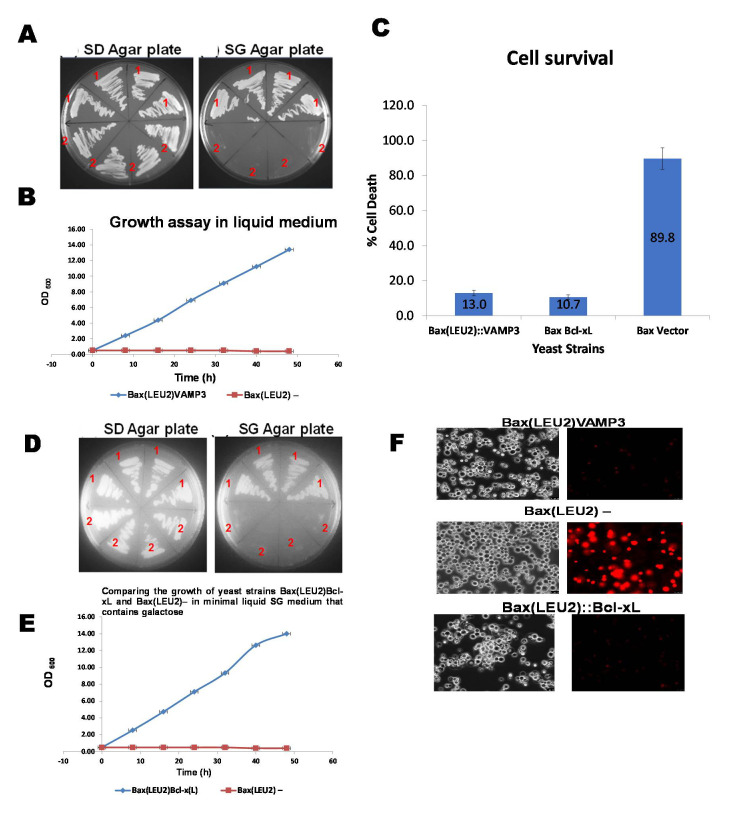
Apoptosis is an essential process that is regulated genetically and could lead to a serious disease condition if not well controlled. Bax is one of the main proapoptotic proteins and actively involved in programmed cell death. It has been suggested that Bax induced apoptosis in yeast could be obstructed by enhancing vesicular membrane trafficking. Plasma membrane proteins and lipid oxidation were reduced by a vesicle-associated membrane protein (VAMP) when expressed in yeast, suggesting its potential role in repairing membranes. Membrane integrity is crucial, as the loss of membrane integrity will result in the leakage of ions from mitochondria, and ultimately cell death due to overproduction of reactive oxygen species (ROS). Expression of ' VAMP has been linked to antiapoptosis activity. Since plant VAMP has been associated with antiapoptotic activities, this study investigates the possible participation of human VAMP3 in blocking human Bax mediated apoptosis. Some novel genes were identified to rescue Bax's proapoptotic effects, in a yeast-based human hippocampal cDNA library screen. VAMP3 (a gene code for proteins involved in protein secretion) gene was chosen for further study to confirm its role in inhibiting apoptosis. VAMP3 was coexpressed with a chromosomally integrated Bax gene expression cassette driven by the GAL1 promoter. The antiapoptotic proteins of the Bcl-2 family (Bcl xL) were known to negate the proapoptotic properties of Bax. However, the new gene (VAMP3) results show that novel antiapoptotic proteins can be identified using a yeast-based assay. The findings presented here show that human VAMP3 protein has antiapoptotic property and could abrogate Bax induced apoptosis (cell death).
细胞凋亡是一个受基因调控的重要过程,如果控制不当可能导致严重的疾病状态。Bax是主要的促凋亡蛋白之一,积极参与程序性细胞死亡。有人提出,通过增强囊泡膜运输可以阻碍Bax在酵母中诱导的细胞凋亡。当在酵母中表达时,一种囊泡相关膜蛋白(VAMP)可降低质膜蛋白和脂质氧化,表明其在修复膜方面的潜在作用。膜完整性至关重要,因为膜完整性的丧失会导致离子从线粒体泄漏,最终由于活性氧(ROS)的过量产生而导致细胞死亡。VAMP的表达与抗凋亡活性有关。由于植物VAMP与抗凋亡活性有关,本研究调查了人类VAMP3在阻断人类Bax介导的细胞凋亡中的可能参与情况。在基于酵母的人类海马cDNA文库筛选中,鉴定出一些新基因可挽救Bax的促凋亡作用。选择VAMP3(一种参与蛋白质分泌的蛋白质的基因编码)基因进行进一步研究,以确认其在抑制细胞凋亡中的作用。VAMP3与由GAL1启动子驱动的染色体整合Bax基因表达盒共表达。已知Bcl-2家族的抗凋亡蛋白(Bcl xL)可抵消Bax的促凋亡特性。然而,新基因(VAMP3)的结果表明,可以使用基于酵母的检测方法鉴定新的抗凋亡蛋白。此处呈现的研究结果表明,人类VAMP3蛋白具有抗凋亡特性,并且可以消除Bax诱导的细胞凋亡(细胞死亡)。