Vessella Giulia, Vázquez José Antonio, Valcárcel Jesús, Lagartera Laura, Monterrey Dianélis T, Bastida Agatha, García-Junceda Eduardo, Bedini Emiliano, Fernández-Mayoralas Alfonso, Revuelta Julia
Department of Chemical Sciences University of Naples Federico II, Via Cinthia 4, I-80126 Naples, Italy.
Group of Recycling and Valorization of Waste Materials (REVAL), Marine Research Institute (IIM-CSIC), Eduardo Cabello, 6, 36208 Vigo, Galicia, Spain.
Polymers (Basel). 2021 Jan 19;13(2):313. doi: 10.3390/polym13020313.
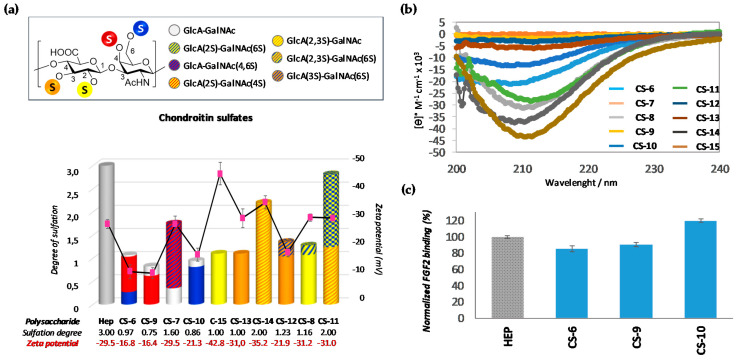
Controlling chondroitin sulfates (CSs) biological functions to exploit their interesting potential biomedical applications requires a comprehensive understanding of how the specific sulfate distribution along the polysaccharide backbone can impact in their biological activities, a still challenging issue. To this aim, herein, we have applied an "holistic approach" recently developed by us to look globally how a specific sulfate distribution within CS disaccharide epitopes can direct the binding of these polysaccharides to growth factors. To do this, we have analyzed several polysaccharides of marine origin and semi-synthetic polysaccharides, the latter to isolate the structure-activity relationships of their rare, and even unnatural, sulfated disaccharide epitopes. SPR studies revealed that all the tested polysaccharides bind to FGF-2 (with exception of CS-8 CS-12 and CS-13) according to a model in which the CSs first form a weak complex with the protein, which is followed by maturation to tight binding with ranging affinities from ~ 1.31 μM to 130 μM for the first step and from ~ 3.88 μM to 1.8 nM for the second one. These binding capacities are, interestingly, related with the surface charge of the 3D-structure that is modulated by the particular sulfate distribution within the disaccharide repeating-units.
要控制硫酸软骨素(CSs)的生物学功能以开发其有趣的潜在生物医学应用,需要全面了解沿多糖主链的特定硫酸盐分布如何影响其生物活性,这仍然是一个具有挑战性的问题。为此,我们在此应用了我们最近开发的一种“整体方法”,以全面了解CS二糖表位内的特定硫酸盐分布如何指导这些多糖与生长因子的结合。为此,我们分析了几种海洋来源的多糖和半合成多糖,后者用于分离其稀有甚至非天然硫酸化二糖表位的构效关系。SPR研究表明,所有测试的多糖(CS-8、CS-12和CS-13除外)都根据一种模型与FGF-2结合,在该模型中,CS首先与蛋白质形成弱复合物,随后成熟为紧密结合,第一步的亲和力范围为1.31μM至130μM,第二步的亲和力范围为3.88μM至1.8 nM。有趣的是,这些结合能力与由二糖重复单元内的特定硫酸盐分布调节的三维结构的表面电荷有关。