Pneumology Department, Hospital Universitari Germans Trias I Pujol, CIBERES, Universitat Autònoma de Barcelona, Carretera del canyet sn, 08916, Badalona, Barcelona, Spain.
Allergy Department, Hospital Universitari Germans Trias I Pujol, Badalona, Spain.
BMC Pulm Med. 2021 Jan 21;21(1):35. doi: 10.1186/s12890-021-01397-7.
Eosinophilic granulomatosis with polyangiitis (EGPA) is a disease that is associated with severe uncontrolled eosinophilic asthma. Eosinophils play an important pathogenic role in the development of both diseases. Benralizumab is an antieosinophilic monoclonal antibody that binds to the α subunit of the human interleukin 5 receptor that is expressed on the surface of the eosinophil and basophil. We present the first case of rapid improvement in symptoms and lung function during admission for exacerbation of a severe eosinophilic asthma associated with EGPA.
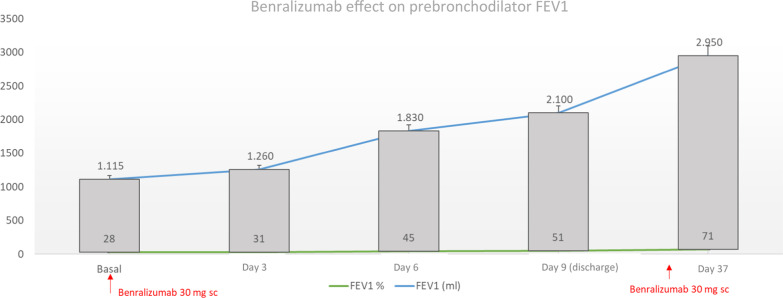
A 57-year-old man diagnosed with severe eosinophilic asthma associated to EGPA was admitted to the Pulmonology Department due to severe bronchospasm. At admission he presented 2300 eosinophils/µl. Despite intensive bronchodilator treatment, intravenous methylprednisolone at a dose of 80 mg/d, oxygen therapy, and budesonide nebulization, the patient continued to present daily episodes of bronchospasm. Ten days after admission, with blood eosinophil levels of 1700 cells/µl, benralizumab 30 mg sc was administered. That day, the Forced Expiratory Volume in the first second (FEV1) was 28% of the theoretical value (1150 ml). AT three days, FEV1 increased to 110 ml (31%). On the 9th day FEV1 was 51% (2100 ml). The blood eosinophil level on the 9th day was 0 cells/µl.
The rapid improvement of FEV1 is in line with studies based on clinical trials that found improvement after two days in peak flow and one phase II study that showed rapid response in exacerbation of asthma in the emergency room. The antieosinophilic effect at 24 h and the effect in different tissues determine the rapid improvement and the potential advantage of benralizumab in the treatment of EGPA. This case suggests the usefulness of benralizumab in patients with EGPA and eosinophilic severe asthma who show bronchospasm refractory to conventional treatment during a hospitalization due to asthma exacerbation.
嗜酸性肉芽肿性多血管炎(EGPA)是一种与严重的、无法控制的嗜酸性粒细胞性哮喘相关的疾病。嗜酸性粒细胞在这两种疾病的发展中都起着重要的致病作用。贝那鲁肽是一种抗嗜酸性粒细胞单克隆抗体,与白细胞介素 5 受体的α亚单位结合,该受体表达在嗜酸性粒细胞和嗜碱性粒细胞的表面。我们报告了首例 EGPA 相关严重嗜酸性粒细胞性哮喘加重入院期间症状和肺功能迅速改善的病例。
一名 57 岁男性,被诊断为 EGPA 相关严重嗜酸性粒细胞性哮喘,因严重支气管痉挛而被收入肺病科。入院时,他的嗜酸性粒细胞为 2300/μl。尽管给予了强化支气管扩张剂治疗、静脉注射甲基强的松龙 80mg/d、氧疗和布地奈德雾化吸入,但患者仍持续每天发生支气管痉挛。入院 10 天后,当血液嗜酸性粒细胞水平为 1700 个/μl 时,给予贝那鲁肽 30mg sc 治疗。那天,第一秒用力呼气量(FEV1)为理论值的 28%(1150ml)。第 3 天,FEV1 增加到 110ml(31%)。第 9 天,FEV1 为 51%(2100ml)。第 9 天的血液嗜酸性粒细胞水平为 0 个/μl。
FEV1 的迅速改善与基于临床试验的研究一致,这些研究发现治疗后 2 天峰值流量改善,一项二期研究显示急诊室哮喘加重时快速反应。24 小时的抗嗜酸性粒细胞作用和不同组织的作用决定了贝那鲁肽的快速改善和在 EGPA 治疗中的潜在优势。该病例提示贝那鲁肽在 EGPA 和嗜酸性粒细胞性严重哮喘患者中的有用性,这些患者在因哮喘加重而住院期间表现出常规治疗无效的支气管痉挛。